Science Through Time · Chemistry
From a Surgeon Who Blistered His Own Hand During an Eclipse to a Cream Named for the Mountain That Burned Its Inventor: A Short History of Sunscreen
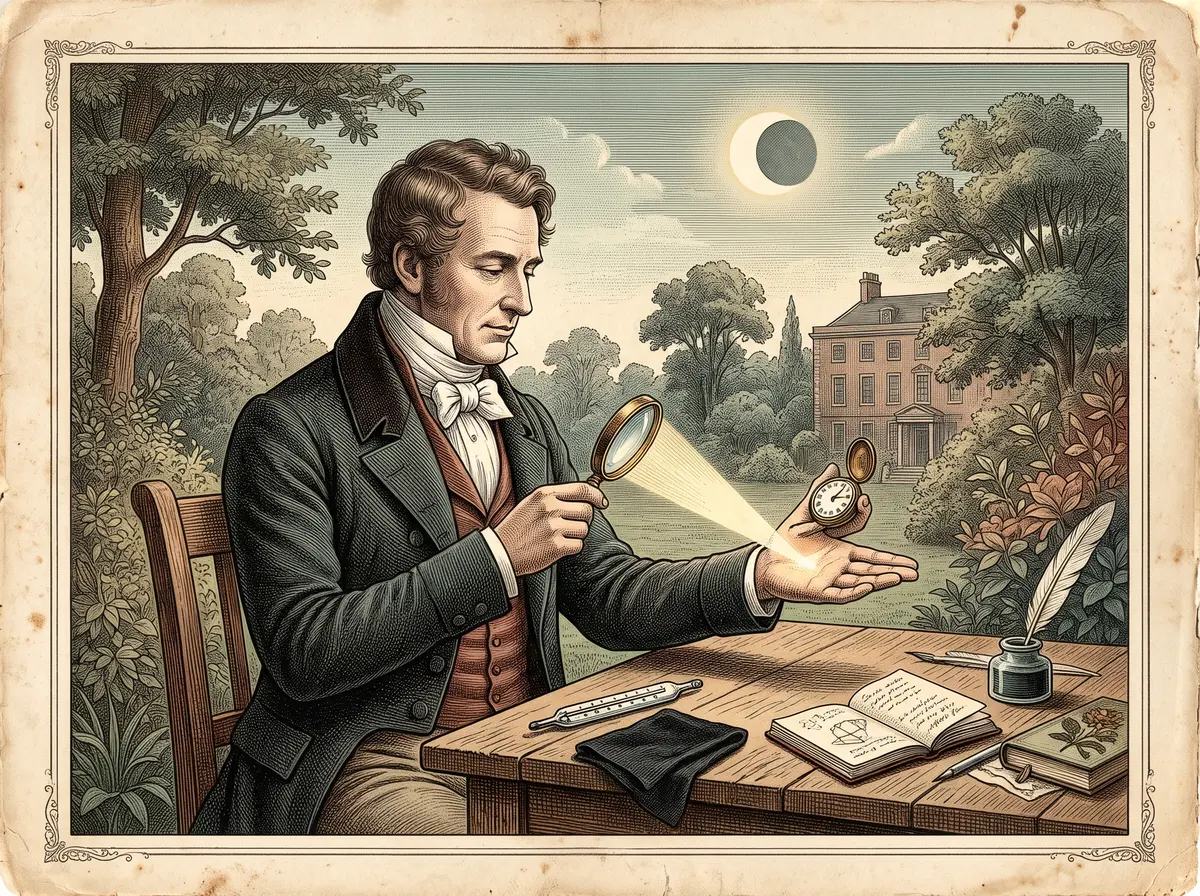
On September 7, 1820, while the Moon slid across the Sun over London, the surgeon Sir Everard Home held a magnifying lens over the back of his own hand and checked his watch. At a quarter past two, the focused sunlight began to hurt within four minutes. At five, a blister rose. He wrote it down, and the next day he tried it on his arm.
By the Curiosities Desk · · 5 min read · Filed under Chemistry · Today’s round
What happened: Sunscreen
Home was not being reckless for fun. He was chasing a question that had bothered him since April 1781, when he fell asleep on a ship’s deck crossing the Tropic and woke up badly burned. What, exactly, does the Sun do to skin? Most people assumed sunburn was simply a heat burn.
In August 1820 he started testing that idea on himself. He left the back of one hand in the noon sun with a thermometer resting on it; in 45 minutes, blisters rose. Then came his cleverest trial. He put both hands in the sunshine, each with a thermometer, and covered one with black cloth. Black absorbs heat, so the covered hand ran hotter: on one reading, 106°F under the cloth against 98°F on bare skin. Yet the bare hand scorched every time, while the hotter, covered one, in Home’s words, “had not suffered in the slightest degree.”
He repeated the comparison with a lens during the eclipse and on the days after it, laying different fabrics over his arm. Under tight black wool, the concentrated rays left no lasting mark. Under white wool and under Irish linen, blisters formed within 15 minutes. On a man from Grenada, 15 minutes of focused rays caused a brief sting and no visible damage. Home read his results to the Royal Society on November 9, 1820. His conclusion: dark pigment protects skin from the Sun’s “scorching” power even though it makes the skin warmer, so heat alone could not be the culprit.
The real culprit took decades to pin down. In 1889, the Swedish physician Erik Johan Widmark showed experimentally that ultraviolet (UV) light, the invisible light just beyond violet, causes skin to redden and burn. Two years later, according to the dermatologist and historian Frederick Urbach, the German physician Friedrich Hammer was already suggesting a chemical shield made with quinine, a compound that soaks up UV.
Products followed slowly. Around 1910, the German dermatologist Paul Unna’s “Zeozon” reached shelves. In 1936, the L’Oréal founder Eugène Schueller released Ambre Solaire, closer to a tanning oil than modern sunscreen. In 1944, Benjamin Green, a Miami pharmacist who served as an airman in World War II, worked with “red vet pet,” a thick red veterinary petrolatum used as a sun barrier. After the war, he softened it with cocoa butter and coconut oil, and the line became Coppertone.
Then there is the story with the best punchline. In 1938, an Austrian chemistry student named Franz Greiter got a severe sunburn climbing Piz Buin, a 3,312-meter peak on the Swiss-Austrian border. The tale comes mostly from the company he later founded, so treat the details as brand lore. But the product is real: in 1946 he launched Gletscher Crème, or “Glacier Cream,” and named the business after the mountain that had burned him.
Why it was strange: Sunscreen
Home’s black-cloth hand overturned common sense. The hand that got hotter came out fine. The one that stayed cooler blistered. Something in sunlight was doing damage that had nothing to do with warmth.
The odd part is that the missing piece already existed. In 1801, the German physicist Johann Wilhelm Ritter had found invisible “chemical rays” beyond the violet end of the spectrum by watching them darken silver chloride. Nobody connected those rays to a sunburned hand for almost 90 years. Home, and the chemist Humphry Davy, whom he consulted, still explained the effect in terms of heat being absorbed and converted.
Home’s sunburn quest also puts him in the company of other researchers who tested ideas on their own bodies, like The Doctor Who Drank a Beaker of Bacteria to Prove Ulcers Weren’t Caused by Stress.
What scientists learned: Sunscreen
Sunburn is not a heat burn. It is mostly the work of UVB, ultraviolet light with wavelengths of roughly 280 to 315 nanometers. UVB damages DNA in skin cells, and the body answers with inflammation: redness, pain, and sometimes blisters. In 1921, researchers in Germany found that skin reddens most readily at about 297 nanometers. UVA, with longer wavelengths, burns less but reaches deeper into the skin and contributes to aging and skin cancer.
That is why Home’s results came out the way they did. Melanin, the skin’s dark pigment, absorbs UV before it reaches vulnerable cells. His black cloth did the same job from the outside.
Sunscreens work in two broad ways. Some ingredients, like zinc oxide, are minerals that absorb and scatter UV. Others are organic molecules, carbon-based compounds whose chemical bonds absorb UV energy and release it as a small amount of heat.
Greiter’s lasting contribution was a number. The sun protection factor, or SPF, compares how much UV it takes to redden protected skin with how much it takes to redden bare skin. London’s Science Museum dates his introduction of SPF to 1962; other accounts tie it to 1974. By that measure, Glacier Cream rated about SPF 2.
Some of nature’s own sunscreens are stranger still: The Zookeepers Who Wiped a Hippo’s Face With Gauze to Find Out Why It ‘Sweats Blood’.
How it reaches us today: Sunscreen
The U.S. Food and Drug Administration adopted the SPF measure in 1978, and the number still anchors sunscreen labels worldwide. SPF 30 blocks roughly 97 percent of UVB in lab tests, and SPF 50 roughly 98 percent. In those tests, sunscreen is applied more thickly than most people put it on. Modern labels also report protection against UVA, which SPF alone doesn’t measure.
The chemistry is still moving. In June 2026, the FDA approved bemotrizinol, a filter that absorbs both UVA and UVB and had been authorized in Europe since 1999. It was the first new sunscreen ingredient approved in the U.S. in more than two decades.
Sunscreen sits on the same shelf of long-running inventions as The Five-Dollar Tinfoil Candle That Became ChapStick, and alongside the other long histories in From the First Spark to the Thing You Still Use.
Fun fact: Sunscreen
Glacier Cream’s estimated SPF of 2 means it let through about half of the burning UV.
A note on skin health: sunburn and skin cancer are common and often preventable. If a mole or spot on your skin is new, changing, or won’t heal, a doctor or dermatologist can take a quick look.
Sources: Sunscreen
- Home, E. (1821). “On the black rete mucosum… being a defence against the scorching effect of the sun’s rays.” Philosophical Transactions of the Royal Society of London 111 (full text via Philosophical Transactions OCR archive)
- Royal Society, “Making Science” archive: Home’s manuscript paper and eclipse plate, read November 9, 1820
- Drissi et al. (2022). “Sunscreen: a brief walk through history.” Proceedings (Baylor University Medical Center) 35(1): 121–123
- Science Museum Group: Piz Buin SF 30 sun block lotion (Greiter, Glacier Cream and SPF)
- “Coppertone Owes Its Success to a Pharmacist” — Pharmacy Times