The Five-Dollar Tinfoil Candle That Became ChapStick
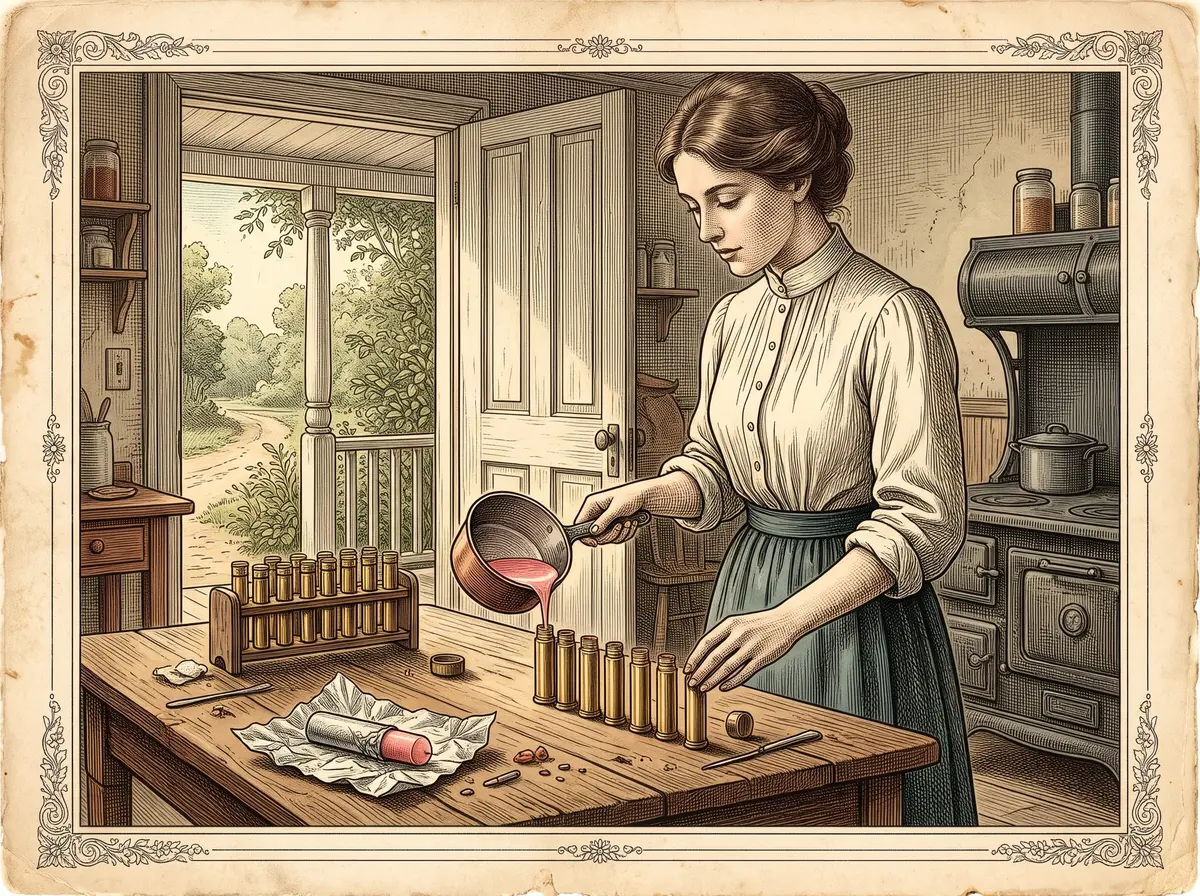
In 1912, in Lynchburg, Virginia, John Morton handed his friend five dollars for a lip remedy that nobody wanted to buy. It looked like a birthday candle that had lost its wick, wrapped in a crinkle of tinfoil. Soon his wife was melting it down on the kitchen stove, pouring it into little brass tubes, and setting them on the porch to cool.
By the Curiosities Desk · · 5 min read · Filed under Medicine · Today’s round
What happened: ChapStick
The story starts with Charles Browne Fleet, a Lynchburg pharmacist born in 1843 and often called “Dr. Fleet” by his customers. According to the official ChapStick brand history, he opened a small family pharmacy in town in 1869, and the Lynchburg Museum describes him as a “pharmacological tinker” — the kind of druggist who mixed up his own balms, tonics, and remedies in the back of the shop to see what worked.
One of his experiments was a waxy ointment for cracked, wind-burned lips. Exactly when he made it is a little fuzzy: the brand and the Lynchburg Museum place it in the 1890s, while other accounts push it back to the early 1880s. Either way, the product had a design problem. It came as a small, solid stick about the shape of a wickless candle, wrapped in foil. To use it, you peeled back the foil and rubbed the bare stick on your mouth, and the foil tore and the stick got grubby. The museum puts it plainly: Fleet was a gifted inventor but a poor salesman, and the balm sold mostly to locals, and not many of them.
By 1912 Fleet was close to 70 and had moved on. He offered the formula and the rights to his friend John Morton, another Lynchburg resident, who paid five dollars for the lot. The Lynchburg Museum notes that five dollars then was roughly what you’d pay for a suit — real money, but hardly a fortune.
What turned the candle into a product was a packaging fix, and the brand’s own history credits it to Mrs. Morton. Her idea was to melt the pink mixture, pour it into tubes, and let it harden so the stick could be pushed up a little at a time as it was used. The Mortons did this at home. According to the museum, the filled brass tubes were set out on the porch to cool, then cut and packed for shipping. Fingers never had to touch the balm, and the stick no longer crumbled in a pocket.
It sold. Profits from the kitchen operation helped found the Morton Manufacturing Company, which moved into a factory in Lynchburg. In the mid-1930s (sources give 1935 or 1936), Morton hired a local commercial artist, Frank Wright Jr., to design a logo. Wright was paid a one-time fee of fifteen dollars. The lettering he drew is, with updates, the one still printed on the tube. In 1963 the A. H. Robins pharmaceutical company of Richmond bought ChapStick and moved production there.
Why it was strange: ChapStick
The formula was never really the problem. The balm Fleet invented and the one the Mortons sold were close cousins; the difference was a tube. A product that had flopped for years became a household name because someone figured out how to keep it off your fingers.
There’s also a pleasing lopsidedness to the money. The inventor let his idea go for the price of a suit. The man who drew its logo got fifteen dollars. And nearly a century later, in 2024, ChapStick changed hands again for a deal reported at roughly $430 million. That’s the story of a lot of everyday objects: the person with the idea and the person who makes it convenient are often not the same person. For another case of an odd ointment finding its audience, see The Oil-Well Gunk Drillers Hated That Became Vaseline.
What scientists learned: ChapStick
Lip skin turns out to be unusually bad at holding on to water. The outermost layer of skin, called the stratum corneum (the thin sheet of flattened, dead cells that acts as the body’s waterproof seal), is only about three to five cell layers thick on the lips, compared with roughly fifteen to twenty on ordinary skin, according to cosmetic chemist Kelly Dobos. Lips also have no sweat glands and no hair follicles, and usually few or no oil glands. They lose water to the air faster than nearby skin, which is why they crack first in cold, dry, windy weather.
A waxy balm works mainly as an occlusive — a layer that sits on top of the skin and slows evaporation, rather than adding moisture itself. The American Academy of Dermatology advises that for very dry lips, a thick ointment like white petroleum jelly “seals in water longer than waxes or oils.” It also explains why the most natural response makes things worse: licking your lips feels soothing, but as saliva evaporates, your lips become drier. Fleet’s tinkering stumbled onto the right basic approach, a barrier, decades before anyone measured why it helped. Stories like this one sit on the shelf of The Ordinary Object With the Strange Origin.
How it reaches us today: ChapStick
The push-up stick the Mortons poured by hand is now the standard shape for lip balm, and the same twist-up idea holds everything from glue sticks to solid deodorant. Later versions of ChapStick added flavors in the 1970s and sunscreen in the early 1980s, and dermatologists now recommend a lip balm with SPF 30 or higher before going outdoors, even in winter, since lips can sunburn too.
Fleet’s own name lives on in a less glamorous corner of the medicine cabinet. The company he founded in Lynchburg, C.B. Fleet, went on to become known for laxatives and enemas; a bottle of its Fleet Phospho-soda now sits in the Smithsonian’s National Museum of American History. The lip balm he sold for five dollars ended up being the more famous invention, but under someone else’s name. For another everyday item with a medical backstory, read The Baby Swab Once Sold as ‘Baby Gays’ — Whose Box Now Begs You to Keep It Out of Your Ear.
Fun fact: ChapStick
The artist who designed the ChapStick logo was paid fifteen dollars, flat, with no royalties — three times what the formula itself had cost.
Sources: ChapStick
- A Tinkering Pharmacist, an Artist, and “The World’s Smartest Investment” — Lynchburg Museum
- When Was ChapStick Invented? The History of ChapStick — ChapStick
- Virginia’s One-Stop Lip Hydration Station — Science Museum of Virginia
- 7 Dermatologists’ Tips for Healing Dry, Chapped Lips — American Academy of Dermatology
- Fleet Phospho-soda — Smithsonian National Museum of American History
Related stories: ChapStick
- Part of The Ordinary Object With the Strange Origin
- The Oil-Well Gunk Drillers Hated That Became Vaseline — An oil-well nuisance that became a medicine-cabinet staple
- The Baby Swab Once Sold as ‘Baby Gays’ — Whose Box Now Begs You to Keep It Out of Your Ear — Another bathroom-shelf item with a surprising start
- The Minister Who Lived Next to a Brewery and Invented Soda Water to Cure Scurvy — A remedy that became an everyday product