Science Through Time · Chemistry
From Stale Breadcrumbs to a Patent the Supreme Court Rubbed Out: A Short History of the Eraser
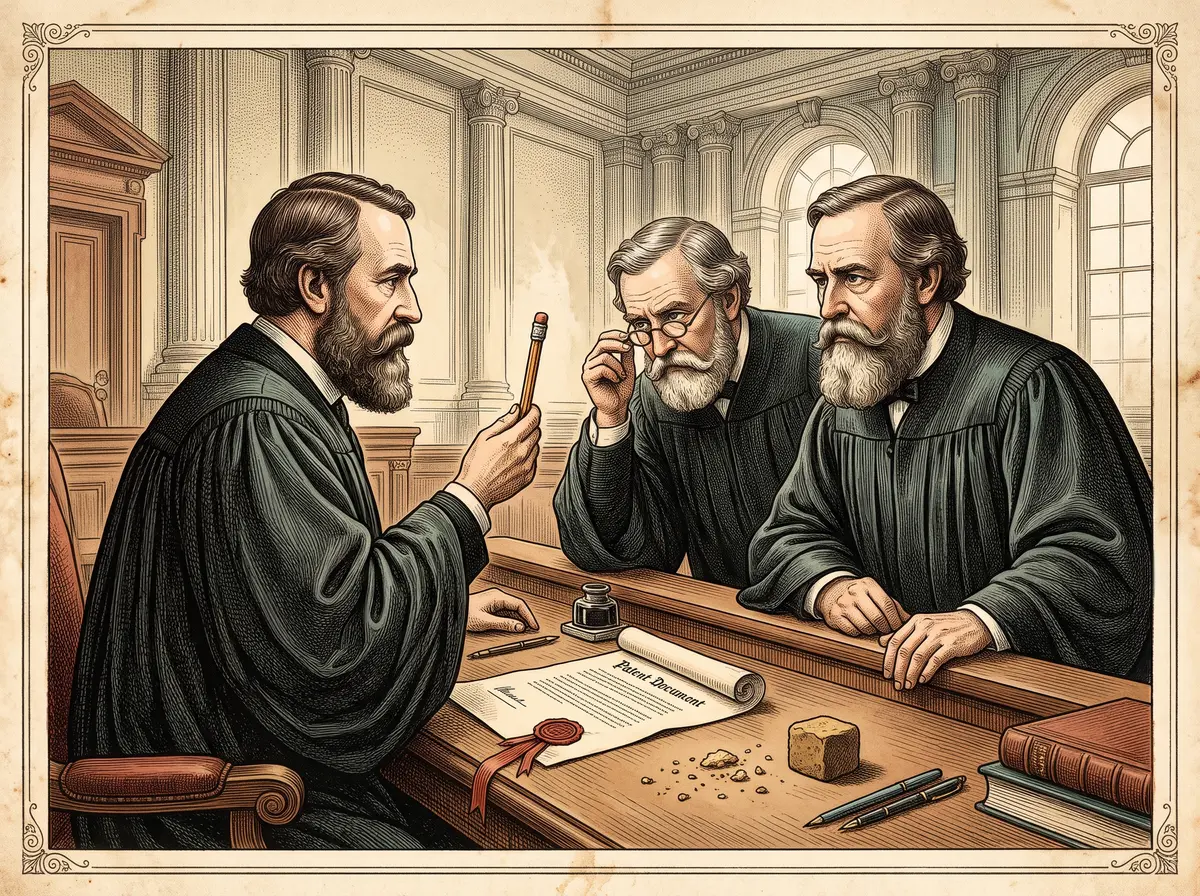
In 1875, the United States Supreme Court sat down to decide a question that sounds like a riddle: is a pencil with an eraser on the end an invention? The patent at stake had reportedly sold for $100,000. The justices looked at the graphite on one end, the rubber on the other, and ruled that gluing two useful things to the same stick was not the same as inventing something new. The patent was, in effect, rubbed out.
By the Curiosities Desk · · 5 min read · Filed under Chemistry · Today’s round
What happened: The Eraser
For most of history, a mistake on the page was hard to undo. Scribes scraped ink off parchment with knives or rough stones like pumice. Once pencils filled with graphite (a soft, slippery form of carbon) spread through Europe from the late 1500s, people found a gentler tool on the dinner table. A wad of fresh bread, kneaded and rubbed over the paper, would lift away pencil marks. It was crumbly and messy, but for well over a century it was the standard method.
The substance that replaced it came from the other side of the world. European explorers had seen Indigenous peoples in South America using the milky sap of certain trees to make bouncing balls and waterproof goods. French scientists reported on it in the first half of the 1700s, and Europeans called it “gum elastic” or caoutchouc, a word borrowed through French from Quechua.
In 1770, the English scientist Joseph Priestley, a few years before he would become famous for discovering oxygen, published a book on how to draw in perspective. In a note at the front, he mentioned a substance “excellently adapted to the purpose of wiping from paper” the marks of a pencil. He said it was sold by Mr. Nairne, a respected London instrument maker with a shop on Cornhill, at three shillings for a cube about half an inch on a side. That was not cheap, but Priestley noted that a piece would last for years.
How Edward Nairne came to sell it is less certain. The popular version says he reached for a piece of bread to erase a mark, grabbed a lump of gum elastic by mistake, and noticed it worked better. That story rests on thin evidence, and some retellings hand the same lucky accident to Priestley instead. What the record does support is that Nairne sold the cubes and Priestley recommended them.
The material’s new job gave it a new name. Because it was used to rub out pencil marks, English speakers began calling it “rubber,” and the word stuck long after the stuff was being made into tires and boots.
Early rubber had a serious problem, though. It turned sticky in summer heat, went stiff and brittle in the cold, and eventually rotted. In 1839, the American inventor Charles Goodyear found that heating rubber with sulfur made it tough and stable, a process later called vulcanization. Durable rubber made erasers cheap, long-lasting, and common.
That set the stage for Hymen Lipman, a Philadelphia stationer who had already founded one of America’s first envelope businesses. On March 30, 1858, he received U.S. Patent 19,783 for a “Combination of Lead-Pencil and Eraser.” His design reserved a section of the pencil, cut a groove into it, and glued in a strip of prepared rubber, so that one end of the pencil wrote and the other end erased. In 1862, Lipman sold the patent to Joseph Reckendorfer, reportedly for $100,000. Reckendorfer then sued the pencil maker Faber for selling pencils with erasers attached, and the case went all the way to the Supreme Court.
Why it was strange: The Eraser
The eraser got its name backwards. Most materials are named first and given jobs later, but rubber was named for a single, small task: rubbing out pencil lines.
The court case was strange in a different way. Nobody disputed that pencils with erasers were useful. The question was whether useful was enough. Justice Ward Hunt, writing for the majority, said it was not. Each part, he argued, did exactly what it already did on its own: the lead still wrote and the rubber still erased. Putting them on one handle did not create a new kind of action. In one of the opinion’s crisper lines, he wrote: “Mechanical skill is one thing: invention is a different thing.” Three justices disagreed, but the ruling stood.
Rubber itself has a dramatic origin story of its own: The Hot Stove Accident That Invented Modern Rubber.
What scientists learned: The Eraser
An eraser works because pencil marks are not really soaked into the paper. Graphite is made of stacked sheets of carbon atoms that slide apart easily. When you write, tiny flakes of it rub off and cling loosely to the surface fibers of the paper, held mainly by weak attractions between molecules.
Rubber clings to those flakes more strongly than paper does. As you rub, the friction pries the graphite loose, and the particles stick to the eraser instead. Erasers also wear away a thin skin of the eraser itself and a little of the paper, which is why they leave crumbs behind. Those crumbs carry the graphite away with them, the same job bread did, only far more cleanly.
In the 20th century, many erasers switched from natural rubber to plastics such as vinyl (PVC, or polyvinyl chloride), softened with additives. They work on the same principle but tend to smudge less and treat paper more gently.
For another everyday writing tool with a stranger past than it looks, see The Strange History of the Ballpoint Pen.
How it reaches us today: The Eraser
The Supreme Court’s reasoning outlived the pencil fight. Reckendorfer v. Faber became an early landmark for a rule patent lawyers still argue about: simply bundling known parts together, when each keeps doing its usual job, is an “aggregation,” not an invention. To earn a patent, a combination has to produce something new through the parts working together.
The pencil kept its eraser anyway. With no patent to pay for, any manufacturer could add one, and the eraser-topped pencil became a fixture of American classrooms. Many pencils sold in Europe still come without one.
And the word “rubber” is a lasting fossil of the eraser’s early fame. Every time someone says it, they are naming a material after a cube that once sold for three shillings in a London instrument shop.
The eraser’s road from a shop cube to the end of a pencil is on the shelf of From the First Spark to the Thing You Still Use.
Fun fact: The Eraser
Joseph Priestley is best remembered for discovering oxygen, but he also helped give us the word “rubber,” all because he wanted his readers to have a clean way to fix their perspective drawings.
Sources: The Eraser
- Reckendorfer v. Faber, 92 U.S. 347 (1875), full text via Cornell Law School Legal Information Institute
- “Who Invented the Electric Eraser?” (with a history of earlier erasers), IEEE Spectrum
- “How do erasers work?,” Popular Science (with chemist Joe Schwarcz of McGill University)
- “Rubber,” Online Etymology Dictionary
- Fact check: bread as a pencil eraser, Snopes