The Anatomist Who Measured Four Men's Cheek Stubble to Bust a Shaving Myth
In 1928, an anatomist at Washington University in St. Louis named Mildred Trotter published a paper that began with a thank-you to "the four men who willingly and faithfully carried out directions." The directions were about shaving. Each man lathered with the same brand of soap, used water at the same temperature, and scraped the same patch of his left cheek, so that a scientist could measure his stubble and answer a question almost everyone thought was already settled.
By the Curiosities Desk · · 5 min read · Filed under Medicine · Today’s round
Part of The Version Everyone Remembers
What happened: The Shaving-Growth Myth
Mildred Trotter was born in 1899 in Monaca, Pennsylvania, and studied zoology at Mount Holyoke College before heading to Washington University in St. Louis for graduate work in anatomy. Her first job there came about in an unusual way. The anatomist C. H. Danforth had received a $5,000 grant for the study of hair. As Trotter later remembered it, the money traced back to the husband of a patient whose family had hypertrichosis, a condition of excessive hair growth. He wanted hair studied even though, she recalled, he knew the research would not help his own family.
So Trotter became a hair scientist. Over the next few years she counted, mapped, and measured hair on many parts of the human body, and she kept running into folk beliefs that nobody had tested properly. In a 1923 paper with the wonderfully dry title “The resistance of hair to certain supposed growth stimulants,” she took aim at a few of them, including the common idea that cutting hair makes it grow better. Her observations, she later summarized, showed that hair on the body regions she tested was not affected by shaving.
There was one obvious gap. The face had not been one of those regions, and the beard, Trotter noted, was the part of the body’s hair that people most strongly believed shaving would boost. So she designed a follow-up.
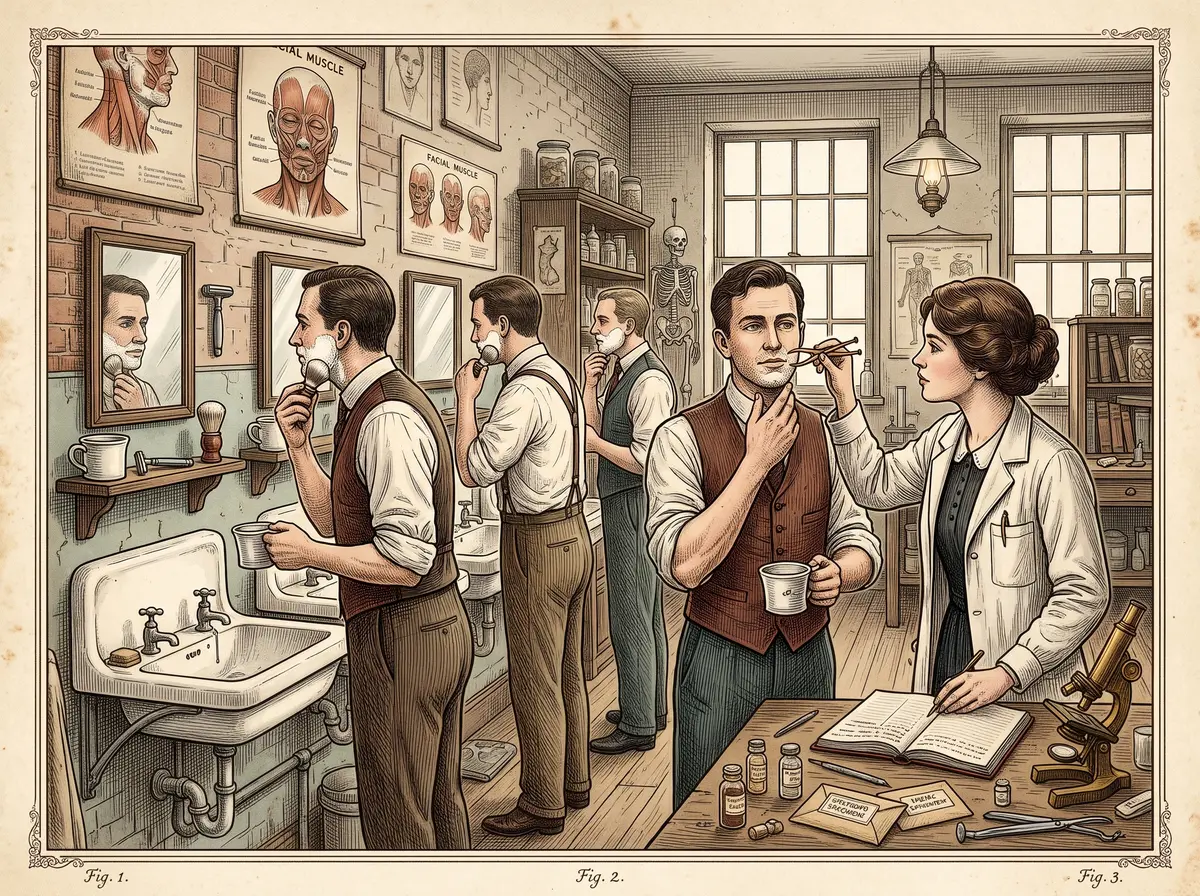
Four men agreed to shave on a schedule. Trotter picked a precise patch of the left cheek, bounded by two imaginary horizontal lines: one level with the tragus (the little flap of cartilage at the front of the ear opening) and one level with the bottom of the earlobe. The men were of different body “types,” as she put it, so she worked hard to keep everything else the same. Each man always used the same brand of shaving soap and water of the same temperature. Three used safety razors with a fresh blade every time. The fourth used a straight razor and made sure it was sharp.
The data came from the hairs themselves. At set intervals, the stubble shaved from that cheek patch was measured for length, which let Trotter track how fast the beard was growing back. Her results appeared in The Anatomical Record in 1928 under the plain title “Hair Growth and Shaving.” She found no sign that shaving made the beard grow faster. A hair-removal research archive later described it as the first paper to demonstrate that shaving does not affect hair growth.
Why it was strange: The Shaving-Growth Myth
The belief Trotter tested was not fringe. It was, and still is, something many people simply know. Plenty of teenagers have been warned not to start shaving too early, in case the hair comes back darker and coarser.
Researchers before her had also disagreed. In 1850 the German physiologist A. A. Berthold concluded that shaving the beard did stimulate growth, and other 19th- and early 20th-century researchers reported mixed results. The question had been argued over for decades without anyone pinning it down carefully.
What makes Trotter’s study charming is how ordinary the method was. No special equipment, no mystery chemistry. Just four cooperative men, a carefully chosen square of cheek, consistent soap, and patient measurement. A myth that had survived for generations needed little more than someone willing to control the bathroom-sink conditions and write down the numbers.
For another myth that met a patient, one-person-at-a-time test, see The Doctor Who Cracked the Knuckles of Only One Hand for 60 Years to Prove His Mother Wrong.
What scientists learned: The Shaving-Growth Myth
The key is where hair actually grows. Each hair is produced by a follicle, a tiny pocket in the skin. The part of the hair you see above the skin is no longer living tissue, so cutting it sends no signal down to the follicle telling it to speed up or thicken. Trotter’s own work in the 1920s also helped show that hair follicles run through cycles of growth, rest, and shedding.
So why does the myth feel true? A hair that grows naturally tapers to a fine point. A razor slices straight through the shaft, leaving a blunt end. As the Mayo Clinic explains, that blunt tip can feel coarser and look darker as it pokes back through the skin, even though the hair’s thickness, color, and growth rate have not changed.
Later work backed Trotter up. In a 1970 study in the Journal of Investigative Dermatology, Y. L. Lynfield and P. MacWilliams had five young men shave one leg weekly for several months while leaving the other leg alone. Shaving made no significant difference in the weight of hair grown in a measured area, or in the width or growth rate of individual hairs.
For a myth that also fell apart once someone controlled the conditions, see The Sugar Rush Mothers Saw in Sons Who Never Had Any Sugar.
How it reaches us today: The Shaving-Growth Myth
Dermatologists and medical sites still answer this question constantly, and the answer rests on the kind of controlled comparison Trotter ran nearly a century ago. If you shave, the hair that comes back is the same hair, just with a blunter tip.
Trotter herself went on to a career far beyond stubble. She moved from hair to bones, saying she “liked studying skeletons better than studying hair.” In 1946 she became the first woman to hold the rank of full professor at Washington University. In 1948 she spent about 14 months identifying the remains of American service members at a U.S. Army laboratory at Schofield Barracks in Hawaii. With Goldine Gleser, she then published formulas in 1952 for estimating a person’s height from the lengths of long bones, work that forensic scientists still rely on. Her large collection of human hair samples is now curated at the Smithsonian’s National Museum of Natural History.
For another everyday medical belief that turned out to rest on a mistake, see The Misplaced Decimal Point That Made Spinach Famous — and Never Existed. The shaving test belongs with the other stories everyone remembers slightly wrong, in The Version Everyone Remembers.
Fun fact: The Shaving-Growth Myth
When Trotter died in 1991, her body was donated, at her wish, to the Washington University School of Medicine, where she had taught anatomy to nearly 4,000 students.
Sources: The Shaving-Growth Myth
- Trotter, Mildred. “Hair Growth and Shaving.” The Anatomical Record 37, no. 4 (1928): 373–379
- Lynfield, Y. L., and P. MacWilliams. “Shaving and Hair Growth.” Journal of Investigative Dermatology 55, no. 3 (1970): 170–172 (PubMed)
- Mildred Trotter biography, Becker Medical Library, Washington University School of Medicine
- Mildred Trotter, “In Her Words” oral history excerpt, Becker Medical Library
- Mayo Clinic, “Does shaving unwanted body hair make it grow back thicker and darker?”