The Scientist Behind It · Space
The Astronomer Who Fired Metal Pellets Into Space 12 Days After Sputnik — and Insisted One Got Away
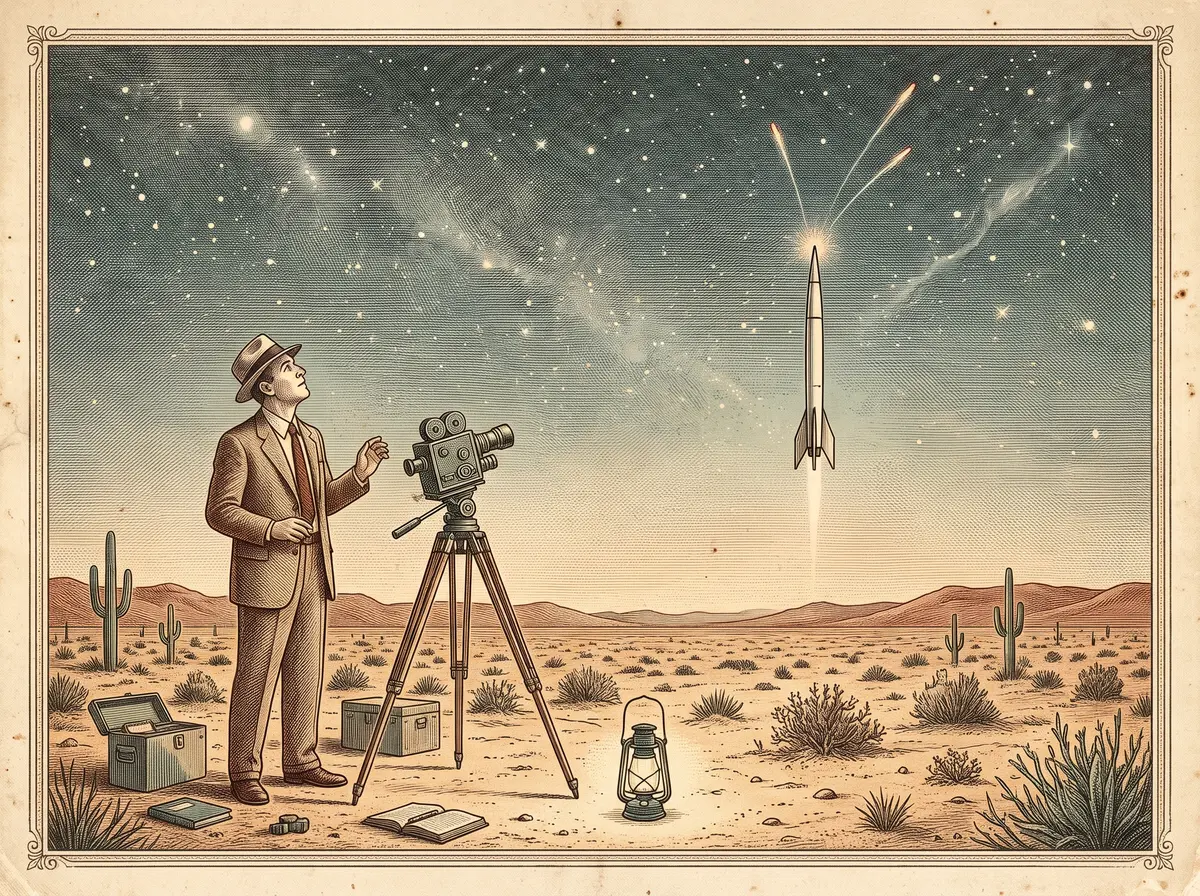
Late on the night of October 16, 1957, twelve days after Sputnik, an Aerobee rocket climbed out of Holloman Air Force Base in New Mexico. About 50 miles up, its nose cap flipped over and three small explosives went off, flinging specks of metal smaller than a pea toward the stars. On the ground, a Caltech astronomer named Fritz Zwicky was sure of what had just happened: America had quietly thrown the first human-made objects out of Earth's gravity for good.
By the Curiosities Desk · · 5 min read · Filed under Space · Today’s round
What happened: The Astronomer Who Fired Metal Pellets Into Space 12 Days After Sputnik —
Fritz Zwicky was born in Varna, Bulgaria, in 1898 to Swiss parents, and came to Caltech in 1925 to work with the physicist Robert Millikan. By several accounts he arrived with very little patience for anyone else’s ideas. Physics World retells a story in which Zwicky told Millikan he had never had “a single original idea” of his own. Millikan asked Zwicky how often he had one. Every two years, Zwicky said. Millikan suggested he take up astrophysics.
He did, brilliantly and loudly. Zwicky helped propose that supernovas, a word he introduced in a 1931 Caltech lecture course, were dying stars collapsing into neutron stars. In 1933 he noticed that the galaxies in the Coma Cluster were moving far too fast to be held together by the matter astronomers could see, and he suggested something invisible was supplying the extra gravity. He called it dunkle Materie: dark matter.
He was also famous for insults. His best-known label for colleagues he disliked was “spherical bastards,” because, as the story is usually told, they were bastards no matter which way you looked at them.
And for more than a decade, he had wanted to shoot something into space.
His plan relied on shaped charges, explosives formed so that they focus their blast into a narrow, extremely fast jet of metal. It’s the principle behind armor-piercing weapons, and Zwicky had spent the war years doing rocket research for the Aerojet company. In 1946 he got his first chance: shaped charges rode a captured German V-2 rocket out of White Sands, New Mexico, on December 17. The rocket worked. The charges never fired. According to the Caltech magazine Engineering and Science, the culprit was apparently a fault in the firing circuit.
Eleven years later, the Soviet Union’s Sputnik 1 changed the mood overnight. On October 16, 1957, the Air Force launched an Aerobee sounding rocket, a research rocket that flies straight up and falls back down, carrying three charges built by three teams: one by Thomas Poulter of Stanford, one by John Rinehart of the Smithsonian Astrophysical Observatory, and one by Zwicky’s group. At roughly 85 kilometers (about 53 miles), the rocket’s tip was kicked loose and turned over so the charges could fire upward, away from Earth.
Cameras on the ground, including a Harvard meteor camera, caught bright streaks: artificial meteors. In the January 1958 issue of Engineering and Science, Caltech announced that the brightest jet had thrown pellets at at least 15 kilometers per second, faster than the roughly 11.2 kilometers per second needed to escape Earth’s gravity. “Small man-made projectiles were launched away from the earth for the first time, never to return,” the article declared. Air & Space magazine later quoted Zwicky as saying, “I am certain they escaped.”
Why it was strange: The Astronomer Who Fired Metal Pellets Into Space 12 Days After Sputnik —
Because the story is probably better than the claim.
Zwicky never published a full scientific paper on the experiment. In 1961, Richard McCrosky of the Smithsonian Astrophysical Observatory analyzed the camera records. As space historian Jonathan McDowell summarizes it, the glowing trails seem to have come from the Poulter and Rinehart charges, not Zwicky’s own. The fastest one, Poulter’s, did hit about 14.4 kilometers per second, technically fast enough to escape. But those pellets weren’t built to glow on their own; they lit up only when slamming into air. McDowell concludes that the fast one was traveling in the wrong direction to leave.
So one tiny, roughly tenth-of-a-gram speck of metal may have briefly been the fastest thing humans had ever launched. It just wasn’t headed for space. McDowell’s verdict is that Zwicky’s escape claim is unlikely and shouldn’t be repeated as fact.
It’s not the only object with a contested “first into space” legend: see The Manhole Cover a Nuclear Test Fired Into the Sky — and the Single Camera Frame That Caught It.
What scientists learned: The Astronomer Who Fired Metal Pellets Into Space 12 Days After Sputnik —
Even without the escape, the experiment worked as a physics demonstration. It showed that shaped charges could hurl small masses at speeds no rocket of 1957 could reach, and that those masses would light up like meteors on the way back down. That made them useful as known, controlled meteors: if you know exactly how fast and how big a particle is, you can watch how it burns and learn how natural meteors interact with the upper atmosphere.
It also showed a quieter lesson about evidence. A camera streak proves something moved fast; it doesn’t prove which direction it went or where it ended up. Telling those apart took careful measurement years later.
The rocket that America hoped would answer Sputnik properly had its own troubles that December, as The Rocket That Exploded on Live TV and Got Called ‘Kaputnik’ recounts.
How it reaches us today: The Astronomer Who Fired Metal Pellets Into Space 12 Days After Sputnik —
The first human-made object widely accepted as escaping Earth’s gravity and reaching orbit around the Sun was the Soviet probe Luna 1, launched in January 1959. Zwicky’s pellets became a footnote, often repeated uncritically.
His bigger bets aged far better. Neutron stars were confirmed when pulsars were discovered in 1967. Dark matter, which he named in 1933, is now a central puzzle of modern cosmology. And the Zwicky Transient Facility, a sky-survey camera at Palomar Observatory, is named for him and still hunts the exploding stars he loved.
For another bold 1950s plan to send things into space using explosions, see The Spaceship That Was Supposed to Ride Atomic Bombs to Saturn.
Fun fact: The Astronomer Who Fired Metal Pellets Into Space 12 Days After Sputnik —
Zwicky personally discovered 122 supernovas with Palomar’s 48-inch Schmidt telescope, which the American Museum of Natural History calls “still a record for any one observer.”
Sources: The Astronomer Who Fired Metal Pellets Into Space 12 Days After Sputnik —
- “The First Shots Into Interplanetary Space,” Engineering and Science (Caltech), January 1958
- Jonathan McDowell, “Zwicky’s 1957 Aerobee experiment” (analysis of the launch and McCrosky’s 1961 findings)
- “In 1957, Two Tiny Pellets Were the First Man-made Objects to Escape Earth’s Gravity,” Air & Space / Smithsonian
- “Profile: Fritz Zwicky’s Extraordinary Vision,” American Museum of Natural History
- “The tempestuous genius of Fritz Zwicky,” Physics World