The Scientist Behind It · Space
The Astronomer Who Smashed His Own Giant Telescope Mount — and Put the Pieces Up for Auction
In December 1836, Londoners could read a handbill advertising an unusual auction: the broken remains of what was meant to be one of the finest telescope mountings in the world. The seller was Sir James South, a knighted astronomer and a former president of the Royal Astronomical Society. He had smashed the mounting himself. And the poster didn't just list the lots — it took aim at the Royal Astronomical Society, the instrument makers who built the thing, and two of the most respected astronomers in England.
By the Curiosities Desk · · 5 min read · Filed under Space · Today’s round
Part of The Person Who Would Not Drop It
What happened: James South's Telescope
James South, born in 1785 in Southwark, London, was trained as a chemist and surgeon, but his heart was in the sky. Marrying an heiress, Charlotte Ellis, in 1816 let him leave surgery behind and spend his money on instruments. With John Herschel he catalogued 380 double stars (pairs of stars that look close together in the sky, many of them truly orbiting each other), and in 1826 the work earned him the Royal Society’s Copley Medal and the Royal Astronomical Society’s Gold Medal. He helped found that society, served as its president, and was knighted by King William IV in 1831.
At his observatory on Campden Hill in Kensington, South planned something grand. Around 1829 he bought a lens about 12 inches across from the Paris optician Robert-Aglaé Cauchoix, paying roughly £1,000. It was described at the time as the largest object-glass, or main telescope lens, in existence. A lens that big needs a stand to match, so South hired Edward Troughton, the most celebrated instrument maker in Britain — the same man who had once proposed South for a fellowship of the Royal Society of Edinburgh.
When the mounting was finished in the early 1830s, South found it shook. Give the long telescope a turn, let go, and it kept trembling, about a dozen vibrations before it settled. For someone measuring the tiny gaps between double stars, a quivering tube was a serious complaint. By the spring of 1832, South and the firm of Troughton & Simms were trading furious letters. He called the polar axis “a decided failure,” stopped the work, and refused to pay.
Troughton went to court in late 1833. The case was sent to arbitration — a ruling by an agreed referee rather than a jury — and the cast was remarkable. The referee, William Henry Maule, and both lawyers had been top Cambridge mathematics graduates. Advising Troughton’s side was the astronomer Reverend Richard Sheepshanks, who worked out a fix for the wobbling pivot. The Dictionary of National Biography later called it “the most remarkable astronomical trial which ever took place in England.”
The arbitrator ordered the makers to finish the job using Sheepshanks’s improvements, and to be paid only if it worked. In July 1834, the Astronomer Royal, John Pond, and the engineer Bryan Donkin tested the instrument and judged it fit for measuring double stars. George Airy, soon to become Astronomer Royal himself, made trial measurements too. In December 1834, according to the Royal Astronomical Society’s own history, the makers were awarded their whole claim. Troughton died the following year.
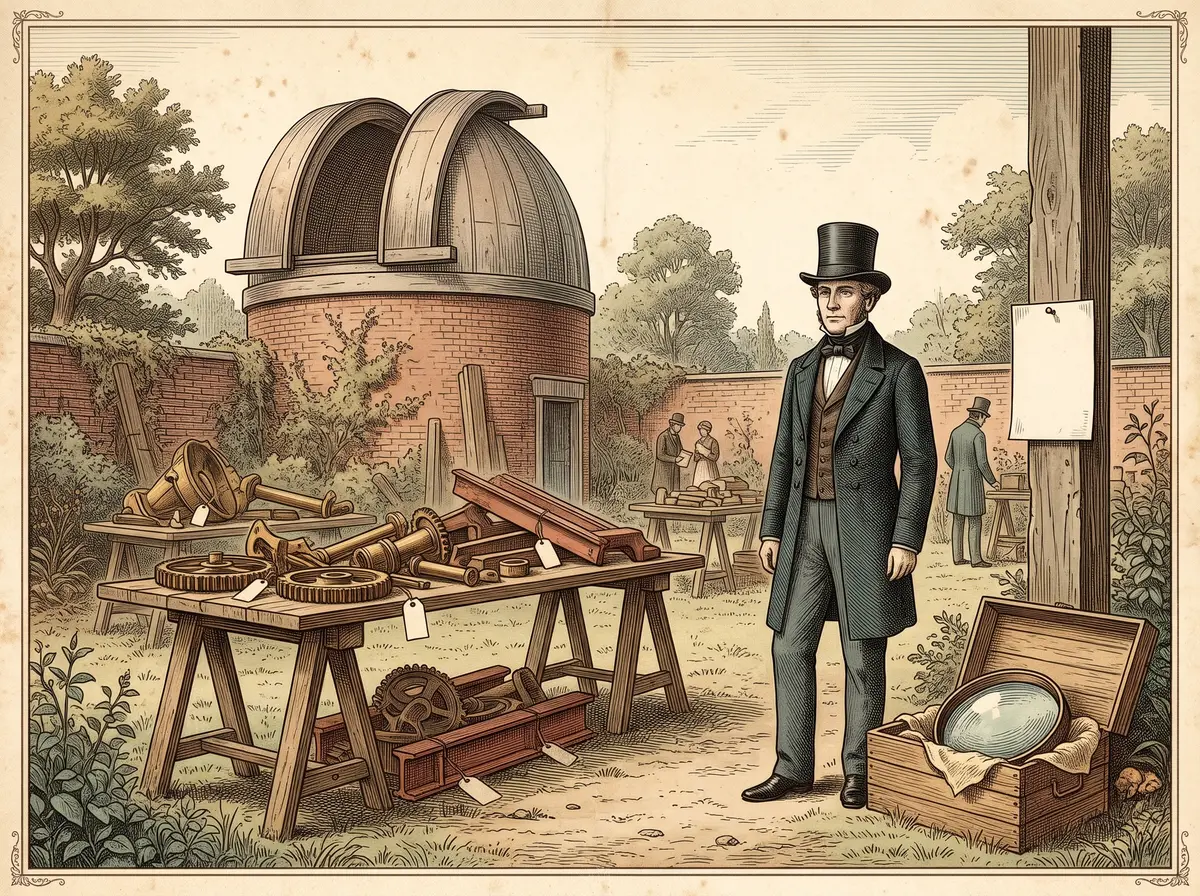
South did not accept the verdict. He broke the mounting to pieces, and in December 1836 he advertised the fragments for sale with a poster that the society’s official historians later called “scurrilous.” It attacked the Royal Astronomical Society, Troughton & Simms, and “their Assistants, Mr. Airy and the Rev. R. Sheepshanks.” By the historians’ estimate, the whole affair cost South “fully £8000.”
Why it was strange: James South's Telescope
South was no outsider: a medal winner, a knight, a founder of the very society he ended up mocking in public. And he didn’t lose the argument quietly. Independent experts tested the mount and said it worked. South’s answer was to make sure nobody could ever use it.
There’s also a sad irony in it. Lord Rosse, who later built the biggest telescope of the century, offered to design a new mounting for South. South said no. In 1842 he showed the fragments to the American astronomer Ormsby MacKnight Mitchel and called them “the wreck of all his hopes,” adding that the astronomer Wilhelm Struve, working at Dorpat in the Russian Empire, had already “reaped the golden harvest among the double stars.”
More stories of people who could not let something go are collected in The Person Who Would Not Drop It.
What scientists learned: James South's Telescope
The fight was about something real. An equatorial mount tilts a telescope’s main axis (the polar axis) to point at the celestial pole, so turning that one axis lets the telescope follow a star as Earth rotates. The bigger and heavier the lens and tube, the harder it is to make that frame stiff. Any wobble smears the image — a real problem when the gap between two stars can be smaller than one arcsecond, which is 1/3,600 of a degree.
Troughton built in the older “English” style, a long frame supported at both ends. In Munich, Joseph von Fraunhofer had mounted Struve’s large refractor at Dorpat (now Tartu, Estonia) on a compact design with the tube balanced by a counterweight and driven by clockwork. That “German equatorial” style became the standard for refractors of the age, and Struve’s double-star measurements made with it set the benchmark South had hoped to reach.
Double-star work mattered because it tested whether Newton’s gravity worked out among the stars, not just around our Sun. Measuring how a pair’s separation and angle change over years reveals their orbit — and, eventually, their masses.
Another astronomer whose career took a famously dramatic turn is the subject of The Astronomer With a Metal Nose and a Beer-Drinking Elk.
How it reaches us today: James South's Telescope
Mount stiffness is still a top concern for telescope builders, from backyard rigs to observatory giants. Engineers still measure how quickly a mount’s vibrations die away after it’s nudged — the same test at the heart of South’s complaint.
The lens survived. Because South had bought it separately, it was never part of the smashed mount. In 1862 he gave it to Trinity College Dublin’s Dunsink Observatory, where Thomas Grubb built it into a new telescope completed in 1868. South died at Campden Hill in 1867, aged 82.
Another astronomer whose plans went sideways: The Astronomer Who Spent Eleven Years at Sea to Watch Venus Cross the Sun — and Missed It Anyway.
Fun fact: James South's Telescope
The lens at the center of the fight still sees starlight: Dunsink Observatory uses its South Telescope for public stargazing nights, more than 190 years after Cauchoix ground the glass.
Sources: James South's Telescope
- Dreyer, J. L. E., and Turner, H. H., eds. History of the Royal Astronomical Society, 1820–1920. London: Royal Astronomical Society, 1923. archive.org
- “The South-Troughton quarrel.” MacTutor History of Mathematics Archive, University of St Andrews. mathshistory.st-andrews.ac.uk
- Clerke, Agnes Mary. “South, James.” Dictionary of National Biography, vol. 53 (1898). Wikisource
- Hoskin, Michael. “Astronomers at War: South v. Sheepshanks.” Journal for the History of Astronomy 20 (1989). doi.org
- “Dunsink Observatory.” Wikipedia (citing Wayman, P. A., “The South Telescope of Dunsink Observatory,” Irish Astronomical Journal 8 (1968): 274). wikipedia.org