The Bobbing Toy Bird a Cold War Think Tank Wanted to Hire as a Water Pump
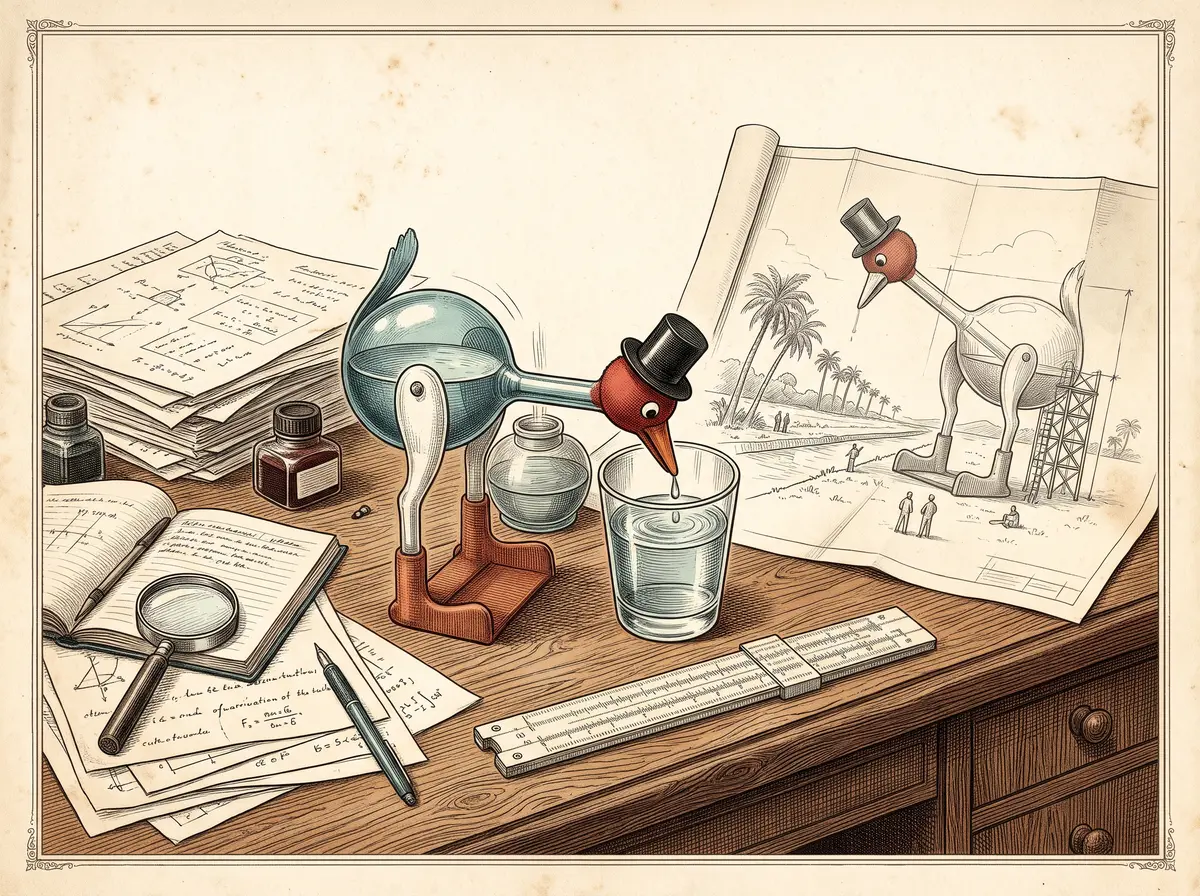
In 1966, a researcher at the RAND Corporation, the Cold War think tank better known for nuclear strategy, sat down to write a serious technical paper about a glass bird in a top hat. The bird dips its red felt beak into a glass of water, swings upright, pauses, and dips again, for hours, with no battery, spring, or plug. His recommendation: find out whether this desk toy could be scaled up to help lift irrigation water in Egypt.
By the Curiosities Desk · · 5 min read · Filed under Physics · Today’s round
What happened: The Drinking Bird
The drinking bird looks like a joke, but it is one of the oldest ideas in this story. In 1768, Benjamin Franklin wrote to his friend John Winthrop, a Harvard professor, about a curious sealed glass tube he had seen in Germany the year before. It was about eight inches long, with a bulb at each end, partly filled with water and emptied of air. Hold one bulb in your hand and “a constant succession of large bubbles” streamed toward the other end, as if the water were boiling from the warmth of a palm.
Franklin was hooked. He set one against a small hole in his window, where cold air leaked in while fires warmed the room, and the bubbles kept flowing day and night. He even wet one bulb with spirits dabbed on with a feather and watched the water rush toward the cooled end until the spirits dried. He guessed, correctly, that the empty space held an invisible vapor.
In the 1870s the Italian engineer Enrico Bernardi joined three such tubes into a small evaporation-powered engine. In the early 20th century a toy version appeared in China, known as the “insatiable birdie.” The Soviet science popularizer Yakov Perelman later described it in his book Physics for Entertainment.
The bird most Americans know came out of New Jersey. Miles V. Sullivan, a chemist who would spend his career at Bell Labs, filed a patent for a “Novelty device” on August 6, 1945. U.S. Patent 2,402,463 was granted on June 18, 1946. It describes a hollow glass structure “shaped into a bird form with two divided spaces,” holding a liquid that evaporates easily (Sullivan suggested alcohol, carbon tetrachloride, or chloroform) and a dish of “water or the like” for the beak to dip into. Today’s birds usually run on dichloromethane, a solvent that boils just above room temperature.
Then came the Einstein stories, and here legend outruns the record. One Einstein biography passes along a story that it “was said” Albert and Elsa Einstein were fascinated by the Chinese birdie when they passed through Shanghai in 1922. Sullivan’s family tells a grander version, in which Einstein stayed up all night trying to work out how the bird operated and had to take one apart. Neither is backed by a firsthand record.
What is documented is the RAND paper. In A Simple Heat Engine of Possible Utility in Primitive Environments (1966), R. B. Murrow described the bird’s engine in detail, reported a small direct experiment showing that it worked, and noted that it ran especially well in dry air like Egypt’s. He recommended studying whether it could be developed into a machine for what he called the “Egyptian low-water-lift problem”: raising water a short distance from canals into fields. There is no sign that a giant bird ever went to work on the Nile.
Why it was strange: The Drinking Bird
A toy that moves forever with no visible fuel looks like a perpetual motion machine, a device that runs without any energy input. Physics says those cannot exist.
The trick is that the bird does have fuel. It just doesn’t look like fuel. The bird is a heat engine, the same family of machine as a steam engine. It runs on the small temperature difference between its wet head and its dry body. The energy comes from the warmth of the room, which keeps evaporating water off the felt. Take away the water, or put the bird in a sealed, perfectly humid jar, and it stops.
For the other kind of “endless” machine, see The Perpetual Motion Machine Secretly Powered by an Old Man Upstairs Eating Bread.
What scientists learned: The Drinking Bird
Here is the cycle. Air is pumped out of the bird when it is made, so the space above the liquid holds only that liquid’s vapor. Water evaporates from the felt head, and evaporation cools it, the same way sweat cools your skin. The cooler head lowers the vapor pressure inside it, meaning the gas there pushes less hard. The warmer body pushes harder, forcing liquid up the neck. The bird becomes top-heavy and tips forward. When it does, the bottom of the neck tube lifts clear of the liquid, a bubble of warm vapor slips up, pressures even out, liquid drains back down, and the bird swings upright with a freshly wetted beak.
Physicists have measured it closely. In 2003, a team at the University of Coimbra in Portugal published “Experiments with the drinking bird” in the American Journal of Physics. They used the toy to show how temperature, humidity, and the laws of thermodynamics limit how much work any heat engine can squeeze from a temperature difference. Even a desk toy has to obey the same efficiency ceiling, the Carnot limit, as a power plant.
Another toy that made physicists look twice is The Toy Top That Stood on Its Head — and Had Niels Bohr and Wolfgang Pauli Bent Over the Floor.
How it reaches us today: The Drinking Bird
The bird remains a staple of physics classrooms, where it teaches evaporation, vapor pressure, and heat engines in one bob. In a 1995 episode of The Simpsons, Homer leaves one pecking at his keyboard at the nuclear plant, with predictable results.
And the RAND idea of putting it to work got a modern sequel. In March 2024, researchers led by Hao Wu at South China University of Technology reported in the journal Device that they had attached triboelectric nanogenerators, small devices that make electricity from contact and friction, to a rebuilt drinking bird. Running on evaporating water, it produced more than 100 volts, ran for several days on 100 milliliters of water, and powered calculators, temperature sensors, and small displays. That is modest power, not a power plant, but it is real.
The bird keeps company with other surprising origins at The Ordinary Object With the Strange Origin.
Fun fact: The Drinking Bird
In 2004, two physicists at Kent State University built a “dunking bird of the second kind” that needs no volatile liquid at all. It works by capillary action and evaporation, and it bobs once every few hours instead of every few seconds.
Sources: The Drinking Bird
- U.S. Patent 2,402,463, “Novelty device” — Miles V. Sullivan, filed August 6, 1945, granted June 18, 1946
- From Benjamin Franklin to John Winthrop, 2 July 1768 — Founders Online, U.S. National Archives
- A Simple Heat Engine of Possible Utility in Primitive Environments — R. B. Murrow, RAND Corporation, 1966
- Experiments with the drinking bird — J. Güémez, R. Valiente, C. Fiolhais and M. Fiolhais, American Journal of Physics 71 (2003)
- An electricity generator inspired by the drinking bird toy powers electronics with evaporated water — ScienceDaily, on the March 2024 study in Device (Cell Press)