The Scientist Behind It · Chemistry
The Chemist Whose Music Won Broadway's Top Prize 67 Years After He Died — and Who Treated It as a Hobby
On March 28, 1954, the Tony Award for best musical went to *Kismet*, a Broadway show whose hit tunes, including "Stranger in Paradise," were built from music by Alexander Borodin. Borodin could not attend. He had died in 1887, and for most of his working life he had been better known in St. Petersburg as a professor of chemistry who wrote symphonies when he could find the time.
By the Curiosities Desk · · 5 min read · Filed under Chemistry · Today’s round
Part of The Person Who Would Not Drop It
What happened: Borodin's Double Life
Alexander Borodin was born in St. Petersburg in 1833, the illegitimate son of an elderly Georgian nobleman, Luka Gedevanishvili, and a young Russian woman, Evdokia Antonova. As was common for such children, he was registered as the son of one of the nobleman’s serfs, Porfiry Borodin. He was freed at age seven and raised in comfort, and he showed two talents early. He wrote his first piece of music at about nine. He also began doing chemistry experiments at home as a boy.
Russia did not grant chemistry degrees at the time, so in 1850 Borodin enrolled at the Medical-Surgical Academy in St. Petersburg, where chemistry was taught as part of medicine. He earned his doctorate in 1858. He served briefly as a military hospital doctor, a job made harder by the fact that, by several accounts, he tended to faint at the sight of blood. His chemistry teacher, Nikolai Zinin, warned him that his music was a distraction, telling him, in one widely repeated line, that “you cannot hunt two hares at the same time.”
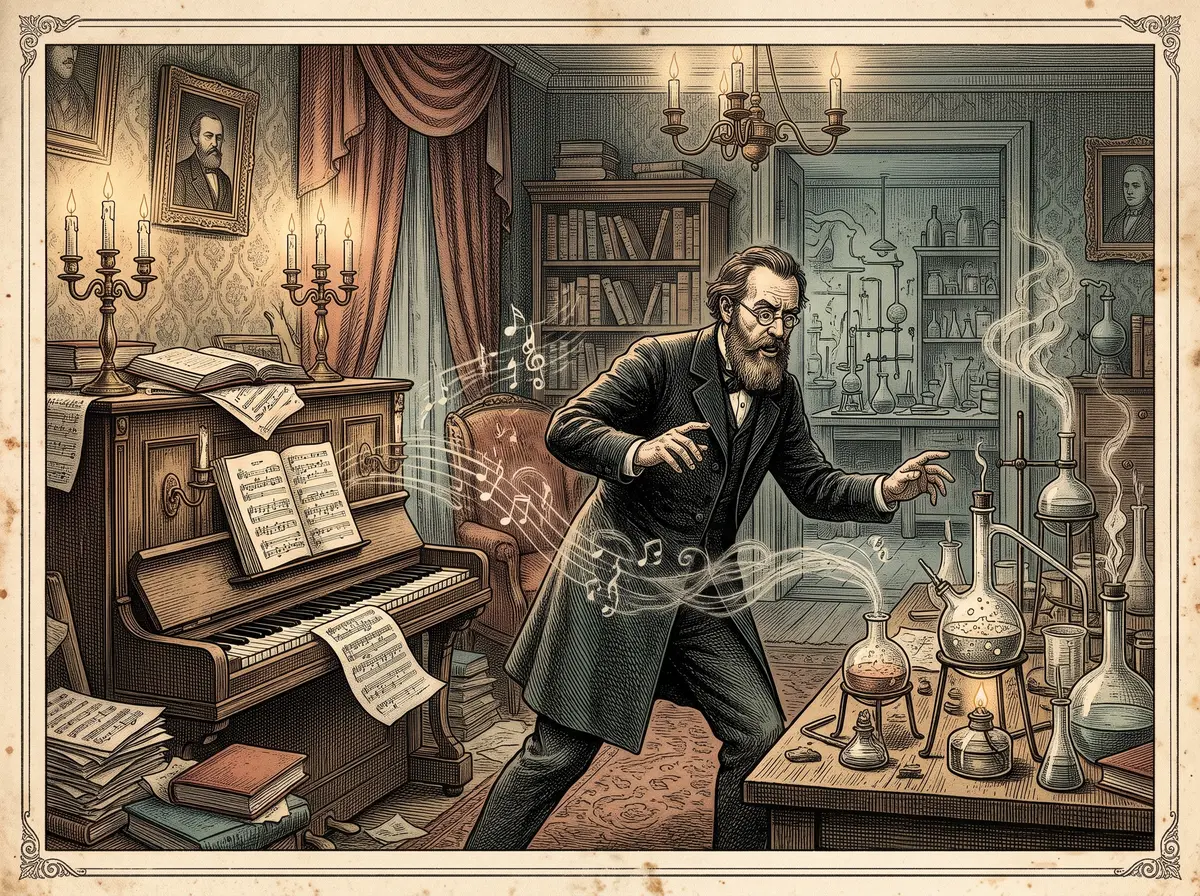
Borodin tried anyway. After three years of study in western Europe, he returned to the Academy in 1862 as a chemistry professor and became a full professor in 1864. He lived in a university apartment next to his laboratory, which made it very easy to drift between the two. His friend and fellow composer Nikolai Rimsky-Korsakov later recalled visiting and finding him at work in the lab. The two would go back to the apartment to play music, and Borodin would keep jumping up to run and check on his experiments, making the corridor ring with chords as he went.
The chemistry was real. In 1861, Borodin reported making methyl bromide from silver acetate and bromine, a reaction that strips a carbon atom off an acid and puts a bromine atom in its place. In the early 1870s he studied aldehydes, a family of reactive, often strong-smelling molecules, and found that two of them could link up into a larger molecule. At almost the same moment, the French chemist Charles-Adolphe Wurtz published the same reaction. Wurtz reported in 1872; Borodin described his own work to the Russian Chemical Society in 1873.
Music, meanwhile, got the leftovers. A story told by many of his biographers says Borodin could compose only when he was too ill to lecture, so his musical friends, reversing the usual greeting, wished him poor health. However it was phrased, the schedule showed. He worked on his opera Prince Igor for about 18 years and never finished it. He spent much of his spare energy on another cause: in 1872 he helped found medical courses for women in St. Petersburg and taught in them until 1885.
On February 27, 1887, at a costume ball held for the Academy’s professors, Borodin suddenly collapsed and died almost instantly, at 53. Rimsky-Korsakov and his student Alexander Glazunov finished Prince Igor from his notes, and it premiered in 1890. Its “Polovtsian Dances” became concert favorites. Sixty-three years later, the songwriters Robert Wright and George Forrest borrowed those dances and other Borodin pieces for Kismet, which opened on Broadway in December 1953 and ran for 583 performances.
Why it was strange: Borodin's Double Life
We tend to imagine great composers as people who lived for music. Borodin did not. He considered chemistry and medicine his real jobs, and music the thing he did in spare hours or sick days. Yet it is the music that most people know, while his two best-known chemical reactions mostly carry other people’s names.
Then there is the Tony. Many articles say Borodin was given a posthumous Tony Award. The official 1954 list is more modest: the best musical prize went to the production, with Borodin credited as composer. Either way, a professor who died in 1887 ended up on the winning side of a Broadway awards night.
Another chemist whose famous legend outgrew his real work is The Chemist Credited With Perfecting Vodka — Who Said He’d Never Drunk It.
What scientists learned: Borodin's Double Life
The reaction Borodin and Wurtz found is called the aldol reaction. The name combines “aldehyde” and “alcohol,” because the new, larger molecule carries both chemical groups. Its real importance is that it joins carbon to carbon, which is one of the hardest and most useful things an organic chemist can do. Being able to snap small carbon pieces together into bigger ones is how chemists build complex molecules from simple starting materials.
Borodin’s 1861 reaction had a quieter career. In the 1930s and 1940s, the German chemists Heinz and Cläre Hunsdiecker turned the idea into a general method, and it is now usually called the Hunsdiecker reaction, sometimes the Hunsdiecker-Borodin reaction. Historians still debate how original some of Borodin’s work was; the historian of science Michael Gordin has argued that it fit closely within the research programs of his teachers.
For more scientists who kept at a question long after others would have let it go, see The Person Who Would Not Drop It.
How it reaches us today: Borodin's Double Life
The aldol reaction is a staple of every organic chemistry course and of industry. Chemists use aldol-type reactions to make flavorings such as cinnamaldehyde, the molecule that gives cinnamon its smell, and to build pieces of complex drug molecules. Your own cells run a version too: an enzyme called aldolase splits a sugar molecule during glycolysis, the process that turns glucose into usable energy, by running an aldol reaction in reverse.
And his music never left. “Stranger in Paradise” became a hit for several singers in the 1950s, and the “Polovtsian Dances” remain a regular in concert halls.
Another chemist whose most famous moment came from outside the lab is The Snake Dream Told at a Birthday Party for a Molecule.
Fun fact: Borodin's Double Life
The melody of “Baubles, Bangles and Beads” from Kismet comes from the second movement of Borodin’s String Quartet No. 2, written by a man who spent his weekdays studying aldehydes.
Sources: Borodin's Double Life
- Borodin, A. “Ueber einen neuen Abkömmling des Valerals.” Berichte der deutschen chemischen Gesellschaft 6 (1873): 982–985
- Gordin, Michael D. “Facing the Music: How Original Was Borodin’s Chemistry?” Journal of Chemical Education 83, no. 4 (2006): 561–565
- “Aleksandr Borodin,” Encyclopaedia Britannica
- “Alexander Borodin, chemist and composer,” McGill University Office for Science and Society
- “8th Tony Awards” (1954 winners list)