The Scientist Behind It · Chemistry
The Chemist Who Brought His Cat to Meet Goethe — and Left With the Beans That Gave Us Caffeine
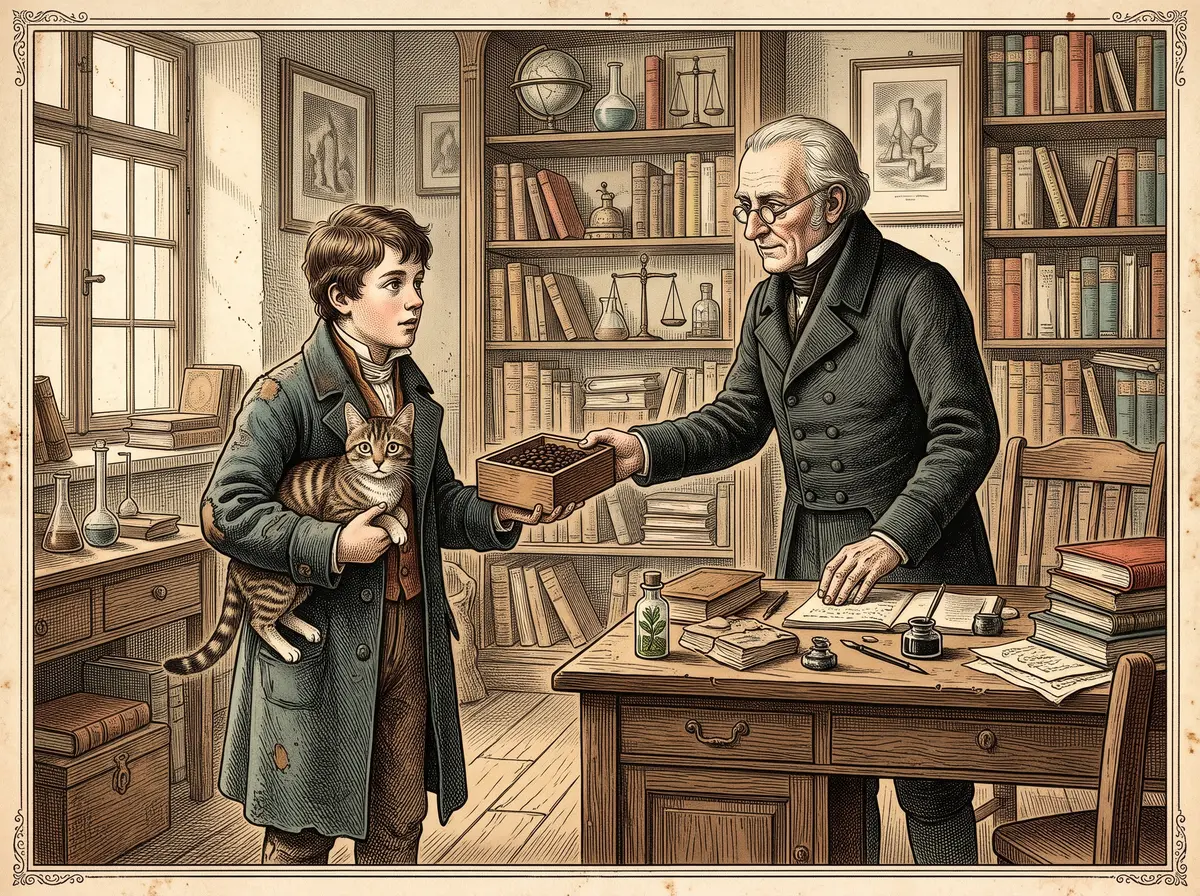
In the autumn of 1819, a young chemistry student named Friedlieb Ferdinand Runge walked into the house of Germany's most famous writer with a cat tucked under his arm. He was there to make its pupils grow huge. The demonstration went well. On the way out, the great man handed him a box of coffee beans, and Runge was so taken with the gift that, by his own telling, he nearly walked off without the cat.
By the Curiosities Desk · · 5 min read · Filed under Chemistry · Today’s round
Part of The Person Who Would Not Drop It
What happened: Caffeine
Runge had come to chemistry through a pharmacy. As a teenage apprentice to his uncle, an apothecary in Lübeck, he spent his days around medicinal plants, including members of the nightshade family. One of them is henbane; another is belladonna, or deadly nightshade. Both contain compounds that make the pupil of the eye open wide. Runge started studying that effect there and kept at it when he went to university. In Jena he extended the work to belladonna and thorn apple, and in 1819 he earned his medical doctorate there with a dissertation on atropine, the main active ingredient of belladonna.
His experiments had a reliable test subject: a cat. A drop of plant extract in its eye, and the pupil would swell wide. Fellow students nicknamed him “Dr. Gift,” German for “Dr. Poison.” By the account of historian J. H. Maar, he took it as a compliment.
Word of the trick reached Johann Wolfgang von Goethe. Goethe, then 70, is remembered for Faust, but he also wrote seriously about plants and color. He knew Runge’s teacher in Jena, the chemist Johann Wolfgang Döbereiner, and through him invited the student to show what he could do. The visit took place on October 3, 1819, at Goethe’s house in Jena.
Most of what we know about the afternoon comes from Runge himself, in a short memoir titled “My Visit to Goethe in 1819.” He wrote it in 1866, close to 50 years later, so the details are a cheerful old man’s memory rather than a lab notebook. In his telling, he arrived in borrowed clothes that didn’t quite fit, cat in hand. He put the extract in the cat’s eye, and the pupil widened while Goethe watched. Goethe was impressed.
Then the poet reached for a box. A Greek admirer had sent him some coffee beans as a delicacy, and Goethe passed them to Runge with a suggestion that he might use them in his investigations. Nobody knows exactly why; one popular history suggests he suspected coffee hid a potent drug. Either way, Runge left so pleased with his prize that he forgot his test subject. As he remembered it, Goethe called after him: “You forgot your assistant.”
Runge went to work. Within months he had pulled a white, bitter, crystalline substance out of the beans, which he called Kaffeebase, or “coffee base.” We call it caffeine. He described it in 1819 in the journal Isis and again in his 1820 book on plant chemistry, Neueste phytochemische Entdeckungen (“Newest Phytochemical Discoveries”). French chemists including Pierre-Jean Robiquet and Pierre-Joseph Pelletier reported the same compound around 1821, but Runge’s publication came first.
Why it was strange: Caffeine
One of the world’s most widely used drugs was found because a cat was brought to a poet’s house to have its eyes dilated. Nobody went looking for caffeine; a poet handed a box of beans to a student he’d just met.
It is also strange how little the discovery did for Runge. He went on to a remarkable career that almost nobody remembers. As a factory chemist in Oranienburg, near Berlin, he distilled coal tar, the sticky waste of gasworks, and found in it phenol and aniline, the starting points for the synthetic dye industry. He made colored dyes from them more than 20 years before William Perkin’s famous mauve of 1856. His employers turned down his plans to develop them. After the factory was sold, the new owner dismissed him in 1852, and he lived his last years in modest circumstances. He died in Oranienburg in 1867.
His habit of bringing animals into the work has company: see The Physicist Who Cleaned His 40-Foot Spectrograph by Sending the Family Cat Through It.
What scientists learned: Caffeine
The cat trick and the coffee beans turned out to be two sides of the same science. Atropine and caffeine are both alkaloids: nitrogen-containing compounds that plants make and that act powerfully on animal bodies.
Atropine works by blocking acetylcholine, a chemical messenger that tells muscles to contract. The iris has a ring-shaped muscle that squeezes the pupil small. Block its signal and the ring relaxes, so the pupil opens wide. Because the effect is so visible, a dilating pupil became a simple way to detect certain plant poisons.
Caffeine blocks a different messenger. As the day goes on, a molecule called adenosine builds up in the brain and binds to receptors that promote drowsiness. Caffeine fits those same receptors without switching them on, so it sits there and keeps adenosine from delivering its sleepy message. In 1833 the chemists Christoph Heinrich Pfaff and Justus von Liebig worked out its formula, C₈H₁₀N₄O₂, and that unusually high nitrogen content helped make it a showcase molecule.
Goethe’s own curiosity about how machines can imitate life shows up in The Mechanical Duck That Fooled Paris With Fake Poop.
How it reaches us today: Caffeine
Caffeine is now among the most widely consumed psychoactive substances on Earth. In the United States, the average adult takes in roughly 280 milligrams a day, about one to two mugs of coffee.
Runge’s other habits left marks too. Late in life he dripped reacting solutions onto blotting paper and watched colored rings creep outward, collecting hundreds of these “self-grown pictures” in privately printed books. Chemists now count them among the forerunners of paper chromatography, a way of separating mixtures by how fast they travel through paper. And when an eye doctor puts drops in your eyes before an exam, the drugs are doing what Runge’s extract did to the cat.
Another chemist whose odd persistence paid off is in The Alchemist Who Boiled Urine Looking for Gold and Found Phosphorus.
Runge, still at the bench after the factory let him go, sits with the others in The Person Who Would Not Drop It.
Fun fact: Caffeine
Runge named aniline Kyanol, “blue oil,” after the vivid blue it turned when treated with bleach. Today most of the indigo that dyes blue jeans is made starting from aniline.
A note on safety: belladonna and other nightshades are seriously poisonous, and their effects on the eye are not a home experiment. If someone may have swallowed part of one of these plants, contact a poison control center or emergency services right away.
Sources: Caffeine
- J. H. Maar, “Friedlieb Ferdinand Runge (1794–1867) – An Unusual Chemist”, Substantia, 2024 — a detailed biography drawing on Runge’s own 1866 account of the Goethe visit, with dates for the caffeine publications.
- Claus Priesner, “Runge, Friedlieb Ferdinand”, Neue Deutsche Biographie 22 (2005) — the standard German biographical reference, covering his doctorate, coal-tar work, and dismissal.
- Andrea Sella, “Shades of chromatography”, Chemistry World — on Runge’s self-grown pictures, the Goethe meeting, and his dye work.
- Franklyn Rocha Cabrero and Richard J. Hamilton, “Caffeine Withdrawal”, StatPearls, NCBI Bookshelf — on how caffeine blocks adenosine receptors and typical daily intake.