The Snake Dream Told at a Birthday Party for a Molecule — and the Chemists Who Spent a Century Arguing Over It
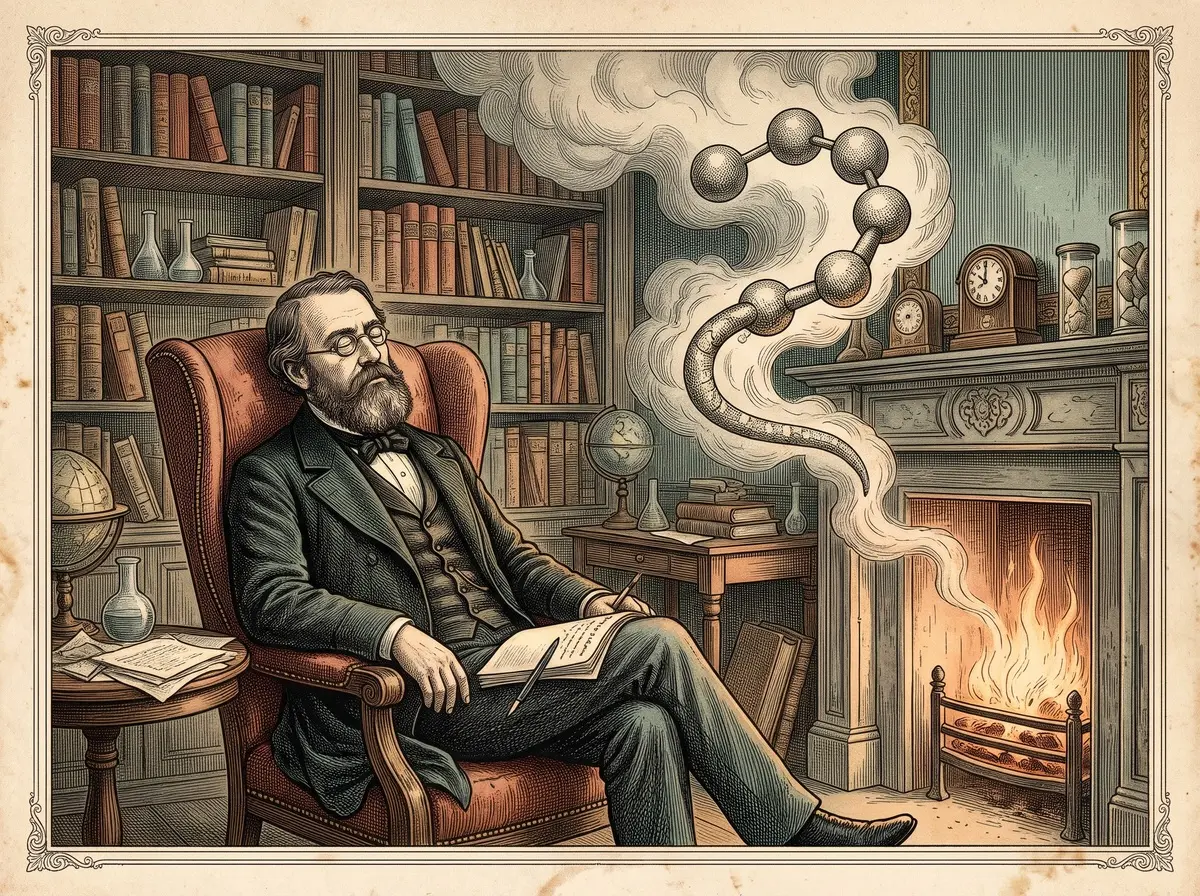
In March 1890, the chemists of Germany threw a party in Berlin for a molecule. The guest of honor was benzene, or rather the 25th anniversary of the paper that first drew it as a ring. And when August Kekulé, the paper's author, stood up to give his thank-you speech, he told the room that the idea had come to him while he was dozing by the fire, watching a snake bite its own tail.
By the Curiosities Desk · · 5 min read · Filed under Chemistry · Today’s round
Part of The Version Everyone Remembers
What happened: Kekule's Benzene Dream
Benzene was a puzzle that had nagged chemists since Michael Faraday isolated it in 1825. Each molecule held six carbons and six hydrogens, and that didn’t fit the rules. Carbon was known to form four bonds, and a straight chain of six carbons should hold far more than six hydrogens. Benzene also behaved oddly: it was remarkably stable, and it was the parent of a whole family of fragrant “aromatic” compounds.
In January 1865, Kekulé, then a professor in Ghent, Belgium, published a short paper in French proposing an answer: the six carbons were joined in a closed ring, alternating single and double bonds, with one hydrogen on each corner. A longer German version followed in 1866. The idea worked so well that it became the foundation of a booming dye and drug industry, and by 1890 the German Chemical Society decided it deserved a celebration. It became known as the Benzolfest, from the German word for benzene.
Kekulé, then 60, gave a long speech that was printed in the society’s journal, the Berichte. In it he told two stories. The first was set in London around 1855, when he was a young chemist riding home on the open top deck of a horse-drawn omnibus. He fell into a reverie, he said, and “the atoms were gambolling before my eyes,” pairing up and forming chains, until the conductor’s cry of “Clapham Road” woke him. That vision, he said, led to his theory of how atoms link into structures.
The second story was set in Ghent. He was trying to write his textbook, but it wasn’t going well. He turned his chair to the fire and drifted into half-sleep. Again the atoms danced, this time twisting in long, snake-like rows. Then: “One of the snakes had seized hold of its own tail, and the form whirled mockingly before my eyes.” He woke, he said, and spent the rest of the night working out what it meant. Historian Alan Rocke has dated the moment, if it happened as described, to early 1862.
Kekulé closed with a line that chemists have quoted ever since: “Let us learn to dream, gentlemen,” followed by a warning not to publish those dreams until they had been “put to the proof by the waking understanding.”
Why it was strange: Kekule's Benzene Dream
It was a delightful story, and that was part of the trouble. A snake swallowing its tail is the ouroboros, one of the oldest symbols in the world, and the tale arrived 25 years after the fact, at a party, from a man being toasted. The omnibus vision and the fireside vision share almost the same shape, a doze followed by dancing atoms, which made some historians wonder whether either was a literal memory.
Chemists had been joking about it before Kekulé ever told it in public. In 1886, a parody of the society’s journal called the Berichte der Durstigen Chemischen Gesellschaft (the “Journal of the Thirsty Chemical Society”) pictured benzene as six monkeys clutching one another in a ring. Some historians think the snake story was already going around by word of mouth; others wonder whether Kekulé’s 1890 version was partly a playful nod back to the monkeys.
Then, in 1984, chemist John Wotiz of Southern Illinois University and his graduate student Susanna Rudofsky argued that Kekulé may have misrepresented how he reached his idea, in part to downplay earlier ring-like proposals by others, especially the Viennese schoolteacher Josef Loschmidt, who sketched possible benzene structures in an 1861 booklet. As Wotiz reportedly put it, “you don’t have to give footnotes for a dream.” The dispute grew bitter enough to fill a contentious 1990 symposium in Boston, a 1993 book called The Kekulé Riddle, and even lawsuits.
Other famous science stories have faced the same kind of test; see The Bathtub That Took 24 Hours to Drain to Test a Myth.
What scientists learned: Kekule's Benzene Dream
Whether or not the snake was real, the ring was. Kekulé’s structure explained why benzene had exactly six hydrogens: in a closed loop, each carbon uses two bonds to hold its neighbors, one more for a double bond, and the last for a single hydrogen. In 1872 he refined the idea, suggesting that the single and double bonds rapidly swap places. Modern chemistry describes it a little differently. Benzene’s bonding electrons are delocalized, meaning they are shared evenly around the whole ring instead of sitting in fixed double bonds, which is why all six carbon-carbon bonds turn out to be the same length and why the ring is so hard to break.
The debate over the dream taught historians something too. Rocke, who has studied Kekulé’s letters closely, says he is “strongly inclined to trust Kekulé’s sincerity,” noting that by 1890 no one, including Loschmidt, had contested his priority. Even so, he concedes that no one can know for certain. Memories of a flash of insight, told decades later, are notoriously easy to polish. The honest answer is that the snake dream is possible, unproven, and probably a simplified version of years of hard thinking.
Another chemist whose big idea gathered legends of its own appears in The Blank Squares That Predicted Three Undiscovered Elements.
How it reaches us today: Kekule's Benzene Dream
The hexagon Kekulé drew is everywhere in chemistry. Benzene rings sit inside aspirin, many dyes, plastics like polystyrene, and countless other medicines and materials.
The dream lives on in a different way. It became the most famous example of the idea that creativity can strike in half-sleep. Kekulé’s own advice is still the best way to read it: dream freely, then check.
For a chemistry idea that didn’t survive the waking understanding, see Polywater: The New Form of Water That Almost Ate the World.
The snake at the Benzolfest is one of the stories on The Version Everyone Remembers.
Fun fact: Kekule's Benzene Dream
Kekulé wasn’t always so poetic about his breakthrough. In a January 1865 letter to his former student Adolf Baeyer, he complained of “chemical constipation,” called the benzene paper he was about to send off “a swindle,” and warned: “the good parts are not new, and the new parts not good.”
Sources: Kekule's Benzene Dream
- August Kekulé, “Benzolfest: Rede,” Berichte der Deutschen Chemischen Gesellschaft 23 (1890): 1302–1311
- Alan J. Rocke, “It Began with a Daydream: The 150th Anniversary of the Kekulé Benzene Structure,” Angewandte Chemie International Edition (2015)
- Papers of John H. Wotiz — Science History Institute Archives
- Mike Sutton, “Kekulé’s dream,” Chemistry World
- Philip Ball, “Chemistry in soft focus” (PDF)