The Cold Researchers Who Stood Volunteers in a Drafty Hallway in Wet Swimsuits — and Got Two Opposite Answers
Fresh out of a hot bath, a group of British volunteers stepped into a drafty passage in nothing but their bathing suits and stood there, dripping and undried, for half an hour. Then they pulled on wet socks. Nobody was being punished. They were on holiday, and the scientists watching them were trying to settle one of the oldest pieces of parental advice in the world: does getting cold give you a cold?
By the Curiosities Desk · · 5 min read · Filed under Medicine · Today’s round
What happened: The Cold Researchers Who Stood Volunteers in a Drafty Hallway in Wet
In the summer of 1946, a cluster of wartime huts on the edge of Salisbury, England, got a strange new job. The buildings had been put up during World War II as the Harvard Hospital, funded by the American Red Cross and Harvard University to study wartime epidemics. After the war, the British virologist Christopher Andrewes took the site over for the Medical Research Council, and it became the Common Cold Unit. The first trial started on 17 July 1946.
The unit’s big idea was the volunteer holiday. People aged 18 to 50 answered adverts offering ten free days in the countryside, with travel paid and a little pocket money. They lived in pairs in small flats, kept well away from everyone else. Meals arrived in a box outside the door. They could go for walks, as long as they avoided people, places, and vehicles. Doctors and nurses visited in gowns and masks. After three days of quarantine to make sure nobody had arrived with a cold, many volunteers got drops in the nose containing fluid from people with colds, while others got harmless dummy drops. Then everyone kept a diary of sniffles.
That set-up made the unit a perfect place to test folk wisdom. If chilly drafts and wet feet really caused colds, here was a chance to prove it under controlled conditions.
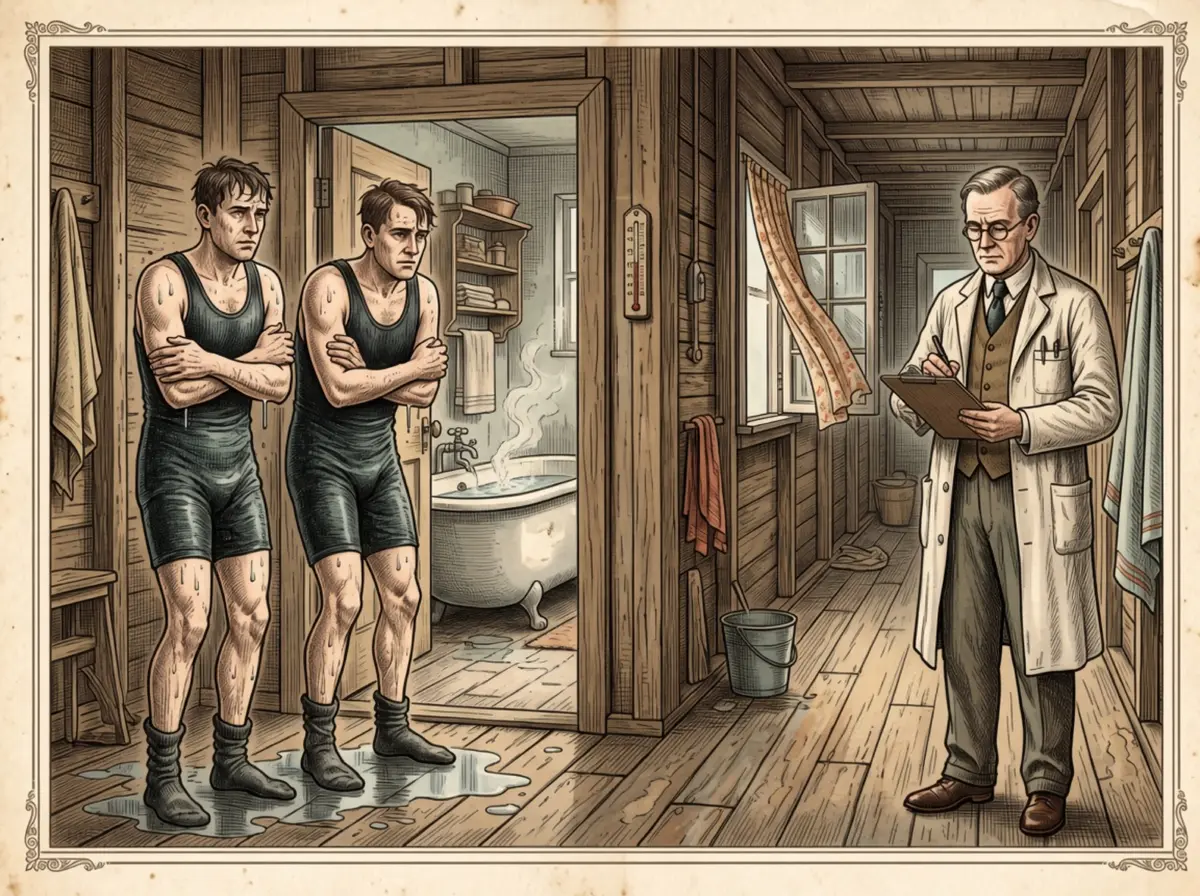
So Andrewes’s team designed the bath-and-hallway trial. Volunteers took a hot bath, then stood undried in a drafty passage in bathing suits for 30 minutes, then wore wet socks for a while afterward. A comparison group was kept snug and warm. Some volunteers in each group also got cold-virus drops.
The first run looked like a win for grandmothers everywhere. According to a 1949 Time report on a lecture Andrewes gave about his work, the chilled volunteers caught colds more readily than the warm ones.
Then the scientists did what scientists are supposed to do: they ran it again. The second time, the result flipped. As Andrewes put it, “we were foolish enough to repeat this experiment—with a contrary result.”
Why it was strange: The Cold Researchers Who Stood Volunteers in a Drafty Hallway in Wet
The experiment didn’t fail because anything went wrong. It “failed” because it worked exactly as a good experiment should, and the answer was not the one anyone wanted.
A single result that matches what everyone already believes is very tempting to publish. Andrewes’s team checked it, and the check fell apart. The one firm conclusion they could draw, he said, was a negative one: chilling on its own does not produce a cold. Volunteers who got cold but got no virus didn’t come down with anything. In a 1948 lecture he had already said it seemed “safe to agree that chilling alone cannot give you a cold,” while admitting “we do not know why this is.” He also noted that Arctic explorers, far from other people, didn’t get colds at all.
There’s a quiet comedy in that. A team spent years carefully freezing volunteers to confirm the most familiar piece of health advice in the language, and the most solid thing they could report was that it was murkier than anyone thought.
The unit had plenty of other gentle oddities. One employer sent factory workers “on holiday” there on full pay, and one couple turned up on their honeymoon. Another cold that went down in history: The Head Cold That Made Apollo 7 Refuse Its Helmets.
What scientists learned: The Cold Researchers Who Stood Volunteers in a Drafty Hallway in Wet
The central lesson is simple: a cold is an infection. You need the virus. Being chilly is not a substitute for catching it from someone.
Later studies kept circling the question. A 1968 study in the New England Journal of Medicine inoculated volunteers with rhinovirus, the most common cold virus, and exposed some of them to rooms near freezing. It found no difference in who got infected, how sick they got, or how fast they recovered.
But “chilling alone” isn’t the whole story either. In 2005, researchers at Cardiff University’s Common Cold Centre had 90 volunteers sit with their bare feet in cold water while 90 others kept their feet in an empty bowl. Over the next four to five days, 13 of the chilled group (14.4 percent) reported a cold, compared with 5 of the controls (5.6 percent). The authors suggested that chilling might wake up a virus some people were already carrying without symptoms, though they called for more research.
In 2015, a Yale team added a possible mechanism. In mouse airway cells, rhinovirus copied itself more efficiently at 33°C, roughly the temperature inside the nose, than at 37°C, core body temperature, because the cells’ early-warning immune response was weaker in the cooler cells. That was cell work, not proof about people, but it hints at why a chilly nose might matter.
Not every experiment gets the answer it was built for: The Navy Tried Everything to Give 100 Sailors the Flu — and Not One Got Sick.
How it reaches us today: The Cold Researchers Who Stood Volunteers in a Drafty Hallway in Wet
The Common Cold Unit never found a cure. But over more than 40 years and roughly 20,000 volunteers, it found many of the viruses behind colds. In 1965 its scientists, led by David Tyrrell, described a cold virus that June Almeida later photographed and helped name coronavirus. The unit closed around 1989 to 1990.
Its biggest legacy may be the method. Deliberately and carefully infecting healthy volunteers, now called a human challenge trial, is still used to test vaccines and treatments. And the advice your family gave you, to put on a coat, lands somewhere in the middle: the cold won’t give you a cold, but staying warm may not hurt.
Colds have led researchers down other unexpected paths, too: The Head Cold That Showed Alexander Fleming Your Tears Kill Germs — and the Lab Staff Paid Threepence to Cry.
Fun fact: The Cold Researchers Who Stood Volunteers in a Drafty Hallway in Wet
The Common Cold Unit advertised itself as a holiday, and it worked. Departing volunteers were even handed adverts to pass on to friends and workmates, so every happy guest became a recruiter.
Sources: The Cold Researchers Who Stood Volunteers in a Drafty Hallway in Wet
- Medicine: Science v. the Cold — Time, 21 November 1949 (contemporary report of Andrewes’s lecture: the hot bath, drafty passage, bathing suits, wet socks, and his “contrary result” quote)
- Johnson & Eccles, “Acute cooling of the feet and the onset of common cold symptoms,” Family Practice, 2005 — Cardiff University repository (primary source: the 180-volunteer foot-chilling trial and its results)
- The Harvard Hospital and Common Cold Unit — Salisbury Healthcare History booklet (the site’s origins, first trial date, volunteer routine, 20,000 volunteers, coronavirus)
- No, You Don’t Get Colds from Being Cold — JSTOR Daily (Andrewes’s 1948 Royal Society of Arts lecture quotes and later chilling studies)
- Cold virus replicates better at cooler temperatures — Yale News, 2015 (the PNAS study on rhinovirus at 33°C vs 37°C in mouse airway cells)
Most colds clear up on their own in a week or so. If one hangs on much longer, or comes with a high fever or trouble breathing, it’s worth checking in with a doctor.