The Scientist Behind It · Medicine
The Coney Island Sideshow That Saved Premature Babies for a Quarter a Look — Run by a 'Doctor' With No Medical Degree
In 1920, a newborn girl in New York weighed about two pounds, and the hospital told her father there was no real chance she would live. So he wrapped her in a blanket, hailed a taxi, and took her to Coney Island. Not to a hospital ward, but to a boardwalk attraction between the rides and the freak shows, where a man in a white coat kept tiny babies alive in glass boxes, and paying customers lined up to watch.
By the Curiosities Desk · · 5 min read · Filed under Medicine · Today’s round
Part of The Person Who Would Not Drop It
What happened: Coney Island's Incubators
The girl was Lucille Horn, and the man was Martin Couney, a showman who ran “infant incubator” exhibits at amusement parks and world’s fairs from 1896 into the 1940s. Horn, who had been born a twin (her twin died at birth), spent about six months in one of his incubators. She told her story to NPR’s StoryCorps in 2015, at 94.
Couney’s own story is harder to pin down, because he told so much of it himself. He said he had studied medicine in Leipzig and Berlin and trained in Paris under Pierre Budin, one of the founders of care for premature babies. Researchers who have since dug through the archives, including the journalist Claire Prentice and the biographer Dawn Raffel, found no record of him at any medical school, and the U.S. National Library of Medicine could not locate a thesis. Records suggest he was born Michael Cohen in 1869 in Krotoschin, then part of Prussia, and first arrived in the United States in 1888, at about 19. As far as anyone can tell, he never qualified as a doctor.
What he did know was incubators, and how to make crowds care about them. By his own account, his first show was the Kinderbrutanstalt, or “child hatchery,” at the Berlin exposition of 1896, where he claimed none of the babies died. In 1897 he brought the idea to Earl’s Court in London. English physicians refused to lend him local infants, so premature babies were brought over from Paris in wicker baskets. Shows followed in Omaha in 1898 and Buffalo in 1901, where Scientific American covered the exhibit. Around 1903, Couney settled at Coney Island for good.
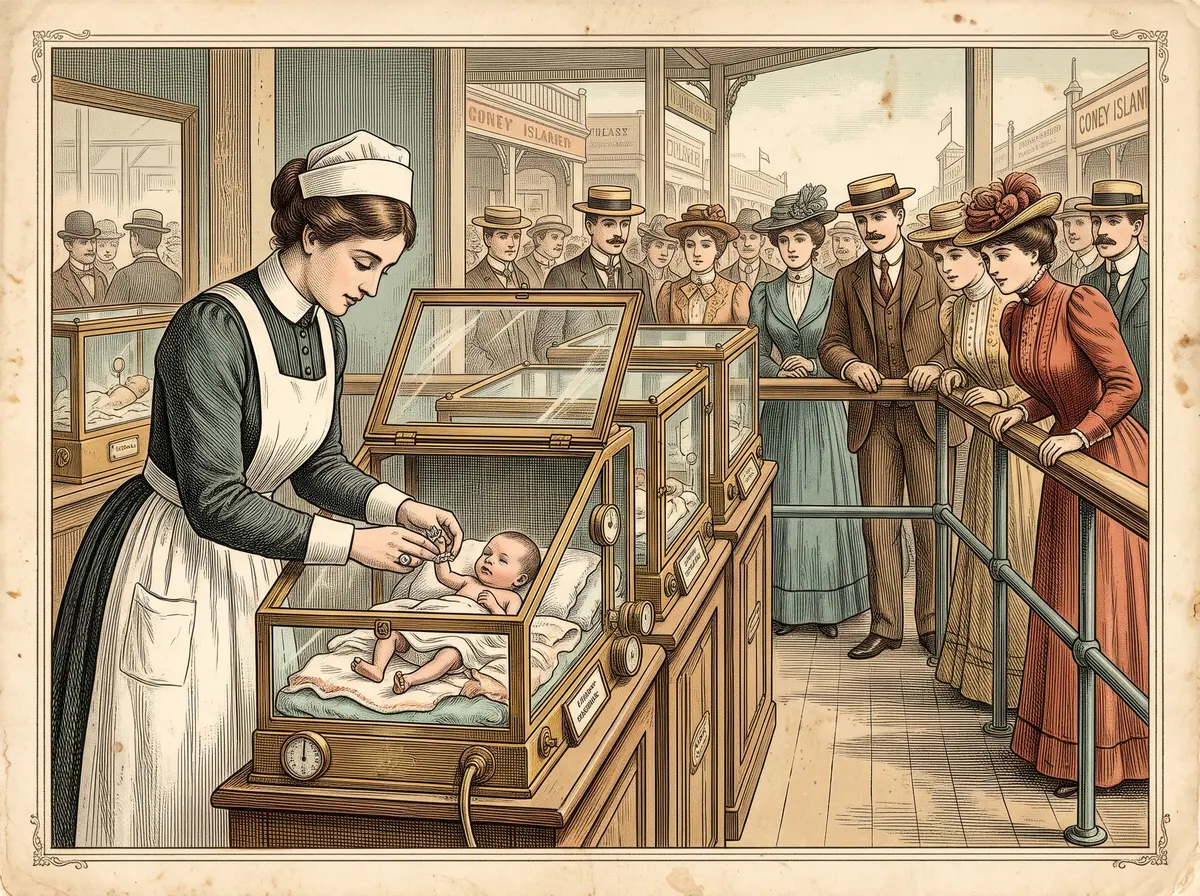
The setup barely changed for four decades. Visitors paid 25 cents to walk past rows of incubators. Parents paid nothing. Couney’s staff included trained nurses and wet nurses (women hired to breastfeed babies who were not their own), who were held to a strict diet. One long-time nurse, Madame Louise Recht, fed the smallest babies by spoon. When the amusement park Dreamland burned in 1911, the babies were carried out and moved to Couney’s other exhibit at Luna Park.
Couney’s own daughter, Hildegarde, was born about six weeks early in 1907, weighing roughly three pounds, and spent her first months in one of the exhibit’s incubators. She grew up to work beside him as a nurse.
Why it was strange: Coney Island's Incubators
The most advanced care for premature babies in America was, for years, a carnival act. Barkers shouted “Don’t pass the babies by!” A sign at the entrance read “All the World Loves a Baby.” At the 1933 Chicago fair, the incubators sat near the fan dancer Sally Rand’s show.
Many doctors were uneasy, and with reason. An 1898 editorial in the British medical journal The Lancet protested turning sick infants into a public show, and the New York Society for the Prevention of Cruelty to Children repeatedly accused Couney of exploitation, though none of its complaints was sustained. Yet few American hospitals had incubators, so physicians quietly sent him the babies they could not help. The arrangement was uncomfortable on every side. It also worked.
Couney isn’t the only person on this site who pushed past a closed door; more of them are gathered in The Person Who Would Not Drop It.
What scientists learned: Coney Island's Incubators
Premature babies struggle with three things above all: staying warm, eating enough, and fighting off infection. Their skin is thin and they have little body fat, so they lose heat fast. Warm-air incubators had been used at the Paris Maternité hospital since 1880, and Budin added rules about hygiene, isolating the babies, and feeding them breast milk in measured amounts. Couney’s shows ran on those principles: steady warmth, clean hands, careful feeding, and nurses watching around the clock.
His survival numbers are impressive but shaky. Couney said he took in about 8,000 babies and saved about 6,500, figures nobody has been able to verify. A better-documented count comes from the 1939–40 New York World’s Fair, where a report in the Journal of the American Medical Association listed 96 babies admitted and 10 deaths. Even that has a catch: the sickest babies often died before they could be brought in.
The medical establishment did take notes. The Chicago pediatrician Julius Hess, who built one of America’s first hospital units for premature infants, credited Couney in his 1922 textbook. Hess’s ward used the same toolkit, now inside a hospital instead of beside a roller coaster.
Another early step in newborn care came from a blood sample left in the sun: The Blood Sample Left on a Sunny Windowsill — and Why Jaundiced Newborns Now Sleep Under Blue Lights.
How it reaches us today: Coney Island's Incubators
Couney closed his Coney Island exhibit in 1943, after New York Hospital (Cornell’s teaching hospital) opened its own premature-infant station. According to the pediatrician William Silverman, who wrote the first detailed history of the shows, Couney summed it up simply: “My work is done.” He died in 1950.
Today, every major hospital has a neonatal intensive care unit, or NICU, the direct descendant of those glass boxes. In the United States, about one baby in ten is born preterm, and babies born far earlier and smaller than Lucille Horn now routinely go home. Horn herself lived to 96. In Chicago, Couney reportedly donated an ambulance that became one of the first vehicles in the country dedicated to carrying premature babies.
For a stranger chapter in the history of reproductive medicine, see The Frog in the Hospital Basement That Told You If You Were Pregnant.
Fun fact: Coney Island's Incubators
To show visitors just how tiny the babies were, Madame Recht wore a large diamond ring and would slip it over a baby’s hand and up onto its wrist like a bracelet.
If you’re a parent with a baby in the NICU, you’re far from alone. Hospital social workers and groups like the March of Dimes offer support for families going through it.
Sources: Coney Island's Incubators
- William A. Silverman, “Incubator-Baby Side Shows”, Pediatrics 64 (1979): 127–141 — the foundational history, including the Berlin, London, and World’s Fair shows, the 1940 JAMA figures, and Couney’s closing
- Claire Prentice, “The Man Who Pretended to Be a Doctor Ran a World’s Fair Attraction That Saved the Lives of Thousands of Premature Babies”, Smithsonian (2016) — on Couney’s missing credentials, the cruelty-society complaints, and Julius Hess
- StoryCorps / NPR, “Babies on Display: When a Hospital Couldn’t Save Them, a Sideshow Did” (2015) — Lucille Horn’s account in her own words
- The Embryo Project Encyclopedia, Arizona State University, “Martin Couney and Incubator Exhibits from 1896 to 1943” — exhibit timeline, admission, staffing, and survival claims