Failed Experiments · Chemistry
The Corrosion Cure That Worked So Well It Grew Seaweed on the Navy's Ships
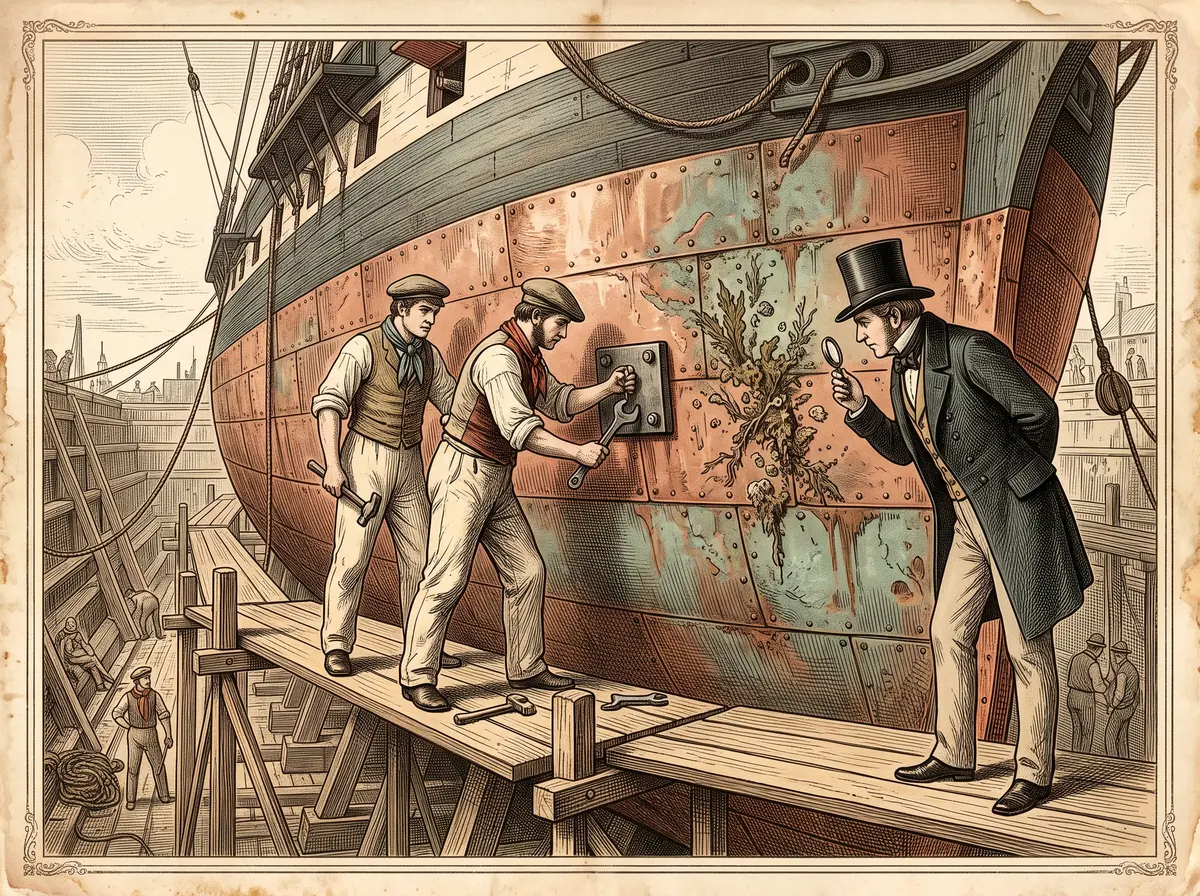
In February 1824, at Portsmouth harbour, workmen fixed lumps of iron to the copper-covered bottoms of Royal Navy ships on the instructions of Sir Humphry Davy, President of the Royal Society. The idea was simple: let the iron corrode so the expensive copper wouldn't. It worked. The copper stopped dissolving. And before long, some of the protected hulls were coming back furred with weeds and crusted with barnacles, because the copper's slow dissolving had been the very thing keeping them clean.
By the Curiosities Desk · · 5 min read · Filed under Chemistry · Today’s round
What happened: Cathodic Protection
By the 1820s, the Royal Navy had been wrapping its wooden hulls in thin copper sheets for decades. The practice took off after HMS Alarm was sheathed in 1761 and came home from the West Indies free of shipworm, the wood-boring mollusk that could riddle a hull, and almost free of fouling, the weeds and shellfish that cling to a ship’s bottom and slow it down. By the 1780s, the whole fleet was coppered.
Copper had one expensive habit: in seawater it slowly dissolved, and the sheets had to be replaced. In 1823, the Navy Board asked Davy why its copper was wearing away so fast, and whether anything could be done.
Davy was the most famous chemist in Britain. He had isolated sodium and potassium with electricity and invented the miners’ safety lamp. He treated the Navy’s request as a patriotic duty and took on the work personally, with his former assistant Michael Faraday helping with the experiments.
His reasoning came from electrochemistry, the study of how chemical reactions and electric currents are linked. When two different metals touch in salt water, they form a tiny battery, and the more reactive metal corrodes in place of the other. Davy found that a small piece of zinc, tin, or iron attached to copper sheeting stopped the copper from dissolving almost completely.
On 22 January 1824, he read a paper to the Royal Society announcing the result. A month later, trials began at Portsmouth on the royal yacht Royal George, the 28-gun HMS Samarang, and the brig HMS Manly. Cast iron was cheap, so most ships got iron “protectors,” as they came to be called. Davy published two more papers on the work, in June 1824 and June 1825.
Then the reports started coming in. Some protected ships had picked up weeds and barnacles. Newspapers claimed the Samarang was one of them. Davy went to Portsmouth when she was docked, found her bottom clean, and called the report “false and entirely unfounded.” But other ships really were fouled, and captains who cared about speed were not happy. On 19 July 1825, the Admiralty ordered the Navy Board to discontinue the project. The fleet went back to letting its copper wear away.
Why it was strange: Cathodic Protection
Most failed experiments fail because the idea doesn’t work. This one failed because it worked exactly as promised.
Nobody, Davy included, had fully appreciated what the corroding copper was doing. As the sheets dissolved, they released copper compounds that are toxic to the larvae of barnacles and other sea creatures, and the constantly wearing surface gave nothing a chance to settle. Davy came to see the link himself. Writing in 1825 about why shellfish don’t stick to copper, he concluded, “It is the solution by which they are prevented.” Protect the copper, and you switch off its built-in antifouling. It’s a reminder, like The Navy That Swapped Lemons for Limes — and Forgot How to Cure Scurvy, that a fix can quietly remove something nobody knew they were relying on.
What scientists learned: Cathodic Protection
The chemistry Davy described was right, and it is still the basis of what engineers now call cathodic protection. In any corrosion cell, one metal gives up electrons and dissolves (the anode) while the other is protected (the cathode). Attach a more reactive “sacrificial” metal, and it becomes the anode and corrodes in place of the metal you care about.
The details of the failure turned out to be more nuanced than “it grew weeds.” Davy’s own trials showed that the amount of protector mattered. With too much iron, roughly one part to every 35 to 80 parts of copper, the copper became coated with chalky mineral deposits, and weeds eventually took hold. At around one part in 150, the copper stayed clean while dissolving only slightly. A 2024 review by corrosion engineers marking the 200th anniversary suggests some captains may have fitted extra iron because it was cheap, and that ships sitting at anchor fouled more readily than ships under sail. Davy later recommended zinc over iron, but it was tried on only one ship in service, which came back “perfectly clean.”
After Davy’s death in 1829, Faraday carried the work forward. In 1834 he worked out the exact relationship between electric current and the amount of metal that corrodes, the foundation for designing these systems by calculation. The roots of it all go back to From Frog Legs to Lithium: A Short History of the Battery.
How it reaches us today: Cathodic Protection
About a century after Davy, cathodic protection came back, on metal that had no reason to fear barnacles. It began to be applied to steel gas pipelines in 1928 and spread widely through the 1930s. Today it guards buried pipelines, offshore oil platforms, bridges, harbour structures, and the inside of many home water heaters. Navies fit it to virtually every ship and submarine, now pairing it with antifouling paint so the hull stays both whole and clean. The blocks of zinc or aluminium you might see bolted near a boat’s propeller are Davy’s protectors, two centuries on. His experiment belongs on the shelf with The Experiment That Did Not Come Out: a failure in 1825 that turned out to be early rather than wrong.
Fun fact: Cathodic Protection
In his first laboratory tests, Davy found that “a piece of zinc as large as a pea, or the point of a small iron nail” was enough to protect roughly 40 to 50 square inches of copper from seawater.
Sources: Cathodic Protection
- Humphry Davy, “On the Corrosion of Copper Sheeting by Sea Water, and on Methods of Preventing This Effect; And on Their Application to Ships of War and Other Ships”, Philosophical Transactions of the Royal Society of London 114 (1824)
- Humphry Davy, “Further Researches on the Preservation of Metals by Electro-Chemical Means”, Philosophical Transactions of the Royal Society of London 115 (1825)
- Institute of Corrosion, “200 Years On: Sir Humphry Davy and Cathodic Protection” (2024)
- British Association for Romantic Studies, “Archive Spotlight: Humphry Davy’s Notebooks and the Navy”
- Encyclopaedia Britannica, “Sir Humphry Davy, Baronet: Later years”