The Scientist Behind It · Archaeology
The Diplomat Who Bought a Lost Maya City for $50 — and Closed the Deal With the Buttons on His Coat
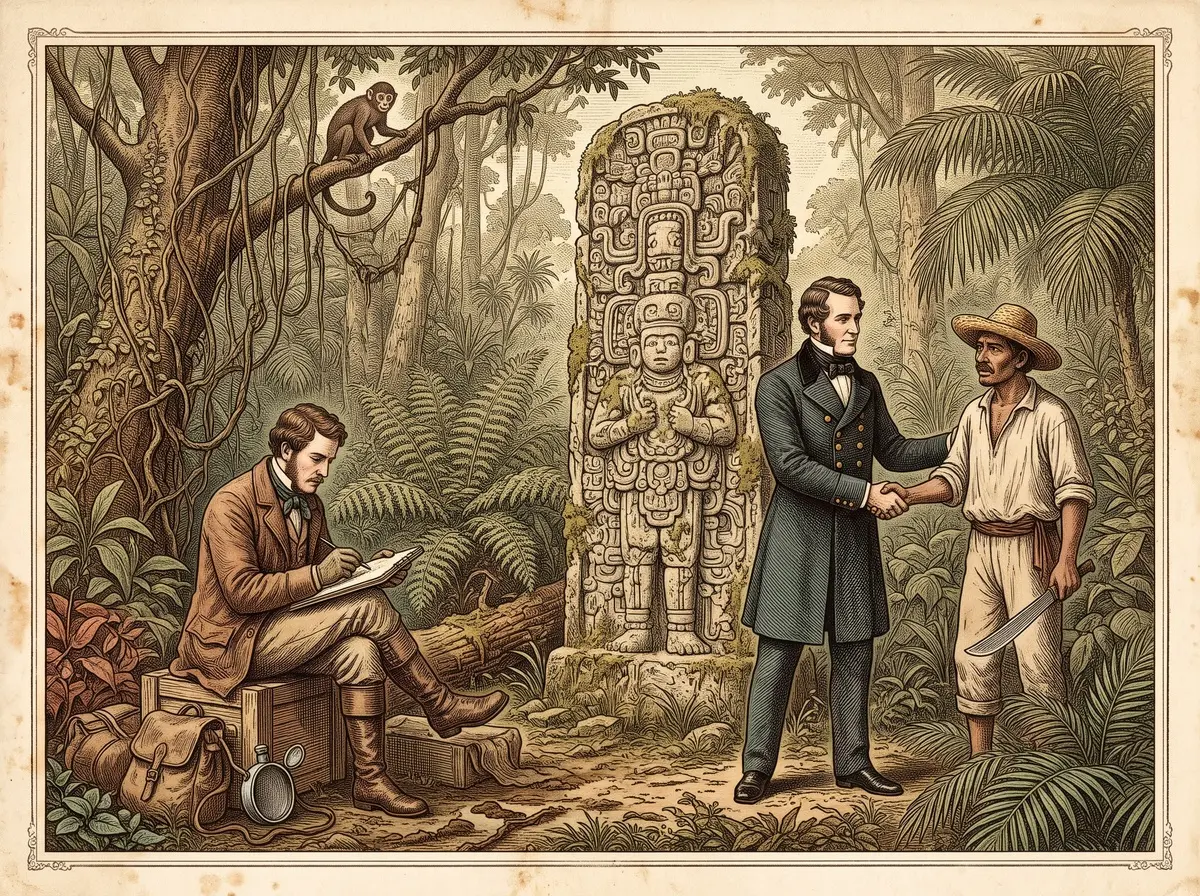
In 1839, deep in the forest of western Honduras, an American diplomat named John Lloyd Stephens offered a local farmer fifty dollars for an entire ruined city. The farmer stared at him as if trying to decide which of them had lost his mind. To settle the matter, Stephens opened his trunk and put on his official diplomatic coat, the one with "a profusion of large eagle buttons." It worked.
By the Curiosities Desk · · 5 min read · Filed under Archaeology · Today’s round
Part of The Person Who Would Not Drop It
What happened: Copan in 1839
Stephens was a New York lawyer turned travel writer whose 1837 book about Egypt and the Holy Land had made him famous. In 1839, President Martin Van Buren sent him to Central America on a diplomatic mission to the Federal Republic of Central America. The timing was terrible: the republic was coming apart in civil war. Stephens had also read scattered reports of overgrown stone ruins in the region, and he quietly planned to use the trip to find them.
He brought a partner, Frederick Catherwood, an English architect and artist who had spent years drawing ancient monuments in Egypt and the Middle East. The two sailed from New York on October 3, 1839, and by late that year they had made their way to the village of Copán, close to the Guatemalan border.
What they found there stunned them. Their guide, José, hacked a path through the forest with a machete. Across a river rose a stone wall, and beyond it, in Stephens’s words, “a square stone column, about fourteen feet high, and three feet on each side,” carved on every face. The guide called it an “Idol.” Then came another, and another. After several hours of scrambling, Stephens returned to Catherwood and “reported upwards of fifty objects to be copied.”
Copying them proved miserable. Stephens found his partner “standing with his feet in the mud,” drawing “with his gloves on, to protect his hands from the moschetoes.” The carvings were so intricate that one seemed, Catherwood felt, to “defy his art.”
Meanwhile Stephens was “brooding over the title-deeds” of the man who controlled the land, Don José María. It turned out Don José María didn’t own the site outright; he held a lease from a Don Bernardo de Aguila, with three years left to run. Stephens wanted to come back with workers and tools, but he didn’t dare spend the money without the right to dig. So he offered to buy it.
He later explained the market with a straight face: “The reader is, perhaps, curious to know how old cities sell in Central America. Like other articles of trade, they are regulated by the quantity in market, and the demand.” His offer was fifty dollars. Don José María, Stephens wrote, “thought me only a fool; if I had offered more, he would probably have considered me something worse.” The farmer said he would think it over and talk to his wife. He worried about trouble with the government, and Stephens’s letters of recommendation didn’t quite calm him. The coat did. Don José María “could not withstand the buttons on my coat.” Stephens summed up the deal in one line: “There was never any difficulty about price.”
Why it was strange: Copan in 1839
Stephens wasn’t buying the city to live in it. He had a much bigger plan, and he pitched it to Catherwood as “an operation”: buy Copán, “remove the monuments of a bygone people,” and ship them to “the great commercial emporium,” meaning New York, to found “a great national museum of American antiquities.” The carved stones stood on a river that, he noted, emptied “into the same ocean by which the docks of New York are washed.”
The ocean was willing, but the river was not. There were rapids downstream that locals told him were impassable. His fallback plan was to cut one monument into pieces and make casts of the rest. Neither ever happened, and Stephens went home with something lighter: notebooks and Catherwood’s drawings.
Treasure hunters of other eras were not always so restrained; compare The Circus Strongman Who Found Egypt’s Greatest Tomb.
What scientists learned: Copan in 1839
The book Stephens published in 1841, Incidents of Travel in Central America, Chiapas, and Yucatan, with Catherwood’s illustrations, was hugely popular and changed how outsiders saw the Americas. At the time, many writers assumed that monuments this sophisticated must have been built by some far-off people: Egyptians, wandering Israelites, or survivors of Atlantis. Stephens, after visiting Copán, Palenque, and Uxmal, rejected those theories and argued that the cities, and the writing carved on them, were homegrown: built by people native to the Americas. Modern research has borne him out. The builders were the ancestors of the Maya people who still live in the region, and his argument helped lay the groundwork for modern Maya studies.
Catherwood’s careful drawings mattered just as much. His views of buildings are regarded as highly accurate, accurate enough that later researchers have used them to help restore the temples he drew. Today we know Copán was a major Maya city, ruled by a dynasty of sixteen kings founded in AD 427 and largely abandoned by the early 900s.
Stephens’s diplomatic mission went less well. An obituary in Putnam’s Monthly later said he “travelled over all Guatemala looking for the government to which he was accredited, and which he never could find.”
Another explorer whose enthusiasm outran his caution appears in The Man Who Found Troy — and Dug Straight Through It.
How it reaches us today: Copan in 1839
Stephens’s dream of moving Copán to New York never came true, which turned out to be a good thing. The city stayed where its builders put it. In the 1890s, Harvard’s Peabody Museum ran expeditions there under an agreement with Honduras that let it take half of what it found, though it ended up taking far less. Its workers uncovered Copán’s Hieroglyphic Stairway, a 64-step inscription recording the city’s rulers from AD 425 to 755 and the longest known hieroglyphic text in the Americas. The steps had slumped out of order over the centuries, and researchers are still reconstructing their sequence today.
In 1980, UNESCO named the Maya Site of Copán a World Heritage Site. It belongs to Honduras, not to anyone with fifty dollars and a good coat.
Stephens, still writing the cities down after the fifty-dollar sale, sits with the others in The Person Who Would Not Drop It.
Fun fact: Copan in 1839
Stephens and Catherwood had been handing out medicine in the village, and Don José María’s wife was one of their patients, suffering from rheumatism. Stephens wrote that his offer for the city surprised the farmer about as much as if he had asked to buy “his poor old wife, our rheumatic patient, to practise medicine upon.”
Sources: Copan in 1839
- John Lloyd Stephens, Incidents of Travel in Central America, Chiapas and Yucatan, Chapter 5 (Wikisource)
- John Lloyd Stephens, Incidents of Travel in Central America, Chiapas and Yucatan, Chapter 6: “Buying a City” (Wikisource)
- Joshua J. Mark, “Early Explorers of the Maya Civilization: John Lloyd Stephens and Frederick Catherwood,” World History Encyclopedia
- Peabody Museum of Archaeology and Ethnology, Harvard, “Fragile Memories: Hieroglyphic Stairway”
- UNESCO World Heritage Centre, “Maya Site of Copan”