The Doctor Who Moved Tuberculosis Patients Into Mammoth Cave — and Let the Tour Groups Walk Past
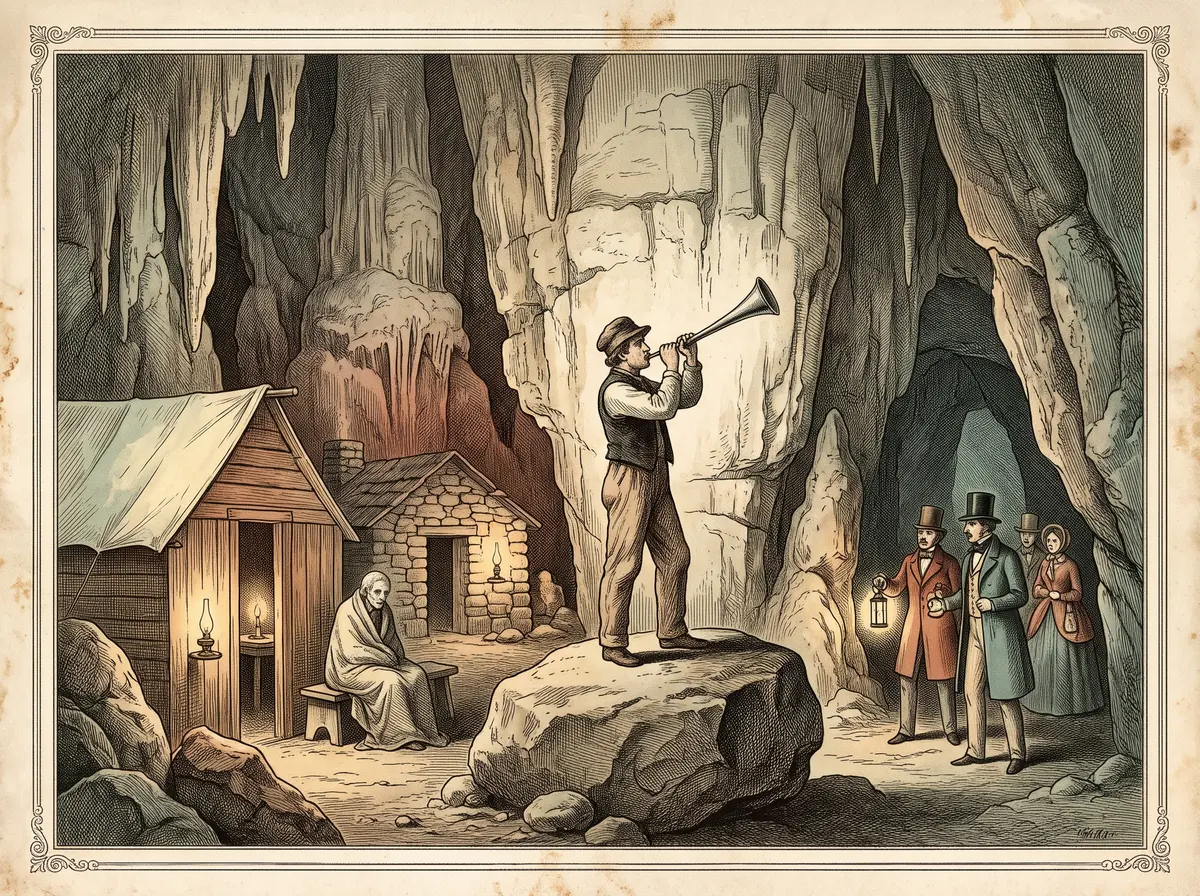
A mile underground in Kentucky, in the winter of 1842, a man blew a horn to call his neighbors to dinner. The neighbors were tuberculosis patients, living in little wooden huts with canvas roofs in the pitch-dark passages of Mammoth Cave. Every so often, a tour group carrying lanterns wandered past their front doors.
By the Curiosities Desk · · 5 min read · Filed under Medicine · Today’s round
What happened: Mammoth Cave in 1842
In October 1839, a Louisville physician named John Croghan bought Mammoth Cave and the land around it for $10,000. The cave was already a tourist attraction, and Croghan had a bold medical idea to go with it. Deep inside, the air stays cool and damp at nearly the same temperature all year. Saltpeter miners and visitors had reported feeling healthy down there, and one later writer called the cave air “slightly exhilarating.” Croghan wondered whether that steady climate could heal consumption, the 19th-century name for tuberculosis, the lung disease that was then one of the leading causes of death in America.
To test it, Croghan had huts built underground. The National Park Service records two stone cabins and eight wooden structures, each about 12 by 18 feet, with tongue-and-groove floors and canvas roofs. They were built by enslaved workers, who also carried in many of the patients’ meals, cooked outside the cave. One of them, a man named Alfred, later remembered standing on a rock and blowing a horn to call the patients to eat.
The first resident was a local physician, William Mitchell. In a letter printed in a Louisville newspaper that November, he wrote that he had gone into the cave on May 20, 1842, and set up house about three-quarters of a mile from the entrance. More patients followed through the autumn and winter of 1842–43: around 16 by the park’s count, and perhaps as many as 20.
At first, the plan seemed to work. Patients reported feeling better, and Croghan began imagining a hotel inside the cave. Meanwhile, the ordinary tours carried on. Paying visitors following their guides through the dark sometimes came across the patients, pale and coughing, outside their huts.
Then winter wore on, and things went wrong. To cook and keep warm in the chill, the residents burned fires and lit lard-oil lamps, and the smoke had nowhere to go. Cedar boughs brought in to freshen the air withered. Coughing echoed through the passages. Alfred recalled that the patients “looked more like a company of skeletons than anything else.”
Some patients gave up and climbed out. One of them, Oliver Hazard Perry Anderson, wrote in a diary entry dated January 12, 1843, that he was the fifth person to leave. He was not sour about it. “We are pioneers,” he wrote, adding that later generations would “reap benefits of our experiments.”
By early 1843 the experiment was over. Five patients died inside the cave. Their bodies were reportedly laid on a flat stone still known as Corpse Rock, though that detail comes down through cave tradition rather than a written record. According to park ranger Jackie Wheet, the longest stay lasted about four and a half months, and nearly every patient died within days or weeks of returning to the surface. Croghan never repeated the trial. He died of tuberculosis himself on January 11, 1849.
Why it was strange: Mammoth Cave in 1842
Croghan wasn’t being reckless by the standards of his day. Nobody yet knew what caused tuberculosis. A leading theory blamed bad air, so changing the air a patient breathed seemed perfectly logical. Sending patients to the seaside, the mountains or warmer climates was standard advice, and Croghan simply picked the most extreme change of air he owned.
The strange part is how literally he followed the logic. If the cave air seemed good for an afternoon, surely months of it would cure the disease. And because the cave still had to pay for itself, the “hospital” shared its hallways with sightseers. A Boston doctor, Omri Willey, was already arguing in print by late December 1842 that no one had gained “any permanent benefit from the Cave.”
It’s one more case of a cure worse than the disease, like the ones collected in Cures That Were Worse Than the Disease.
What scientists learned: Mammoth Cave in 1842
In 1882, Robert Koch identified the real culprit: a bacterium now called Mycobacterium tuberculosis. It spreads through the air when a person with active lung disease coughs, and no particular climate kills it. That explains why the cave couldn’t help. Constant temperature did nothing to the bacteria, while the smoke and damp added more strain to lungs that were already failing.
The early burst of improvement has a likely explanation too. The park’s own history credits it to better morale: patients who felt hopeful and cared for felt better for a while, even though the disease kept advancing. It’s a classic trap in medicine. Without a comparison group, a treatment can look like it’s working when hope is doing most of the work.
Croghan wasn’t the first doctor to try curing consumption by changing what patients breathed. Half a century earlier, an English physician prescribed living alongside cows: The Doctor Who Prescribed Living With Cows for Tuberculosis — and Let Them Breathe on His Patients.
How it reaches us today: Mammoth Cave in 1842
Later in the 19th century, the treatment of tuberculosis swung the opposite way, toward mountain sanatoriums full of sunlight, fresh air, rest and good food. Those didn’t cure the disease either, but they did one useful thing the cave couldn’t: they separated contagious patients from their families. Real cures arrived in the 1940s, with the antibiotic streptomycin, and today tuberculosis is treated with a combination of drugs, usually taken for months.
Tuberculosis is still not history, though. The World Health Organization reports that it killed about 1.23 million people in 2024, making it the world’s deadliest single infectious disease. Modern detection still gets creative, as in The Giant Rats That Sniff Spit for Tuberculosis — and Get Paid in Banana.
Two of Croghan’s stone huts still stand inside Mammoth Cave National Park, and some guided tours end beside them.
Fun fact: Mammoth Cave in 1842
You can still read one patient’s autograph. Oliver Hazard Perry Anderson scratched “OHPAnderson Dec 23rd 1842” into the cave, and it remains there today, close to 200 years later.
Sources: Mammoth Cave in 1842
- “Tuberculosis Experiment at Mammoth Cave” — National Park Service, Mammoth Cave National Park
- “TB Huts” — National Park Service
- “When Tuberculosis Patients Quarantined Inside Kentucky’s Mammoth Cave,” Smithsonian Magazine (quotes from William Mitchell’s letter, O. H. P. Anderson’s diary, Omri Willey’s rebuttal and park ranger Jackie Wheet) — Smithsonian
- John E. Kleber, ed., “Croghan, John,” The Encyclopedia of Louisville (University Press of Kentucky, 2001), pp. 232–233 — Google Books
- World Health Organization, Global Tuberculosis Report 2025 — WHO
Tuberculosis is preventable and curable today. If you have a long-lasting cough, fever, night sweats or unexplained weight loss, a doctor or local health clinic can test for it, often for free.