Weird Medical History · Chemistry
The Doctor Who Prescribed Living With Cows for Tuberculosis — and Let Them Breathe on His Patients
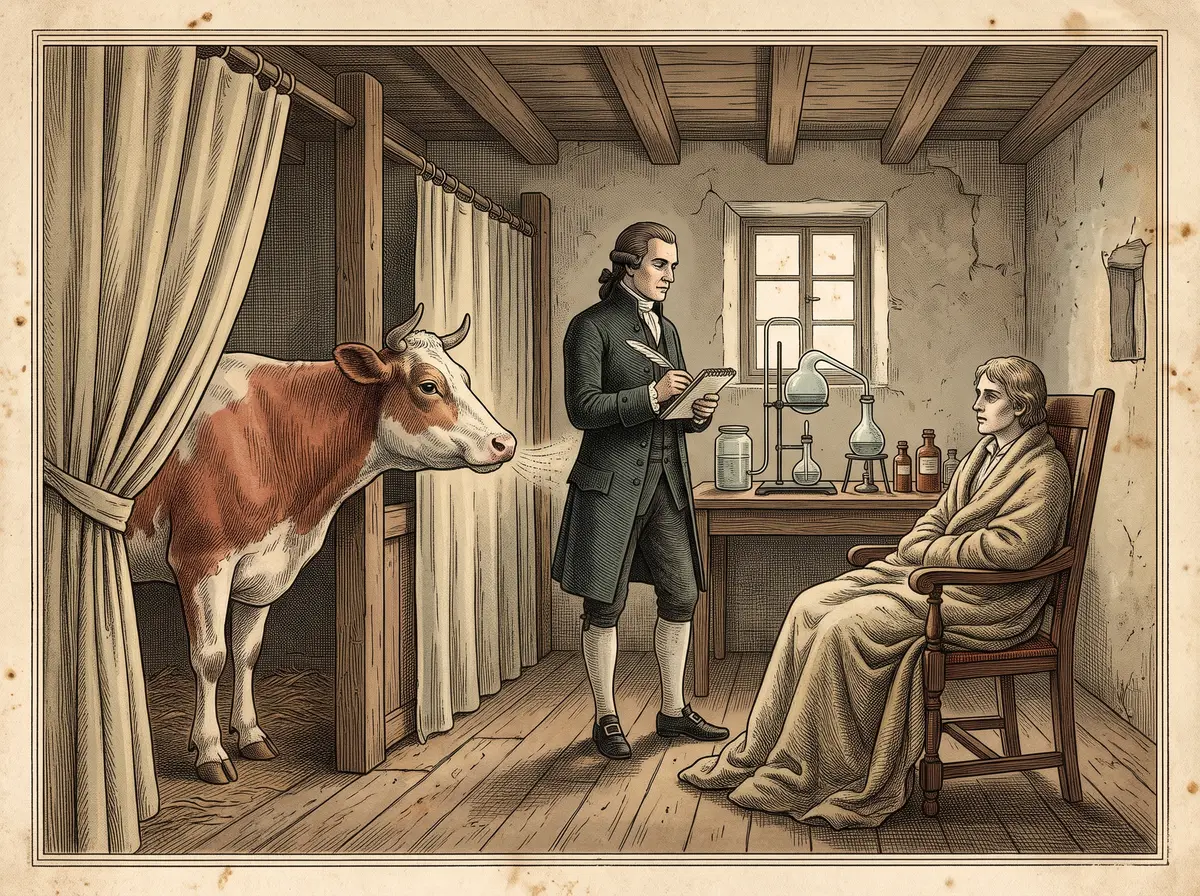
By late 1799, at Thomas Beddoes's medical institute in Bristol, England, a cattle stall stood attached to one of the ground-floor rooms. The patients inside had tuberculosis. The cows were the treatment. The idea, as its inventor put it in a letter to a medical journal, was "living with cows," and for weeks at a time some patients did exactly that, breathing the warm, grassy, unmistakably barnyard air of their four-legged roommates.
By the Curiosities Desk · · 5 min read · Filed under Chemistry · Today’s round
Part of Medicine, Before It Was Sure
What happened: The Cow-Stall Tuberculosis Cure
The doctor behind the cows was Thomas Beddoes, a physician and former Oxford chemistry lecturer who settled in Bristol in the 1790s. He was obsessed with consumption, the old name for pulmonary tuberculosis, a lung infection that slowly wasted its victims and was among the era’s leading killers.
Beddoes belonged to a hopeful new school he called pneumatic medicine, the idea that newly discovered gases could treat illness if patients breathed them in. Chemists had recently isolated oxygen, hydrogen, and “fixed air” (carbon dioxide), and Beddoes wanted to test each on the sick. The engineer James Watt, of steam-engine fame, designed equipment to make and dispense the gases. Watt had a painful personal reason to help: his teenage daughter Jessie was dying of consumption. She breathed fixed air under Beddoes’s care in 1794 and died that June.
Beddoes pressed on. In March 1799 he publicly announced his Medical Pneumatic Institution in two houses on Dowry Square in Hotwells, Bristol, opened with money from his most generous backer, the patient and chemist Tom Wedgwood. To run the laboratory he hired a young Cornishman named Humphry Davy, appointed two months before his 20th birthday.
Gases were not Beddoes’s only idea. Butchers, he believed, rarely caught consumption, and he suspected the warm animal vapors they breathed at work. If that air protected butchers, maybe it could help patients too.
So the institute got a cow-house. According to a local history of the site, a cattle stall was attached to a ground-floor room. Historian Mike Jay’s account has the cows breathing on patients through a curtain. The literary scholar John Barrell, reviewing that history, describes patients staying for days or weeks, breathing the cows’ breath in air thick with everything else a cow produces. At least one patient complained about the “cow dung, etc.”
On November 21, 1799, Beddoes wrote to The Medical and Physical Journal to explain. He had already recommended living with cows for consumption in print, he said, and since nobody else had tried it, he was testing it himself on a large scale. He was careful not to promise a miracle. He did not expect a quick cure for most cases of true consumption, he wrote, but he hoped to find “something valuable, at least in the way of relief.” He also reported that a Bristol apothecary, after seeing one of his patients who had lived with the cows for about a month, had started copying the method.
Two months later, the same journal ran a London surgeon’s “Hints on the Medicinal Effect of Living with Cows, in Pulmonary Consumption.” Cow therapy was, briefly, a real medical debate.
Why it was strange: The Cow-Stall Tuberculosis Cure
Bristol had fun with it. Satirists spread the story that Beddoes was bringing cows into invalids’ bedrooms and upsetting the town’s lodging-house keepers. The real setup was a stall beside a room, but the joke wasn’t far off.
What makes the story more than a punchline is how reasonable it looked from the inside. Beddoes spotted a pattern (healthy butchers), proposed a cause (animal air), and tested it while reporting his uncertainty honestly. According to Jay, Beddoes saw what he called “promise of success” in three of six cases, and he was frank about liking the setup partly for its steady warmth. The flaw was the premise. Nobody yet knew what actually caused tuberculosis, so there was no way to tell whether air from a cow could reach it.
It echoes another remedy built on a plausible-sounding chain of reasoning: The Wound Cure You Rubbed on the Sword Instead of the Patient.
What scientists learned: The Cow-Stall Tuberculosis Cure
Mostly, that the cows didn’t help. Barrell’s verdict is blunt: “This did not work.” Davy himself eventually concluded that pneumatic medicine was still “an art yet in its infancy, weak, almost useless.”
The missing piece arrived in 1882, when the German physician Robert Koch identified the bacterium that causes tuberculosis, Mycobacterium tuberculosis. TB spreads when an infected person coughs tiny droplets into the air that someone else inhales. No vapor, bovine or otherwise, kills the bacterium inside the lungs. That took antibiotics, starting with streptomycin in the 1940s.
There was even an irony. Cattle carry their own form of the disease, bovine tuberculosis, which according to the CDC people catch mostly from unpasteurized dairy, though prolonged close contact with infected animals is also a risk.
The pneumatic side of Beddoes’s work paid off in a way he never planned. Davy’s experiments at the institute with nitrous oxide led him to suggest it might be useful during surgical operations, a hint that took decades to act on. That thread runs through From Laughing Gas Parties to the Operating Room: A Short History of Anesthesia.
How it reaches us today: The Cow-Stall Tuberculosis Cure
Beddoes’s hunch that barn air does something to human lungs turns out to hold a sliver of truth, just not the one he wanted. In a 2016 study in The New England Journal of Medicine, researchers compared Amish children, raised on traditional single-family dairy farms, with Hutterite children, raised on industrialized communal farms. None of the 30 Amish children studied had asthma, compared with 6 of the 30 Hutterite children. Amish house dust carried far more endotoxin, a molecule shed by bacteria, and in mice it helped prevent allergic airway reactions. Early exposure to farm microbes seems to train a child’s immune system. That’s about preventing asthma, not curing an infection, but Beddoes, who also treated asthma, would have been fascinated.
His bigger idea, breathing a chosen gas as medicine, lives on in oxygen therapy and inhaled anesthesia. For another early attempt to borrow from cows that ended up teaching the opposite lesson, see The Doctors Who Tried to Replace Blood With Fresh Cow’s Milk. The cow stall belongs with the other treatments from before medicine was sure, in Medicine, Before It Was Sure.
Fun fact: The Cow-Stall Tuberculosis Cure
The same Bristol institute with the cow stall out back was where Davy got poets high on laughing gas. After trying it, Robert Southey wrote that Davy had “invented a new pleasure for which language has no name.”
Tuberculosis is still curable with the right antibiotics, but it takes a full course of treatment. If you have a cough that lasts more than a few weeks, especially with fever or night sweats, it’s worth getting checked by a doctor.
Sources: The Cow-Stall Tuberculosis Cure
- Thomas Beddoes, letter to the editors of The Medical and Physical Journal, 21 November 1799, The Medical and Physical Journal 2 (1799): 415–16 (via The Collected Letters of Thomas Beddoes, ed. Tim Fulford with Sara Slinn)
- W. Blair, “Hints on the Medicinal Effect of Living with Cows, in Pulmonary Consumption”, The Medical and Physical Journal 3, no. 11 (January 1800): 14–15
- John Barrell, “Dephlogisticated: Dr Beddoes”, London Review of Books 31, no. 22 (2009), reviewing Mike Jay, The Atmosphere of Heaven (Yale University Press, 2009)
- Sharon Ruston, “Laughing gas and the scientific pursuit of the sublime”, Wellcome Collection (2022)
- Michelle M. Stein et al., “Innate Immunity and Asthma Risk in Amish and Hutterite Farm Children”, The New England Journal of Medicine 375 (2016): 411–421