The Doctors Who Tried to Replace Blood With Fresh Cow's Milk
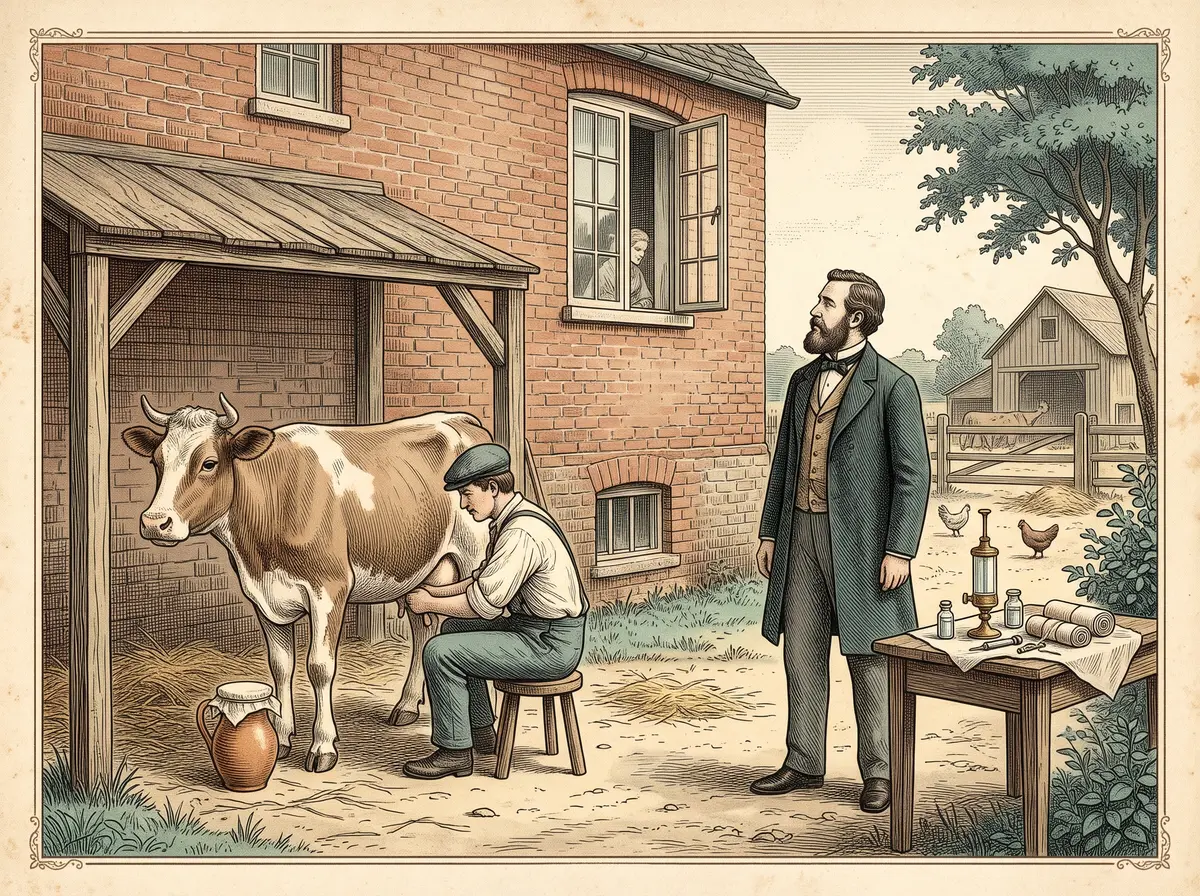
In October 1875, the New York surgeon T. Gaillard Thomas stood over a gravely ill patient with a vein in her arm exposed, while outside, a young and healthy cow was led into the yard. The plan was simple and, to modern ears, astonishing: milk the cow into a warm pitcher, strain it through gauze, and pump it straight into the woman's bloodstream as a stand-in for blood.
By the Curiosities Desk · · 5 min read · Filed under Medicine · Today’s round
What happened: A Milk Transfusion
The idea began in Toronto in July 1854, in the middle of a cholera epidemic. Cholera kills mainly through dehydration: the infection drains so much fluid from the body that the blood thickens and circulation fails. Two Toronto physicians, James Bovell and Edward Mulberry Hodder, wanted something they could put back into their patients’ veins.
They chose cow’s milk. Their reasoning came from the French microscopist Alfred Donné, whose work suggested that the tiny fat droplets in milk might be “convertible into the white corpuscles of the blood.” If milk could turn into blood, it seemed, it could stand in for it.
Their first patient, a 40-year-old man, received 12 ounces of cow’s milk, strained through gauze and kept at about 100°F. By their account he responded dramatically. A second patient, treated three days later, did equally well. Then the luck ran out. Two patients transfused the following week died, and so did three more treated by Bovell’s student John MacKenzie. Hodder later recalled that when they asked the city to provide a cow and some basic comforts for the work, they were refused, and they gave it up.
The method resurfaced in the United States in the 1870s, and its most enthusiastic champion was Theodore Gaillard Thomas, a prominent New York gynecologist. In 1875 he was treating a 30-year-old woman from Oswego, New York, who was bleeding heavily after surgery to remove an ovarian tumor. Thomas did not trust blood transfusion; he wrote of “the inherent difficulties and dangers of the operation,” chiefly that blood clots so quickly, and that a small clot or a bubble of air entering a vein could be fatal.
So he sent for a cow. In his own words, “a young and healthy cow was driven into the yard,” and the animal was milked at the moment the fluid was needed. He slowly injected about eight and a half ounces into a vein in her arm. According to a later review of his reports, she soon complained that her head felt like it was bursting, then developed a racing pulse and a high fever. But over the following week she recovered.
In 1878 he published a short book, The Intra-Venous Injection of Milk as a Substitute for the Transfusion of Blood, describing seven operations, and predicted “a brilliant and useful future” for the technique. He was not alone. The New York physician Joseph Howe tried goat’s milk, and in 1878 a colleague named Brinton predicted that milk would, “in a few years, entirely supersede the transfusion of blood.”
Why it was strange: A Milk Transfusion
Milk is food. It is meant for the stomach, where digestion breaks it down. These doctors skipped that step and sent it straight into the bloodstream, on the theory that the body would know what to do with it.
What makes the episode more than a gross-out curiosity is that the logic was not crazy for its time. Blood transfusion in the 1870s really was dangerous. Nobody knew about blood types, and there was no way to stop blood from clotting in the tubes. Milk didn’t clot, was easy to get, and looked, under a microscope, a little like blood with its floating particles.
Part of the story’s earlier roots, including the lamb’s blood transfusions of the 1600s, is told in From Lamb’s Blood to Blood Types: A Short History of the Transfusion.
What scientists learned: A Milk Transfusion
They learned, the hard way, that milk is not blood. Howe ran the obvious experiment on animals: he bled seven dogs until they fainted and gave them milk. All seven died, while two bled dogs left untreated recovered. He concluded that “the milk killed the dogs,” though he wondered whether the volume was to blame. In 1880 he tried human milk on a patient with lung disease, who stopped breathing and had to be revived. He decided human milk was no better than the animal kind.
Today we can say why. Red blood cells carry oxygen, and milk has none. Milk fat doesn’t become white blood cells; large fat droplets in the bloodstream can block small vessels, and the foreign proteins can trigger fevers and severe reactions. In 1879 the French physicians Moutard-Martin and Richet warned of deaths after milk injection, and by 1880 the practice had fallen into disrepute in New York.
The deeper lesson was about fluid itself. Much of what helped the patients who survived was probably simple volume: refilling a drained circulatory system. That pointed toward something far plainer than milk. The clotting problem that drove Thomas to the dairy, meanwhile, was eventually tamed by chemistry; one strand of that story is in The Farmer Who Drove Through a Blizzard With a Dead Cow and a Milk Can of Blood.
How it reaches us today: A Milk Transfusion
Milk transfusion was abandoned once salt water arrived. Isotonic saline, a salt solution matched to the body’s own fluids, came into intravenous use in the 1880s and quickly became popular. The ordinary IV bag hanging beside a hospital bed is its direct descendant, and rehydration is still the core of cholera treatment.
The irony is that saline had already been tried. In 1832, during an earlier cholera epidemic, the Scottish doctor Thomas Latta injected salt water into patients’ veins in Leith, near Edinburgh, and reported it in The Lancet. The practice faded for nearly 50 years, which is partly why, in 1854, a pair of Toronto doctors reached for a milk pail instead.
Another doctor who tested a medical idea in an unexpected way appears in The Student Who Drank Vomit to Prove Yellow Fever Wasn’t Contagious.
The cow in the hospital yard belongs with the other trials in The Experiment That Did Not Come Out.
Fun fact: A Milk Transfusion
Thomas’s instructions were specific about freshness: the milk should come from a healthy cow and be drawn shortly before use. The one clearly harmful case he knew of, he blamed not on the method but on milk that had gone bad.
A note on safety: modern transfusions and IV fluids are carefully tested and matched, and nothing should go into a vein except under medical care. If you or someone close to you is facing a serious illness, your care team is the best place to start with questions.
Sources: A Milk Transfusion
- T. Gaillard Thomas, The Intra-Venous Injection of Milk as a Substitute for the Transfusion of Blood: Illustrated by Seven Operations (New York: D. Appleton, 1878), National Library of Medicine Digital Collections — Thomas’s own account, including the cow in the yard.
- Harold A. Oberman, “Early History of Blood Substitutes: Transfusion of Milk”, Transfusion 9, no. 2 (1969): 74–77 — the standard review of the Toronto, New York, and Howe experiments and their decline.
- “Hodder, Edward Mulberry”, Dictionary of Canadian Biography — on Hodder, Bovell, and the 1854 Toronto cholera transfusions.
- “Leith in the Time of Cholera: The Story of Thomas Latta”, Hektoen International — on the 1832 saline injections and why they were forgotten.