Impossible Inventions · Chemistry
The Electric Sugar Machine That Only Worked When Everyone Left the Room
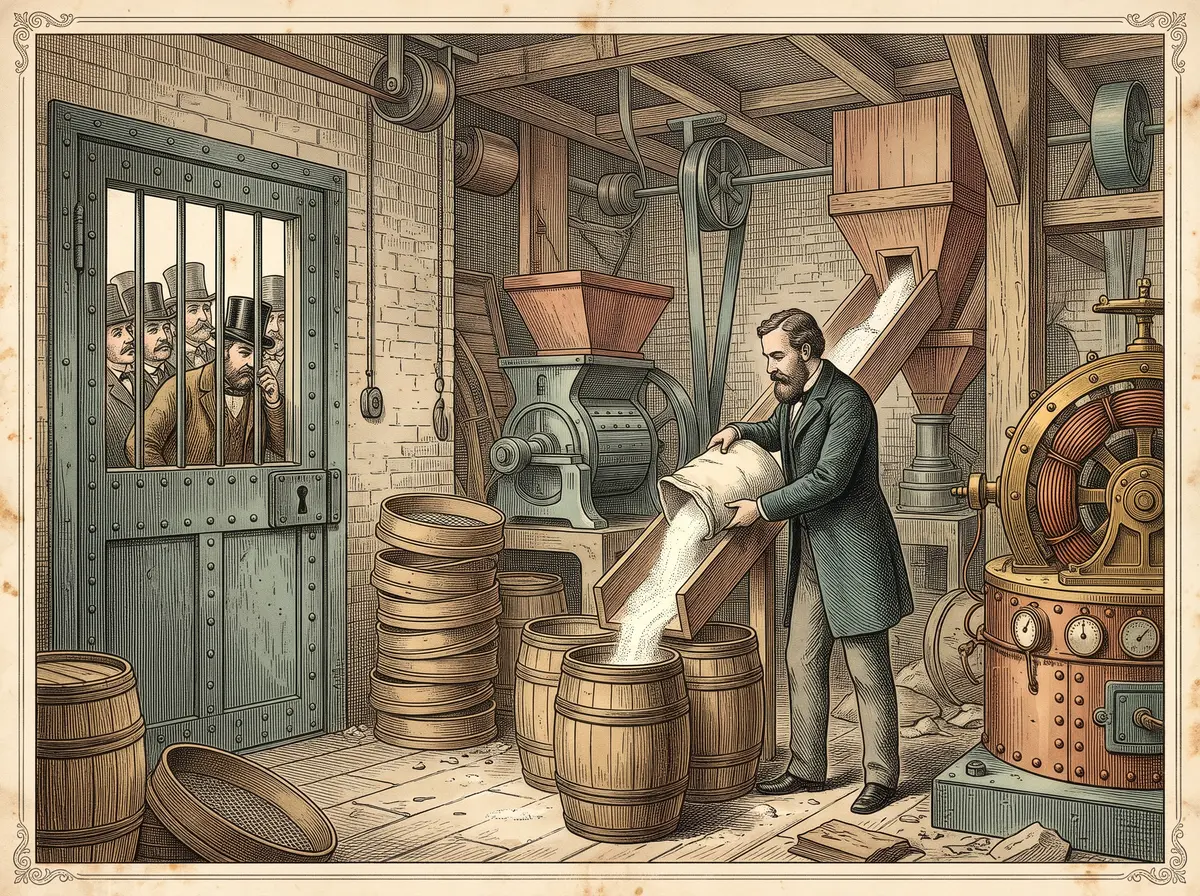
In the mid-1880s, investors in Brooklyn's Electric Sugar Refining Company were invited to watch the future of sugar. They inspected a room full of crushers, chutes and sieves, peered at a barrel of brown raw sugar, and were then politely shown the door. It was locked behind them. There was banging. When they were let back in, the barrels held sparkling white refined sugar, made, they were told, by electricity.
By the Curiosities Desk · · 5 min read · Filed under Chemistry · Today’s round
Part of Built to Do the Impossible
What happened: The Electric Sugar Refining Company Hoax
The man behind the door was Henry C. Friend, who also spelled his name Freund. He introduced himself as a German chemist and went by “Professor,” though historians have found no sign that he was either. A Chicago grape-sugar venture of his had already collapsed in 1881, after an investor had him arrested; the charges were later dropped.
By 1883 Friend was in New York with a bigger claim. Refining sugar, the job of turning sticky brown raw sugar into pure white crystals, was a slow, expensive industrial process. Friend said he had a secret method, driven by electricity, that could do it for a small fraction of the usual cost. According to the Museum of Hoaxes’ account of the case, he put the price at about 80 cents a ton.
The Havemeyers, the family that dominated American sugar refining, said they would back him if they could examine the process. Friend refused. The process, he explained, could not be patented, so he could not let anyone see it.
Others were less demanding. In 1884 Friend and W. H. Cotterill, a former London solicitor, formed the Electric Sugar Refining Company: 10,000 shares at $100 each, with 3,000 sold in England. The company bought the old Atlantic Flour Mills in Red Hook, Brooklyn, where Friend built locked, iron-lined secret rooms that only he and his wife, Olive, could enter.
By 1888 the shares were reportedly trading in England at $625. Skeptics were not hard to find. Trade journals questioned the secrecy, and when rival refiners wrote to Thomas Edison’s office to ask how electrical refining could work, the reply, as historian Benjamin R. Cohen recounts, was that electricity could bleach sugar but Edison knew of no way to refine it.
Then, on March 10, 1888, Friend died, reportedly of illness linked to heavy drinking. Rumors that he had faked it were common enough that a company director insisted to reporters he was “dead as a hammer.”
Olive, her mother Emily, and her stepfather, the Rev. William Howard, said they knew the secret. The company agreed to pay Olive $75,000 to reveal it once a full-scale refinery was ready. Months of delays followed. Late in 1888 the family left for Milan, Michigan, where Cotterill followed and asked a simple question: did the process turn raw sugar directly into refined sugar? He did not get a straight answer. On January 2, 1889, back in Brooklyn, Cotterill and other officers broke into the secret rooms.
They found stockpiled raw sugar, boxes of already-refined sugar, sieves, and the “wonderful machine,” which turned out to be a crusher for breaking up lumps. As the Ann Arbor Argus later reported from the civil trial, “There was nothing about the building for refining sugar.” The method, as investigators pieced it together, was simple: refined sugar bought in small lots from grocers came in through boxes labeled as machinery, and during each demonstration it went down the chutes and through the sieves into the waiting barrels while the raw sugar was taken away.
The shares became worthless within days. In February 1889 Olive, her mother, her stepfather and two cousins were arrested in Michigan. William Howard, who had posed as a machine operator during demonstrations, was convicted in New York and sentenced to nine years and eight months of hard labor at Sing Sing. Olive and Emily pleaded guilty to grand larceny and were sentenced to the time they had already served.
Why it was strange: The Electric Sugar Refining Company Hoax
The trick only worked because of one rule: nobody watches. A real industrial process has to be run by workers and checked by buyers. Friend’s could only run behind a locked door.
And yet the pitch sounded plausible in its moment. In the 1880s electricity seemed able to do anything. Edison’s lamps were lighting Manhattan, and electroplating, the use of current to coat metal objects, was a working industry. “Refined by electricity” sounded less like magic than like the next obvious step. The most convincing frauds borrow the glamour of real science. For another machine that only ran with a hidden helper, see The Perpetual Motion Machine Secretly Powered by an Old Man Upstairs Eating Bread.
What scientists learned: The Electric Sugar Refining Company Hoax
Sugar refining is chemistry and physics, not a single trick. Raw cane sugar is mostly sucrose, coated in molasses and colored impurities. Nineteenth-century refiners washed and dissolved it, filtered the syrup through bone char (charred animal bones, which soak up color), boiled it down until crystals formed, and spun the crystals in centrifuges to separate them from the remaining syrup.
Electricity has a genuine but limited role in that story, which is why Edison’s answer was so careful. Passing current through a solution can drive chemical reactions, a process called electrolysis, and some of those reactions bleach color. But electrolysis also produces acid near one electrode, and acid helps split sucrose into two simpler sugars, glucose and fructose, a change chemists call inversion. Inverted sugar doesn’t form neat white crystals, which is the opposite of what a refiner wants. A sugar trade journal raised this very objection in November 1888, two months before the break-in.
The lesson the chemists of the day kept repeating was about method, not sugar: a claim nobody is allowed to test is not a scientific result. For a sea-water version of the same hidden-helper trick, see The Minister Who Sold Gold From Seawater — With a Diver Hiding Under the Wharf.
How it reaches us today: The Electric Sugar Refining Company Hoax
Electricity did eventually find honest work in sugar processing, though not the way Friend promised. Techniques such as electrodialysis, which uses electric current and special membranes to pull dissolved salts out of a liquid, have been studied and used to clean up sugar-beet juices and syrups. They help with one step; they do not replace the refinery.
The bigger legacy is a pattern people still learn to spot: a secret process, a demonstration only the inventor controls, and investors far from the factory. Modern investors and regulators ask for independent testing for exactly that reason. The Electric Sugar machine sits alongside other inventions asked to do the impossible in Built to Do the Impossible, next to The Chemist Who Hammered Silver Dollars Into ‘Gold’ — and Sold It to the U.S. Government.
Fun fact: The Electric Sugar Refining Company Hoax
The “electric” refined sugar that amazed investors passed through a set of nine sieves on its way into the barrels. Its real secret ingredient was a trip to the grocery store.
Sources: The Electric Sugar Refining Company Hoax
- “The Electric Sugar Co. and Mrs. Friend,” Ann Arbor Argus, May 27, 1892 (report from the civil trial, including testimony on what was found in the secret rooms) — Ann Arbor District Library, Old News
- Benjamin R. Cohen, “The Great Electric Sugar Con,” excerpted from Pure Adulteration (University of Chicago Press, 2020) — PBS American Experience
- “Freund’s Electric Sugar Fraud, 1889” — Museum of Hoaxes
- Suzanne Spellen, “Walkabout: Professor Friend and the Electric Sugar Company, Part 4” (the arrests, Howard’s trial and sentence) — Brownstoner