Impossible Inventions · Chemistry
The Chemist Who Hammered Silver Dollars Into 'Gold' — and Sold It to the U.S. Government
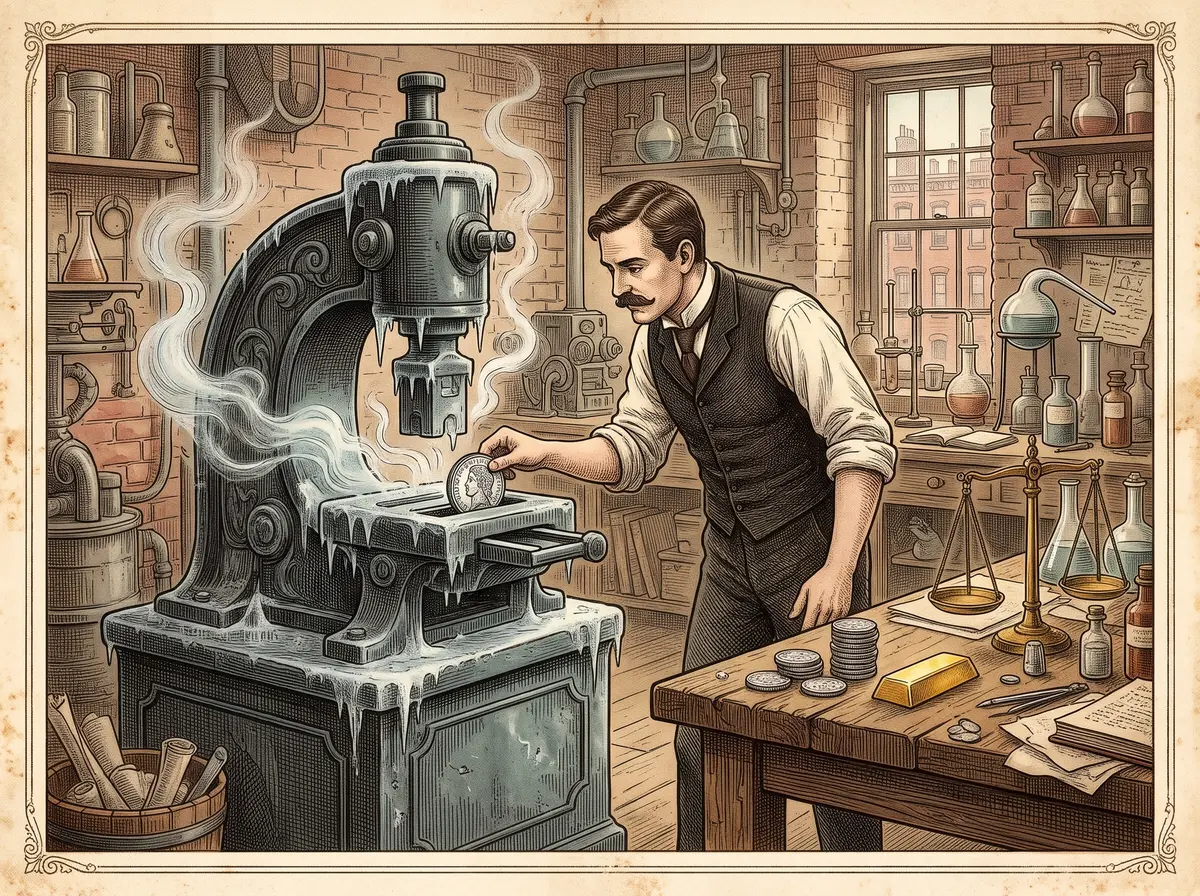
In the spring of 1897, a chemist in New York named Stephen H. Emmens walked a bar of gold into the United States Assay Office and walked out with a government check. Over the next few months he did it again and again — six ingots in all. Where did the gold come from? According to Emmens, from Mexican silver dollars that he had pounded, under bitter cold, in a machine he called the "Force Engine."
By the Curiosities Desk · · 5 min read · Filed under Chemistry · Today’s round
Part of Built to Do the Impossible
What happened: The Emmens Gold Claim
Emmens was not a street-corner huckster. Born in England, he had settled in New York and built a real reputation. The chemist H. Carrington Bolton, writing in the journal Science in December 1897, described him as an author of books, technical papers, and even novels, and as the inventor of “emmensite,” a high explosive. He was a man who knew his way around a laboratory.
That is part of what made his next announcement so startling. Emmens claimed to have found a substance he called argentaurum — from the Latin argentum (silver) and aurum (gold). In his telling, it was a kind of in-between matter, neither silver nor gold, that could be coaxed from one into the other. A 1908 account in Popular Science Monthly summarized his method as “the combined effect of impact and very low temperature.” You took silver, chilled it, and hit it — hard, and for a long time.
The details, as Emmens and later writers described them, were wonderfully mechanical. The silver of choice was the Mexican dollar, a common coin of the era. It went into the Force Engine, which supposedly squeezed and struck the metal at enormous pressures while keeping it very cold. After more hammering, some melting, and a treatment with what he called “modified nitric acid,” the result was refined into ingots. Emmens claimed that one ounce of silver could yield three-quarters of an ounce of gold, with a profit of at least $3 per ounce guaranteed.
Then came the part that made headlines. According to Bolton’s 1897 report, starting on April 13, 1897, Emmens sold the United States Assay Office “six ingots of an alloy of silver and gold for the gross sum of $954.” Emmens himself said the ingots had been accepted by the government assayer, Dr. Cabell Whitehead. Newspapers ran with it. One paper, quoted in a later History Today article, reported he was making enough gold to clear a profit of $150 a week at the Assay Office. The French science magazine La Nature described it as the first gold ingot ever made from silver.
Emmens also tried to win over the scientific establishment. In May 1897 he wrote to Sir William Crookes, one of Britain’s leading chemists and physicists, urging him to beat a Mexican dollar under cold, confined conditions and test it for gold. Crookes did experiment, but according to Popular Science Monthly he could not repeat the result to his satisfaction. Their correspondence soured, and by 1898 it had stopped.
Undeterred, Emmens formed the Argentaurum Company in 1898. Investors would hand over silver plus a processing fee and get back gold. It never went into real production. By 1901, History Today notes, Emmens had essentially vanished from the record.
Why it was strange: The Emmens Gold Claim
The strangest thing is that the government check was real. The Assay Office truly bought his metal. But that proved far less than it seemed to.
An assay office’s job is to measure how much gold and silver is in a lump of metal and pay for it. It doesn’t ask where the gold came from, any more than a grocery scale asks where the apples grew. Bolton’s wording is careful: the ingots were “an alloy of silver and gold.” A sale only showed that Emmens had gold. It said nothing about whether he had made it.
There’s another wrinkle. Silver coins of the period often carried tiny traces of gold left over from imperfect refining. Any experiment that started with coins and ended with “extra” gold had to rule out that the gold was there all along, or that it had slipped in from somewhere else. Emmens never let outsiders check his process from start to finish. According to a later account by the writer Vincent Gaddis, the British author Rupert Gould raised the blunter possibility that the gold was simply bought or melted down from other sources. Nobody has proved exactly what happened in that laboratory, and it’s fairest to say the gold’s origin remains unexplained, not that it was conjured from silver.
For another gold-making claim that came apart under careful measurement, see The Mercury Lamp That Seemed to Be Making Gold — at $2 Million a Pound.
What scientists learned: The Emmens Gold Claim
Emmens’ claim ran into one of chemistry’s hardest walls. An element is defined by the number of protons in the nucleus of its atoms — its atomic number. Silver has 47. Gold has 79. Turning one into the other means adding 32 protons to every atom, which takes nuclear reactions, not a hammer. Squeezing and chilling metal can change its crystal structure, hardness, and shape, but it doesn’t touch the nucleus. In the 1890s, before anyone knew atoms had nuclei, that wall wasn’t fully understood. Bolton still concluded that the modern alchemists were on the wrong path.
The episode also teaches a lesson about evidence: a test only proves what it controls for. Without knowing exactly how much gold went in, no one could say how much came out. It’s the same trap a 17th-century chemist fell into in The Chemist Who Offered to Turn Holland’s Sand Dunes Into a Gold Mine — and Passed the Test.
How it reaches us today: The Emmens Gold Claim
Ironically, physicists did eventually turn other elements into gold. In particle accelerators and nuclear reactors, atoms can be transmuted, and tiny amounts of gold have been made this way. It costs vastly more than the gold is worth, so it remains a curiosity, not a gold mine.
Emmens’ story also shows why science now insists on independent replication and open methods. A secret process, a sale that proves possession rather than creation, and a famous name who “couldn’t quite repeat it” are exactly the warning signs modern reviewers are trained to spot. For an earlier chemist who took his gold-making case all the way to lawmakers, see The Chemist Who Got Parliament to Make Gold-Making Legal Again. The gold claim sits with the other machines asked to do the impossible, in Built to Do the Impossible.
Fun fact: The Emmens Gold Claim
When the journal Science ran a scathing review of one of Emmens’ pamphlets, he responded with a libel suit against the reviewer and the journal’s editor. According to Popular Science Monthly, the case never came to trial.
Sources: The Emmens Gold Claim
- H. Carrington Bolton, “The Revival of Alchemy,” Science, New Series, vol. 6, no. 154 (December 10, 1897), pp. 853–863 — academia.edu copy
- Popular Science Monthly, vol. 72 (1908), pp. 47–48, on Emmens and argentaurum — Wikisource
- “Alchemy: New Light on a Dark Art,” History Today — historytoday.com
- Robert A. Nelson, Adept Alchemy, Part II, Ch. 1, “Transmutations of Silver to Gold” (a sympathetic compilation that reprints and cites period sources, including Emmens’ letters to Crookes; read with caution) — alchemywebsite.com