Failed Experiments · Chemistry
The Mercury Lamp That Seemed to Be Making Gold — at $2 Million a Pound
In July 1924, a respected Berlin professor of photochemistry announced that a lamp in his laboratory had been quietly turning mercury into gold. There was no furnace and no secret powder, just electricity running through mercury vapor for up to 200 hours. Newspapers ran the story around the world, and economists started to worry about what cheap gold would do to the money supply. There was one catch, and it was a big one: by Professor Adolf Miethe's own estimate, his gold cost about $2,164,000 a pound to make.
By the Curiosities Desk · · 5 min read · Filed under Chemistry · Today’s round
What happened: Miethe's Gold Lamp
Adolf Miethe was not a crank. Born in Potsdam in 1862, he had co-invented a magnesium flash powder and in 1899 took over the chair of photography, photochemistry, and spectral analysis at the Technische Hochschule (technical university) in Berlin-Charlottenburg. TIME called Miethe “no quack or sensationalist.”
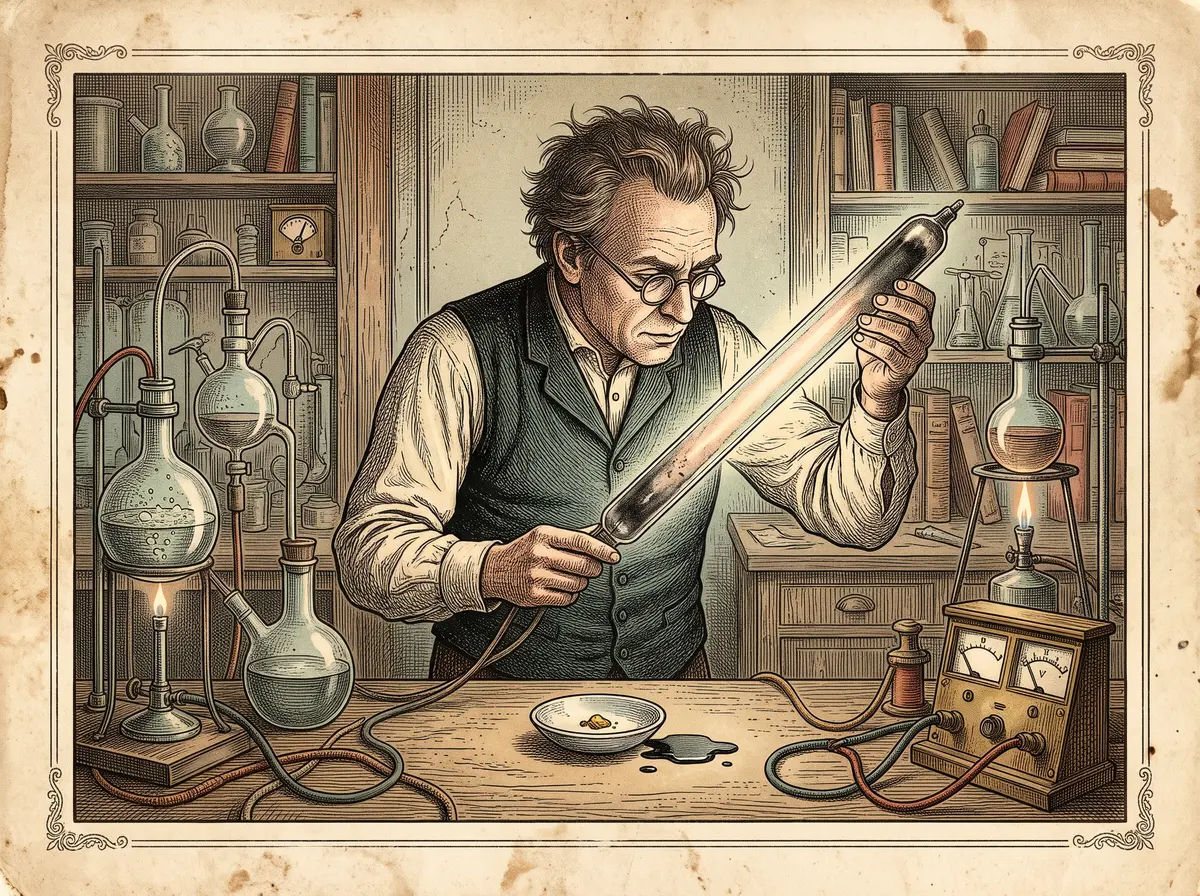
His lab used mercury vapor lamps, glass or quartz tubes in which an electric current passes through mercury vapor and makes it glow with ultraviolet light. According to later accounts of the affair, the lamps kept failing as a dark, sooty deposit built up inside the tubes. When Miethe and his young assistant Hans Stammreich analyzed that residue, they reported finding gold.
They followed up carefully, or thought they did. They ran a high-pressure mercury lamp at around 170 volts for 20 to 200 hours at a stretch, distilled the mercury beforehand (usually twice, sometimes many more times) to strip out impurities, and then tested what was left. Every time, they said, tiny amounts of gold appeared, a tenth of a milligram or less. Miethe filed a patent and published his results in the German journal Die Naturwissenschaften on July 18, 1924, under a title that translates as “The Decay of the Mercury Atom.”
The British journal Nature reprinted the details within weeks but added that the report “could only be received with great reserve.” Meanwhile, in Japan, the physicist Hantaro Nagaoka announced that he too had made gold from mercury, using a different electrical setup.
A test arranged by Scientific American at New York University ran three trials with gold-free equipment and found no gold. In Germany, chemists Otto Hönigschmid and Eduard Zintl weighed the atoms of Miethe’s gold in 1925 and found it was ordinary gold in every respect. At Oxford’s Clarendon Laboratory, Milan Garrett ran sealed mercury through an electric arc for 144 hours and then through a second arc for just as long. His analysis could detect a hundred-millionth of a gram of gold. “No trace of gold was found,” he wrote in Nature in 1926.
The most thorough check came from Fritz Haber, the Nobel Prize-winning chemist who had himself spent years trying to pull gold out of seawater to help pay Germany’s war reparations. Haber and his colleagues tracked down where Miethe’s gold really came from: not from mercury atoms, but from the lamp. Garrett, summing up the case in Nature, agreed with Haber that “Miethe’s gold was derived from the materials of his electrodes and his vessels.” Miethe died in Berlin in May 1927 without having proved his claim.
Why it was strange: Miethe's Gold Lamp
Because almost everything about it looked right. The scientist was reputable. The method was modern: electricity, not alchemy. The timing seemed perfect, too. In 1919 Ernest Rutherford had shown that one element could really be changed into another by bombarding nitrogen with alpha particles from radium. Transmutation was no longer a fantasy, so why not mercury into gold, its next-door neighbor on the periodic table? Mercury has 80 protons and gold has 79. On paper, the two are separated by a single proton.
And the gold was real. Miethe wasn’t imagining his results or faking them. The trouble was that gold is very good at hiding in small quantities, and the more sensitive your test, the more likely you are to find a trace that was there all along.
It’s a cousin of the alchemists’ old hopes in The Chemist Who Got Parliament to Make Gold-Making Legal Again.
What scientists learned: Miethe's Gold Lamp
The first lesson was about energy. Changing an element means changing the nucleus, the tiny, tightly bound core of the atom. Ordinary chemistry and electricity work on the electrons outside it. An electron pushed by 170 volts carries about 170 electronvolts of energy (an electronvolt is a tiny unit physicists use for single particles). Knocking a proton out of a nucleus takes millions of electronvolts. Critics at the time made the same point: the forces in Miethe’s lamp were far too weak.
The second lesson was about contamination, the stray impurities that sneak into an experiment from equipment, air, or reagents. Gold turns up in small traces in many metals and materials, and when you are measuring fractions of a milligram, a lamp’s electrodes or glassware can easily supply that much. Miethe had purified his mercury but not ruled out his apparatus. Haber’s verdict became a classic warning: when a result is extraordinary and the quantities are tiny, look at your equipment first.
For another discovery that turned out to be contamination, see Polywater: The New Form of Water That Almost Ate the World. More stories like this one are on the shelf of The Experiment That Did Not Come Out.
How it reaches us today: Miethe's Gold Lamp
Mercury did eventually become gold, just not in a lamp. In 1941, physicists Rubby Sherr, Kenneth Bainbridge, and Herbert Anderson at Harvard bombarded mercury with fast neutrons from a cyclotron and produced gold. All of it was radioactive and decayed away. In May 2025, CERN’s ALICE experiment reported that near-miss collisions of lead nuclei in the Large Hadron Collider had made about 86 billion gold nuclei during one multi-year run. That came to 29 picograms, or trillionths of a gram, and each nucleus survived only a tiny fraction of a second. As CERN put it, the alchemists’ “hopes of riches have once again been dashed.”
The habit Miethe’s mistake reinforced matters far beyond gold. Modern trace-analysis labs, which measure lead in drinking water or pollutants in blood, run “blanks,” samples that go through every step of a test without the material being studied, precisely to catch whatever the equipment adds by itself.
Haber’s own gold hunt is part of a larger, more complicated life: The Chemist Who Fed the World and Gassed the Trenches.
Fun fact: Miethe's Gold Lamp
Scientists did later run the process in reverse. In 1945, William Meggers of the U.S. National Bureau of Standards got pure mercury-198 that had been made from gold irradiated in a nuclear reactor at Oak Ridge, and used it to build a lamp so precise it became a standard for measuring length.
Sources: Miethe's Gold Lamp
- A. Miethe, “Der Zerfall des Quecksilberatoms,” Die Naturwissenschaften 12 (July 18, 1924), as reported in “The Reported Transmutation of Mercury into Gold,” Nature 114, 197–198 (1924).
- M. W. Garrett, “Transmutation Experiments,” Nature 118, 84 (1926) (Oxford replication; conclusion, with Haber, that the gold came from electrodes and vessels).
- “Science: Synthetic Gold,” TIME, August 4, 1924 (cost estimate of $2,164,000 a pound; up to 200 hours of current).
- CERN, “ALICE detects the conversion of lead into gold at the LHC,” May 8, 2025.
- NIST, “Culture of Excellence” profile of William F. Meggers (mercury-198 made from neutron-irradiated gold). For the wider 1920s debate, including the Scientific American test, see Robert A. Nelson, “Adept Alchemy,” Part II, Chapter 7, which cites the original papers.