Accidental Discoveries · Space
The Enemy Radar Jammer That Turned Out to Be the Sun
At the end of February 1942, James Stanley Hey watched British anti-aircraft radar screens along the coast fill with a roaring hiss, and it looked like the German jamming everyone had been dreading. Then a physicist noticed something odd about the "enemy" transmitter. It switched on at dawn, switched off at nightfall, and drifted slowly across the sky from east to west.
By the Curiosities Desk · · 5 min read · Filed under Space · Today’s round
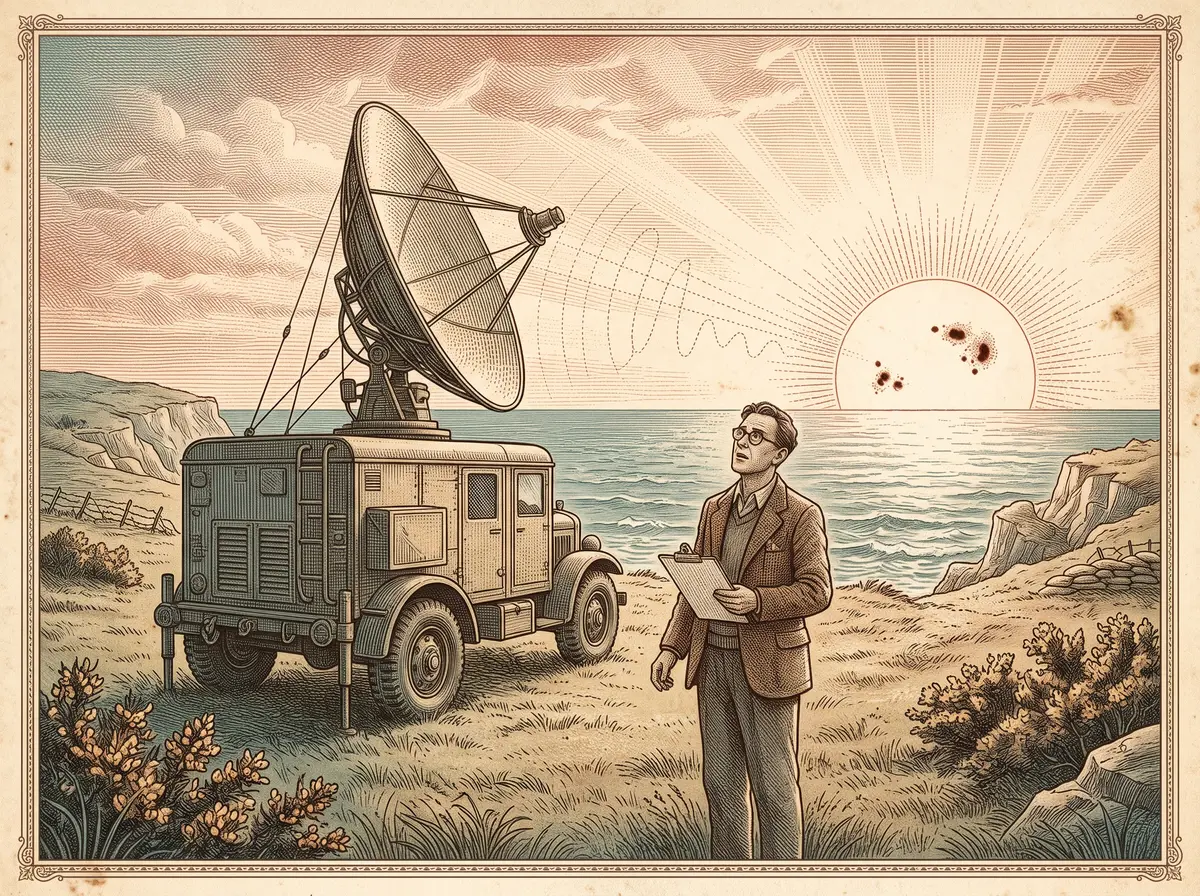
What happened: James Stanley Hey
In 1942, James Stanley Hey was not an astronomer. Born in Nelson, Lancashire, in 1909, he had studied physics at the University of Manchester and then spent years teaching it at Burnley Grammar School. When the war came, he took a six-week course at the Army Radio School and joined what became the Army Operational Research Group (AORG), a team of scientists tasked with making the army’s radar work better under real conditions.
His timing put him in the middle of a crisis. On the night of 11–12 February 1942, the German battlecruisers Scharnhorst and Gneisenau and the heavy cruiser Prinz Eugen slipped out of Brest and steamed straight up the English Channel. British coastal radar failed to raise the alarm in time. Part of the problem was that the Germans had been jamming the radars a little more each day for weeks, so slowly that operators got used to the noise instead of reporting it.
The fix was to watch for jamming far more carefully. Hey was put in charge of tracing interference, and he set up a reporting system, known as the “J Watch,” to log every burst of radar noise.
Within weeks it caught something big. In the last days of February, with 27 and 28 February usually given as the key dates, radar stations around Britain reported severe noise on sets working at wavelengths of roughly 4 to 8 metres. If this was a new German jamming campaign, it was a serious one.
But Hey looked at where the noise was coming from. The radars could be pointed, so operators could note the direction of the strongest interference. When Hey compared the bearings, they didn’t point to a ship or a spot on the French coast. They pointed to the Sun, and they followed it as it moved across the sky. Some colleagues wondered about an airborne jammer, but no aircraft keeps a perfect daily appointment with the Sun.
Hey called the Royal Observatory at Greenwich to ask whether anything unusual was happening on the Sun. Something was: a very active group of sunspots was crossing the solar disc. Hey concluded that this disturbed region of the Sun was pouring out radio waves strong enough to swamp military radar.
He reported it to his boss, Colonel Basil Schonland, whose reply, according to an IEEE history of the group, was a mild “Is that so, Hey?” The finding was classified, and Hey could not publish it until after the war. His short paper finally appeared in Nature in January 1946.
Why it was strange: James Stanley Hey
Astronomers of the time expected the Sun to give off radio waves only as part of its ordinary glow. Any hot object radiates across many wavelengths, with an amount set by its temperature. That kind of radiation is called thermal, or “black-body,” radiation. At radio wavelengths, a Sun at about 6,000 degrees should have been a faint whisper, far too weak to trouble a radar set.
Hey’s Nature paper reported that the Army’s equipment had picked up solar radiation roughly 100,000 times stronger than that expected value. Some colleagues found that hard to accept. The Sun, they argued, was a thermal source and should behave like one.
There’s also an irony: a radar network built to catch enemy aircraft ended up catching the nearest star. It joins other cases of an instrument finding something nobody aimed it at, like The Pigeon Mess That Turned Out to Be the Echo of the Big Bang.
What scientists learned: James Stanley Hey
The main lesson was that the Sun has a loud, changeable radio voice, and that it gets louder when the Sun is active. Sunspots are regions where the Sun’s magnetic field is tangled and intense. Hey reasoned that such regions could accelerate charged particles and produce radio waves far beyond anything temperature alone could explain. Physicists now call this non-thermal emission, meaning radiation that comes from fast-moving particles and magnetic fields rather than simple heat.
Hey was not completely alone. Karl Jansky at Bell Labs had detected radio noise from the Milky Way in the early 1930s, and later in 1942 George Southworth in the United States also linked radio noise to the Sun, at much shorter centimetre wavelengths. But Hey’s was the first identification of radio waves from a specific, active spot in the sky.
It also launched his second career. After the war he turned army radars toward space, discovering radar echoes from meteor trails and, in 1946, a compact, flickering radio source in Cygnus that later proved to be a distant galaxy, Cygnus A. For a related tale of a strange hiss, see The Backyard Dish the Neighbors Thought Could Control the Weather — and the Man Who Used It to Hear the Milky Way.
How it reaches us today: James Stanley Hey
Solar radio astronomy, the field Hey helped start, is now part of space-weather forecasting, which tracks the Sun’s outbursts and their effects on Earth. And the Sun still jams our electronics.
On 6 December 2006, a solar flare produced a radio burst that researchers at NJIT called roughly ten times stronger than the previous record. At its peak it was about 20,000 times brighter in radio than the rest of the Sun. Many GPS receivers on the sunlit side of Earth lost track of their satellites. Hey’s “jammer” was back. Engineers who design navigation and radar systems now have to plan for the Sun as a source of interference. For a modern case of a mystery signal with a down-to-earth cause, see The Kitchen Microwave That Impersonated a Signal From Deep Space. The hiss belongs with the other finds that arrived while someone was busy with a different question, in Found While Looking for Something Else.
Fun fact: James Stanley Hey
James Stanley Hey died on 27 February 2000, 58 years to the day after the date most often given for his discovery. An asteroid, 22473 Stanleyhey, carries his name.
Sources: James Stanley Hey
- J. S. Hey, “Solar Radiations in the 4–6 Metre Radio Wave-Length Band,” Nature 157, 47–48 (1946): https://doi.org/10.1038/157047b0
- IEEE Aerospace and Electronic Systems Society, “History Column: Basil Schonland and Stanley Hey”: https://ieee-aess.org/post/blog/history-column-basil-schonland-and-stanley-hey
- Science Museum Group Collection, “James Stanley Hey”: https://collection.sciencemuseumgroup.org.uk/people/ap26818/hey-james-stanley
- Astronomy, “Feb. 27, 1942: The birth of solar radio astronomy”: https://www.astronomy.com/today-in-the-history-of-astronomy/feb-27-1942-the-birth-of-solar-radio-astronomy/
- ScienceDaily, “GPS Significantly Impacted by Powerful Solar Radio Burst” (2007): https://www.sciencedaily.com/releases/2007/04/070407145619.htm