The First Color TV Camera on the Moon — and the Astronaut Who Pointed It at the Sun
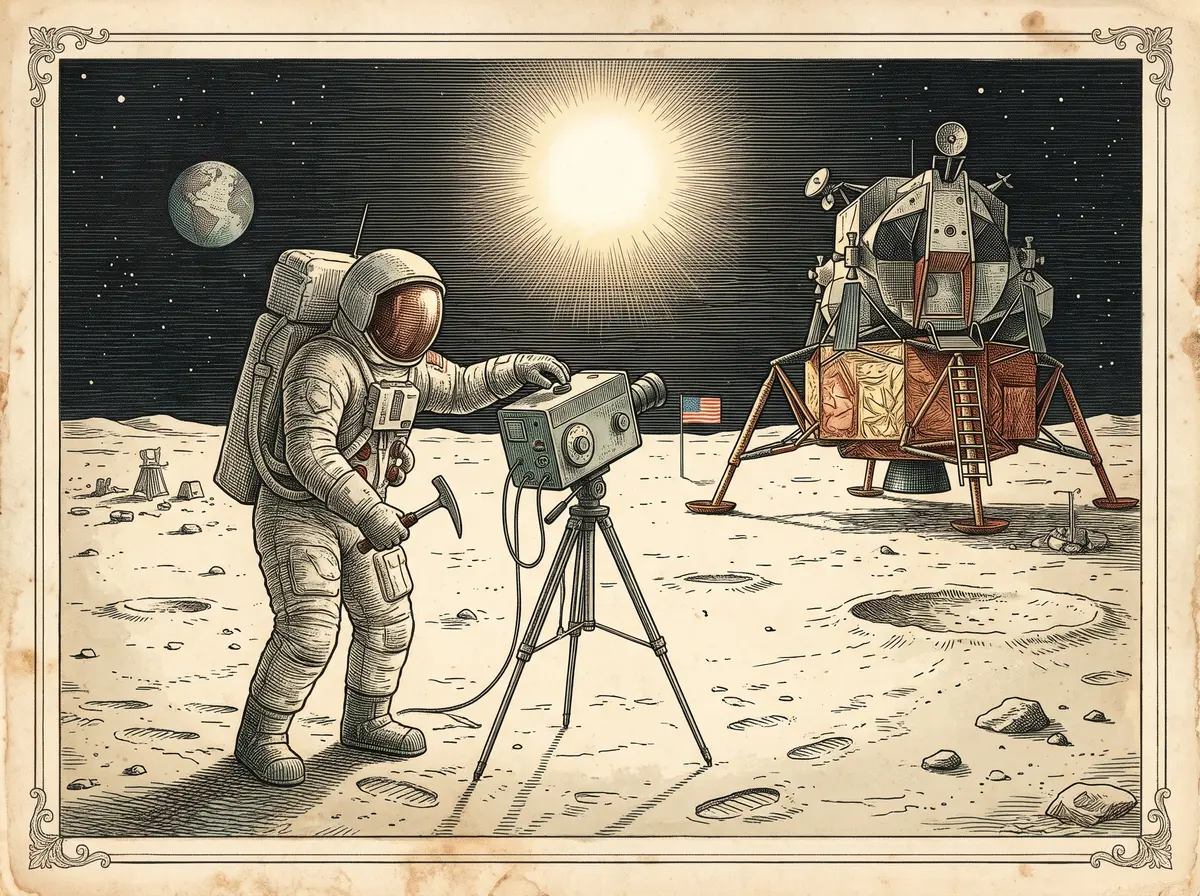
On November 19, 1969, about a quarter of a million miles from the nearest repair shop, astronaut Alan Bean gave the first color television camera ever carried onto the Moon a firm tap on the top with his geology hammer. It didn't help. The camera had been staring straight at the Sun, and viewers back on Earth were now looking at a smear of white glare above a field of black. "Skillful fix, Al," said Mission Control.
By the Curiosities Desk · · 5 min read · Filed under Space · Today’s round
What happened: Apollo 12's Color Camera
Apollo 12 was the second crewed Moon landing, arriving just four months after Apollo 11. Commander Pete Conrad and lunar module pilot Alan Bean set their lander, Intrepid, down in the Ocean of Storms on November 19, 1969, while Dick Gordon orbited overhead in the command module. Conrad’s first words on the surface were a deliberate jab at Neil Armstrong’s famous line: “Whoopie! Man, that may have been a small one for Neil, but that’s a long one for me.” (Smithsonian curator Teasel Muir-Harmony has said the line came out of a bet with a journalist over whether NASA scripted Armstrong’s words.)
The crew had a new toy. Apollo 11’s moonwalk had gone out in grainy black and white. Apollo 12 carried a Westinghouse color camera. To make color, a wheel of colored filters spun behind the lens, and the camera sent red, green and blue views one after another for computers on the ground to blend into a single color picture.
Its heart was a light-sensitive image tube known as a secondary electron conduction (SEC) tube. The tube was very sensitive, which made it good for dim scenes. It also made it fragile. As a Westinghouse engineer later explained to the Apollo Lunar Surface Journal, NASA’s annotated record of every moonwalk, the SEC tube “was very sensitive when exposed to direct, bright light.”
At first the camera sat on a fold-down equipment shelf on the side of the lander, giving viewers a look at the astronauts climbing down. Less than an hour into the first moonwalk, Bean unclipped it to carry it out to a tripod, where it could show the whole work site. According to the Journal’s mission-time transcript, he narrated the problem as it happened: “Here is the TV. And it’s pointing toward the Sun. That’s bad.”
Within about a minute, Capcom Ed Gibson in Houston reported “a pretty bright image” and asked if Bean could adjust it. Soon the ground saw a very bright stripe across the top and darkness over “about 80 percent of the bottom.” Bean suspected glare off the shiny lander, then an electrical fault. He peered into the lens and reported that something looked “cracked and maybe even melted a little bit.” The Smithsonian’s Air & Space magazine notes he also wondered whether the color wheel had jammed.
So, about 17 minutes after the first warning, he tried the oldest repair in the book. “I hit it on the top with my hammer,” he radioed. “I figured we didn’t have a thing to lose.” Houston’s reply came six seconds later: “Skillful fix, Al.” The picture stayed ruined, and Gibson told the crew to press on without it.
They did. Conrad and Bean spent more than seven and a half hours outside over two moonwalks. They set up a science station and visited the old Surveyor 3 probe, but almost none of it reached living rooms live.
Why it was strange: Apollo 12's Color Camera
The camera wasn’t broken by a moon rock, a power failure, or the harsh lunar cold. It was broken by the one thing every astronaut on the surface could see at all times: the Sun.
The deeper surprise is that neither moonwalker seems to have known it was a danger. In a 1991 interview for the Journal, Conrad said, “We were never told it was a big deal.” He added that the crew never trained with a working camera at all. Bean was remarkably candid about his part. He said he’d been treating the camera casually, “just throwing it around,” and said the record of that minute “shows me in one of my more honest moments.”
The second Moon landing faded from public memory partly because of one swing of a tripod. For another Apollo 12 surprise from the same moonwalk, see The Secret Self-Timer Two Astronauts Smuggled to the Moon — and Lost in a Bag of Rocks.
What scientists learned: Apollo 12's Color Camera
The crew brought the camera home, and it went straight to Westinghouse for testing. NASA’s Apollo 12 Mission Report concluded that direct sunlight had damaged the tube’s target, the light-sensitive surface the image forms on. The camera’s automatic light control then made things worse. Like the auto-brightness on a phone screen, it adjusts the picture to the brightest thing in view. Faced with a scorched hot spot, it dimmed everything else into black.
The fix was low-tech. The report said procedures, “including the use of a lens cap,” were being changed. According to TV engineer Bill Wood’s history of Apollo television, crews from Apollo 13 on were told to cap the lens whenever the camera was moved.
From Apollo 15 onward, an RCA camera with a more robust image tube replaced the Westinghouse unit for surface work. It rode on the lunar rover, and controllers in Houston could pan, tilt and zoom it remotely, so no astronaut had to aim it. One small thing undoing a big mission is a recurring theme: see The Missions Undone by One Small Thing.
How it reaches us today: Apollo 12's Color Camera
The famous later Apollo footage of astronauts bounding beside the rover and a lunar module blasting off came from that remote-controlled setup. Apollo 12’s lost broadcast helped push NASA toward it.
The broader rule stuck too: a sensitive instrument needs protection from the things around it that can blind it, and its operators need to train on the real hardware, not a stand-in. Space cameras still have to be guarded against looking at the Sun, by design and by careful pointing. For a different kind of camera mishap, read The Venus Lander That Tested the Hardness of Its Own Lens Cap.
Bean later found his own answer to the missing pictures. He left NASA in 1981 to become a full-time artist and spent decades painting the Moon from memory.
Fun fact: Apollo 12's Color Camera
Conrad said the only version of the camera they had to practice with before launch was a wooden block shaped like it, and a block of wood can’t burn out.
Sources: Apollo 12's Color Camera
- Eric M. Jones (ed.), “TV Troubles,” Apollo 12 Lunar Surface Journal, NASA — https://www.nasa.gov/wp-content/uploads/static/history/alsj/a12/a12.tvtrbls.html
- Bill Wood, “Apollo Television” (2005), Apollo Lunar Surface Journal, NASA — https://www.nasa.gov/wp-content/uploads/static/history/alsj/ApolloTV-Acrobat7.pdf
- Smithsonian National Air and Space Museum, “Seeing Apollo 12,” Nov. 19, 2014 — https://airandspace.si.edu/stories/editorial/seeing-apollo-12
- Air & Space/Smithsonian, “Live From the Moon” — https://www.smithsonianmag.com/air-space-magazine/live-from-the-moon-1882006/
- Geoff Brumfiel, “50 Years Ago, Americans Made the 2nd Moon Landing. Why Doesn’t Anyone Remember?,” NPR, Nov. 19, 2019 — https://whyy.org/npr-story/50-years-ago-americans-made-the-2nd-moon-landing-why-doesnt-anyone-remember
Related stories: Apollo 12's Color Camera
- Part of The Missions Undone by One Small Thing
- The Moon Rocket Struck by Lightning Twice — and the Switch Nobody in Mission Control Had Heard Of — How Apollo 12’s launch nearly ended in its first minute
- The Secret Self-Timer Two Astronauts Smuggled to the Moon — and Lost in a Bag of Rocks — The other thing that went missing on the same mission