The Secret Self-Timer Two Astronauts Smuggled to the Moon — and Lost in a Bag of Rocks
In November 1969, on the Apollo 12 crew's second walk on the Moon, Alan Bean stood beside a dead robot spacecraft with his gloved hand buried in a bag of rocks. He was not looking for a sample. He was looking for a little chrome camera timer that he and commander Pete Conrad had brought along without telling anyone. If they could find it, they were about to take the first picture of two astronauts together on the Moon, and let the world wonder who had snapped it.
By the Curiosities Desk · · 5 min read · Filed under Space · Today’s round
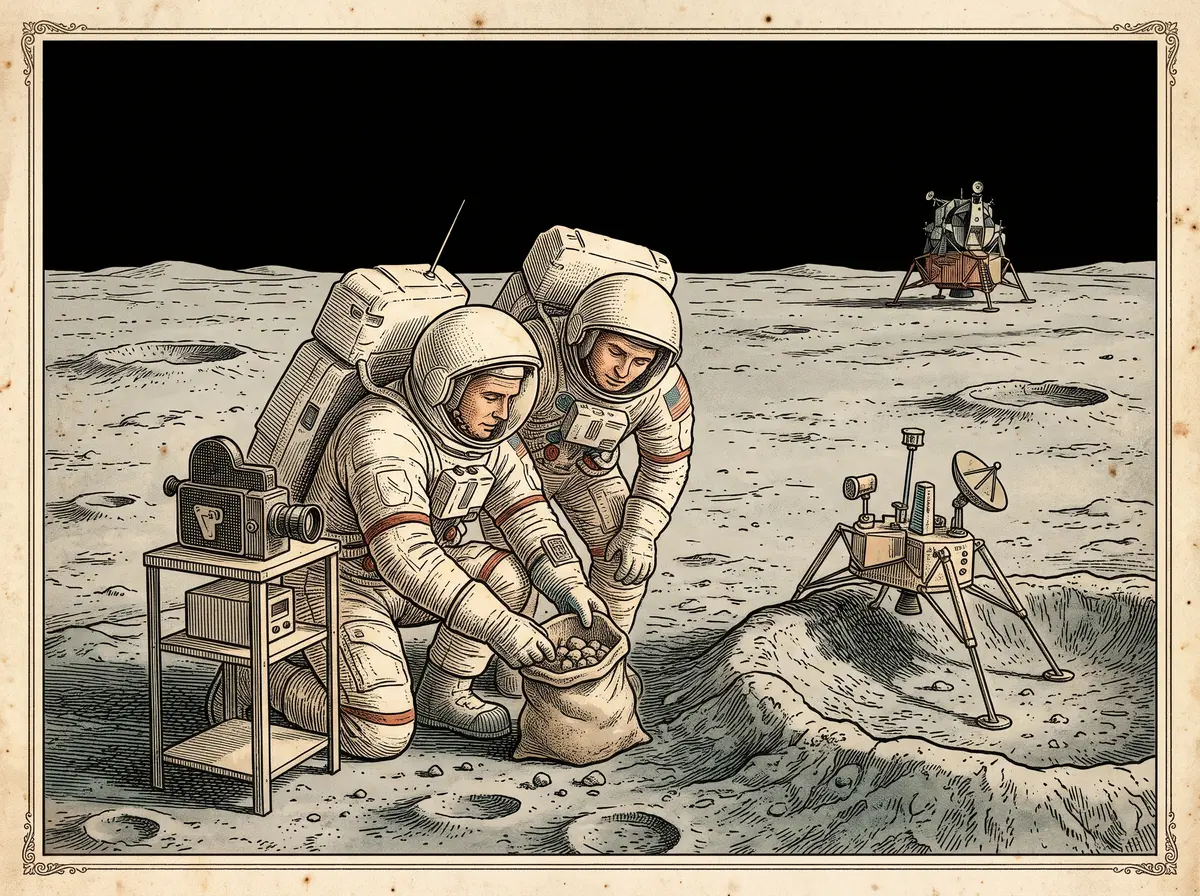
What happened: Apollo 12's Self-Timer
Apollo 12 was the second crewed Moon landing, and its big goal was precision: Apollo 11 had come down miles from its target. The target this time was Surveyor 3, an uncrewed probe that had landed in the Ocean of Storms on April 20, 1967, bounced twice on the way down, and then sat silent for two and a half years.
Conrad and Bean set their lunar module, Intrepid, down just 538 feet (164 meters) from it. That was close enough to walk over and take parts home.
During training, the two men had also hatched a private plan. On the Moon, every photo of one astronaut was taken by the other, so nobody ever got a shot of both of them at once. “We thought it would be wonderful if we could find a way to take a photo of us together on the Moon,” Bean later wrote. The answer was a self-timer for their Hasselblad camera, a small clockwork gadget that trips the shutter after a delay. Bean remembered it giving them “30 seconds or something” to get into the frame. They practiced with it in simulations on Earth, and it worked.
Exactly where the timer came from is a little fuzzy. In a later mission review, Conrad said it was a timer “that I had gone out and purchased in a camera store,” and that he slipped it into his flight suit pocket on launch morning “so nobody knew I had it.” Decades later, Bean recalled in an email that NASA’s crew systems engineers had shown them several timers. The editors of NASA’s Apollo Lunar Surface Journal note that both could be true. Either way, it rode to the Moon as a secret.
The scheme was to stash the timer in the sample bag on their hand tool carrier, a small rack that held their tools. At Surveyor, they would mount the camera on the carrier, start the timer and pose beside the probe. Then NASA’s public affairs office would release the picture, and people would ask the obvious question: who took it?
On the second moonwalk, they reached Surveyor 3, and Bean went for the bag. He couldn’t find the timer. “The dust on the Moon was so tenacious, and the shadows in the bag were so dark,” he wrote, that he couldn’t see it. His thick pressure gloves meant he couldn’t feel it either. He dumped rock samples on the ground, and Conrad helped hunt for a few minutes. Nothing. They put the rocks back and moved on.
The rest of the visit went to plan. With a pair of bolt cutters, Conrad snipped through cables and struts and freed Surveyor’s television camera (“It’s in the bag!”), then broke off its soil scoop. In all, the crew took about 22 pounds (10 kilograms) of the spacecraft home.
Then came the punchline. Back at the lunar module, Conrad dumped the sample bag into the rock box for the trip home. “It was right on the top,” Bean said of the timer. By then their time outside was nearly over. The double portrait never happened.
Why it was strange: Apollo 12's Self-Timer
The crew had crossed a quarter of a million miles and parked a short walk from their target. The plan that failed was the low-tech one. A pocket-sized camera accessory was beaten by two very ordinary things: dirt and shadow.
Lunar dust, also called regolith, is not like sand on a beach. It has never been rounded by wind or water, so the grains are jagged and cling to almost everything. Bean said it seemed to have a particular “attraction” to the shiny timer. In the airless sunlight, shadows are also extremely dark, because there is no air to scatter light into them. A small gray object at the bottom of a dusty bag was close to invisible. The Moon has a way of turning ordinary jobs into hard ones, as in The Moon Buggy Fender That Was Fixed With Duct Tape and Four Maps.
What scientists learned: Apollo 12's Self-Timer
The photo was lost, but the Surveyor parts were the real scientific prize. They were the first pieces of a spacecraft ever retrieved from another world. Engineers tested the television camera after its 947 days on the Moon, including 32 two-week lunar nights. Most parts held up well. They found no significant cold welding, where metal surfaces fuse together in a vacuum, and very few micrometeoroid hits. The main change was discoloration from dust and radiation. That was reassuring news for anyone designing machines meant to last on the Moon.
One famous finding needs a caveat. Scientists reported that Streptococcus mitis bacteria were cultured from foam inside the camera, and the story spread that Earth microbes had survived on the Moon. A 2011 review by John Rummel, Judith Allton and Don Morrison concluded the survival claim has never been shown to be true. Their photo analysis found “multiple opportunities for contamination” while the camera was being handled after it came home. The question of what hitchhikes to and from the Moon also drove The Airstream Trailer That Was Supposed to Save Earth From Moon Germs.
How it reaches us today: Apollo 12's Self-Timer
Surveyor’s camera now belongs to the Smithsonian’s National Air and Space Museum, and its scoop went on loan to the Cosmosphere in Hutchinson, Kansas. The lessons about materials, dust and contamination still shape how NASA plans sample-return missions and longer stays under its Artemis program.
The lost timer is a reminder that the hardest part of working on the Moon is often the simplest task. Gloves, dust and darkness turn finding a small object into real work, which is why tools for future moonwalkers are designed to be big, bright and easy to grip. For another tiny object that loomed large in the Apollo story, see The Corned Beef Sandwich That Got NASA Hauled Before Congress. The timer sits with the other everyday things that have a stranger past than they look, in The Ordinary Object With the Strange Origin.
Fun fact: Apollo 12's Self-Timer
Alan Bean became a painter after leaving NASA, and he eventually painted the picture he never got to take: himself and Pete Conrad posing together beside Surveyor 3, with the camera on the tool carrier. He called it “a fabulous photo.”
Sources: Apollo 12's Self-Timer
- NASA Apollo Lunar Surface Journal, Apollo 12 EVA-2 “Surveyor Crater and Surveyor III” (transcript and mission-review commentary on the timer): https://www.nasa.gov/wp-content/uploads/static/history/alsj/a12/a12.surveyor.html
- The Alan Bean Gallery, “The Fabulous Photo We Never Took” (Bean’s own account and painting): https://www.alanbeangallery.com/the-fabulous-photo-we-never-took
- NASA History, “55 Years Ago: Apollo 12 Makes a Pinpoint Landing on the Moon”: https://www.nasa.gov/history/55-years-ago-apollo-12-makes-a-pinpoint-landing-on-the-moon
- NASA Technical Reports Server, “Test and Evaluation of the Surveyor 3 Television Camera Returned from the Moon by Apollo 12” (NASA-CR-121796, 1970): https://ntrs.nasa.gov/citations/19710024418
- Rummel, Allton and Morrison, “A Microbe on the Moon? Surveyor III and Lessons Learned for Future Sample Return Missions” (Lunar and Planetary Institute, 2011): http://www.lpi.usra.edu/meetings/sssr2011/pdf/5023.pdf