Strange Animals Scientists Studied · Space
The Five Pocket Mice Who Orbited the Moon 75 Times on Apollo 17
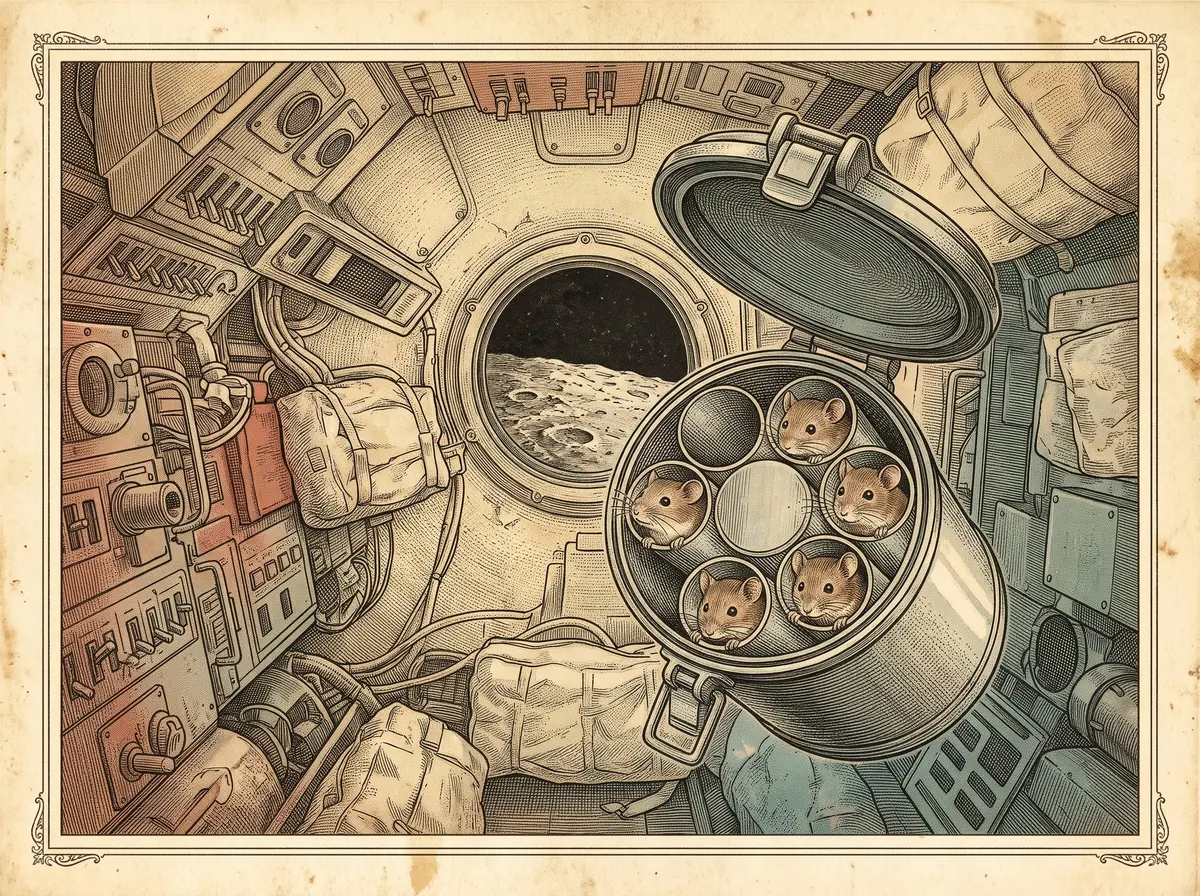
In December 1972, while Gene Cernan and Harrison Schmitt drove a rover across the Moon, their crewmate Ron Evans circled overhead in the command module *America* with five roommates sealed in a metal can in a locker: desert pocket mice, each wearing a tiny plastic radiation detector tucked under the skin of its scalp. According to later accounts, the crew nicknamed them Fe, Fi, Fo, Fum, and Phooey.
By the Curiosities Desk · · 5 min read · Filed under Space · Today’s round
Part of The Animals Hired for a Job
What happened: The Apollo 17 Mice
The mice were there because of a mystery the astronauts kept reporting. Starting with Apollo 11 in 1969, crews described seeing brief flashes of light when their eyes were closed or the cabin was dark. Buzz Aldrin was among the first to mention them. Later crews ran deliberate observation sessions to count the flashes.
The leading explanation was cosmic rays, specifically HZE particles (short for “high charge and energy”): the bare nuclei of heavy atoms, such as iron, racing through space at a large fraction of the speed of light. On Earth, the atmosphere and the planet’s magnetic field shield us from most of them. Beyond that protection, a single particle could zip through an astronaut’s eye and trigger a flash. That raised an uncomfortable question. If one particle could light up a retina, what was it doing to the brain cells along its path?
NASA’s answer was the Biological Cosmic Ray Experiment, or BIOCORE, led by neuropathologist Webb Haymaker at NASA’s Ames Research Center. The test subjects were little pocket mice (Perognathus longimembris) from the California desert. They were chosen for practical reasons. They are tiny, tough, and well studied. Most usefully, they get nearly all the water they need from the seeds they eat, so they could ride for nearly two weeks without anyone refilling a water bottle.
Each mouse lived in its own aluminum tube stocked with a mix of rye, sunflower seeds, oats, and millet. The tubes surrounded a central canister of potassium superoxide, a chemical that releases oxygen and soaks up carbon dioxide. The whole package weighed about 6 kilograms and was stowed in a locker in the command module. About five weeks before launch, each flight mouse had a detector implanted under its scalp: thin layers of plastic that record the track of any heavy particle passing through, like a bullet hole through a stack of paper. Line up the hole with the brain beneath it, and you’d know exactly which cells had been hit.
Apollo 17 launched on December 7, 1972. While Cernan and Schmitt spent about three days on the surface, Evans and the mice kept circling. NASA’s records give America 75 lunar orbits in all. The mission splashed down in the Pacific on December 19.
When scientists opened the canister about seven hours after splashdown, four of the five mice were alive. One, a male designated A3352, had died. The cause was never determined. (NASA’s paperwork used numbers, not nicknames, so it isn’t recorded which name went with the mouse that died.)
Why it was strange: The Apollo 17 Mice
The experiment flipped the usual logic of space biology. Most early animal flights asked whether a body could survive launch and weightlessness at all. BIOCORE assumed survival and asked something finer: whether individual invisible particles were punching microscopic holes through living tissue.
It also turned the mice into precision instruments. Because each scalp detector recorded exact tracks, researchers could, in principle, trace a single atomic nucleus from the plastic down into a specific spot in a specific mouse’s brain. That’s a remarkable amount of bookkeeping for an animal that weighs about as much as two nickels.
Five mice weren’t the first animals to swing past the Moon, either. That honor went to a pair of Soviet reptiles, told in The Two Tortoises That Flew Around the Moon Before Any Human Did.
What scientists learned: The Apollo 17 Mice
The detectors worked. Across the five mice, about 80 heavy-particle tracks were recorded. By the researchers’ count, 59 passed through brain tissue, 5 crossed an eye, and others crossed the nasal cavity and middle ear.
Then came the painstaking part: slicing the tissue into roughly 1,600 thin sections and searching for damage along the tracks. The results, published in NASA’s Biomedical Results of Apollo in 1975, were mixed. No lesions turned up in the retinas, and no brain damage could be clearly pinned on the particles. Researchers did find 13 tiny lesions in the scalps of three mice, but only one lined up with a recorded track. They called that “circumstantial evidence” of vulnerability, not proof.
The biggest surprise was in the nose. The four survivors had dozens of lesions in the tissue that senses smell, at least 51 per animal, including on the side no particle had crossed. Ground control mice didn’t have them. Nobody could say for sure why.
The team was candid about the limits. The spacecraft’s walls had blocked many of the most energetic particles, so the mice got a gentler dose than the experiment had hoped to test. The authors concluded that the lack of visible damage “by no means negates” the possibility of harm, and that less-shielded exposures would be needed to settle it.
Animal passengers on the next big U.S. program had their own odd adventures, described in The Skylab Minnows That Swam in Loops While Their Astronauts Were Space-Sick.
How it reaches us today: The Apollo 17 Mice
The question BIOCORE couldn’t answer is still open, and it matters more now. Astronauts in low Earth orbit stay partly inside Earth’s magnetic shield. A trip to Mars would not. Space agencies today study how heavy cosmic-ray particles affect brain cells and other tissues, using particle accelerators on the ground to fire beams that imitate deep-space radiation.
The light flashes turned out to be real and are still reported by astronauts on the International Space Station. And the mice hold a quieter distinction: for more than half a century, the Apollo 17 crew and their five passengers were the last travelers from Earth to venture out to the Moon, until the Artemis II astronauts swung around it in 2026. The pocket mice belong with the other animals hired for a job, in The Animals Hired for a Job.
Fun fact: The Apollo 17 Mice
Ron Evans and the five mice share the record for most orbits of the Moon: 75 each. The two moonwalkers, having spent part of the trip on the surface, came up short.
Sources: The Apollo 17 Mice
- Webb Haymaker, Bonne C. Look, Eugene V. Benton, and Richard C. Simmonds, “The Apollo 17 Pocket Mouse Experiment (Biocore)” — in Biomedical Results of Apollo, NASA SP-368 (1975), NASA Technical Reports Server (primary source)
- O. T. Bailey et al., “Biocore Experiment,” Apollo 17 Preliminary Science Report — NASA SP-330 (1973)
- Kenneth A. Souza et al., “Life Into Space: Space Life Sciences Experiments, Ames Research Center 1965–1990” — NASA (1995), Apollo 17/BIOCORE entry
- W. Haymaker et al., “The effects of cosmic particle radiation on pocket mice aboard Apollo XVII” — Aviation, Space, and Environmental Medicine 46(4) (1975)
- “Apollo 17 Mission Summary” — NASA History Office