Weird Medical History · Chemistry
The Gold-Wrapped Fake Gut Stones You Grated Into Your Wine Against Poison
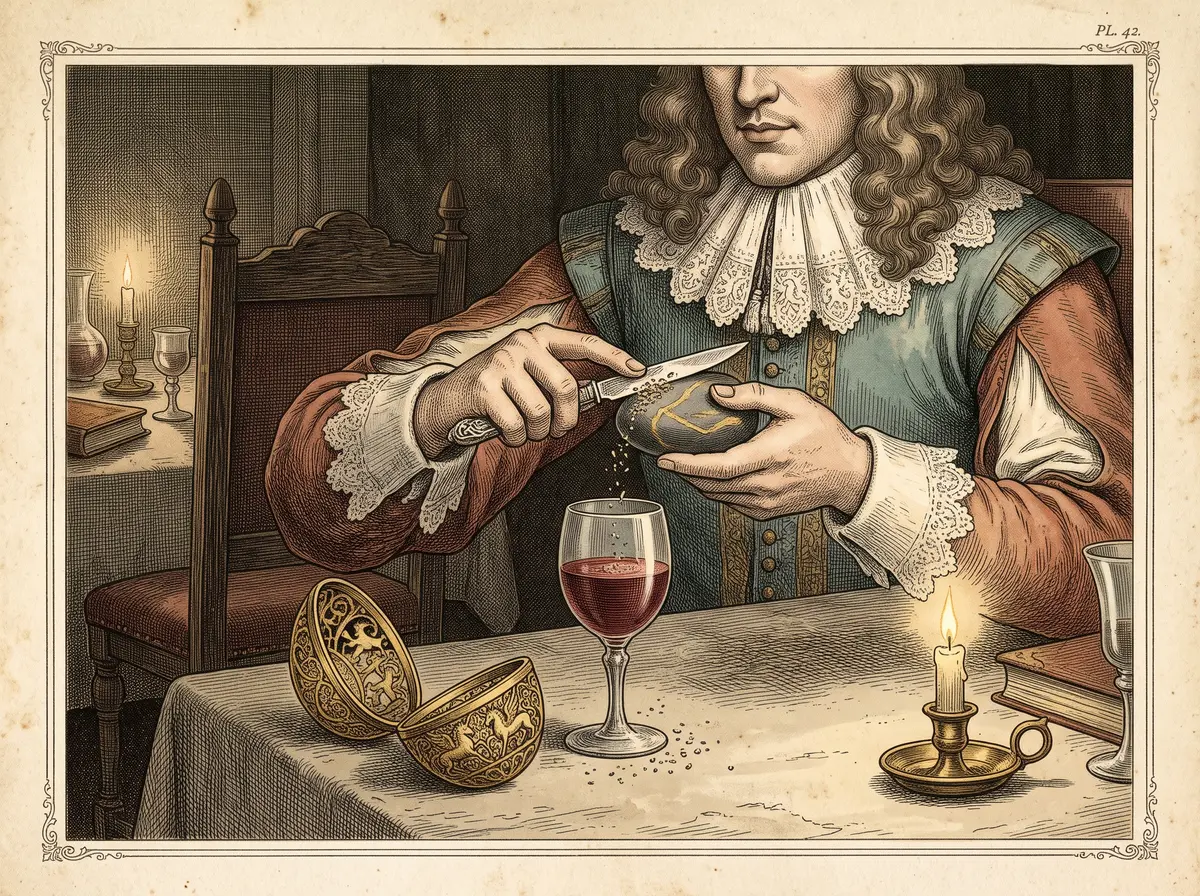
In the 17th century, Gaspar Antonio's handmade stones reached a nobleman's dinner. Before he drinks, he opens a little gold cage shaped like an egg, decorated with tiny unicorns and griffins, and lifts out a smooth grey ball streaked with gold. He scrapes a few shavings off it into his wine, the way you might grate cheese onto pasta. The ball is a Goa stone: a handmade copy of a lump found in a goat's stomach, rolled from crushed gems, seashells and fossil shark teeth. He is drinking it in case someone has poisoned him.
By the Curiosities Desk · · 5 min read · Filed under Chemistry · Today’s round
Part of Medicine, Before It Was Sure
What happened: The Goa Stone
The story starts with the bezoar, a real object with a strange job description. A bezoar is a hard mass that builds up in the digestive tract of animals such as goats, deer and antelope, usually layers of minerals around a core of hair or plant fiber. The word comes from the Persian pād-zahr, meaning “antidote.” Physicians in the Islamic world described bezoars as cures for poison, and through translated Arabic medical texts the idea reached Europe from the 12th century on.
By the 1500s and 1600s, bezoars were among the most prized medicines in Europe. People believed a bezoar could neutralize any poison it touched. According to JSTOR Daily, drawing on historians of the trade, a good one could be worth several times its weight in gold, and owners who could not afford a whole stone could buy thin slivers, or even rent one for a day.
Not everyone was convinced. Around 1567, the French royal surgeon Ambroise Paré set up one of the earliest recorded tests of a drug on a person. A cook in the royal household had been sentenced to death for stealing two silver plates. Paré arranged for him to take poison instead of being hanged, with the promise of a pardon if a bezoar saved him. He was given the poison, then scrapings of bezoar. He died about seven hours later. Paré concluded the stone was useless against poison.
The market kept growing anyway, and real bezoars were scarce. In Goa, the Portuguese colony on India’s west coast, Jesuit apothecaries came up with a solution. A Florentine lay brother named Gaspar Antonio developed a recipe for an artificial bezoar in the 17th century. It became known as the Lapis de Goa.
The recipe was a closely guarded secret, but surviving versions list a startling shopping list. Ingredients included a little natural bezoar, white and red coral, oyster shells, crab claws, fossil shark teeth, ambergris (a waxy substance from sperm whales), musk, clay and, in the luxury editions, crushed rubies, emeralds, sapphires and pearls. The mixture was worked into a paste, shaped into balls, rolled in gold leaf and polished when dry. Later batches dropped the gems to cut costs.
After Antonio died, the recipe passed to Father Jorge Ungarate and other Jesuits. Portugal confirmed the Jesuits’ monopoly in the 1690s, and the stones were exported to apothecaries and royal treasuries across Europe. When the Jesuits were expelled from Portuguese territory in 1759, Capuchin friars in Goa carried on making them, and the recipe survived into the 1800s. The Metropolitan Museum of Art in New York still has one, sitting in its pierced gold case from the late 1600s or early 1700s.
Why it was strange: The Goa Stone
The Goa stone was a fake of something that didn’t work in the first place, and it still sold for a fortune. Buyers weren’t fooled about what it was. They knew it was man-made. The pitch was that the Jesuits had improved on nature by adding gems and gold.
It also turned medicine into jewelry. The cases were often more elaborate than the cure, with filigree monkeys, parrots and dogs, and some people believed the gold itself boosted the stone’s power. A poison cure that was also a status symbol was a hard thing to give up, even after Paré’s grim test.
For another antidote that met a simple test, see The Spider That Walked Out of a Circle of Unicorn Horn — at One of the Royal Society’s First Meetings.
What scientists learned: The Goa Stone
Here’s the twist: bezoars may not have been completely useless against one poison. The minerals in many bezoars are calcium phosphates, including one called brushite. In the 20th century, Gustaf Arrhenius and Andrew Benson, of the Scripps Institution of Oceanography, reportedly found that bezoars soaked in an arsenic solution could pull some of the arsenic out. The proposed chemistry is ion exchange, in which one charged particle swaps places with another. Arsenate, a form of arsenic, closely resembles phosphate and can take its place in the mineral. Another form, arsenite, can bind to sulfur in the broken-down hair inside a stone.
The caveats are big. A 2019 note in MRS Bulletin pointed out that there is little peer-reviewed research behind the claim. Pulling a little arsenic out of a glass is very different from saving a person who has already swallowed it, which is exactly the situation Paré’s cook was in. And whatever a real bezoar did, a Goa stone made largely of shells, clay and gems was a different object.
The broader lesson was about testing. Paré’s experiment was cruel by modern standards, but it asked the right question: does the remedy do what people say, in a real body? Medicine kept asking it, more carefully, for the next four centuries. The everlasting antimony pill is another remedy from the same era that people kept believing in, as told in The Everlasting Pill That Families Fished Out of the Chamber Pot and Passed Down.
How it reaches us today: The Goa Stone
The idea behind the bezoar never quite died. Modern medicine uses substances that grab poisons in the gut. Activated charcoal, for example, can be given in some poisonings to bind certain substances before the body absorbs them. It works on surface chemistry, not magic.
Bezoars still turn up in people, usually as masses of hair, plant fiber or pills, and doctors treat them as a problem to remove. Goa stones survive mostly as museum pieces in New York, London and Vienna, admired more for their cases than for their pharmacy. More stories like this live in Medicine, Before It Was Sure.
Fun fact: The Goa Stone
A fake bezoar helped give English law the rule of “buyer beware.” In the 1603 case Chandelor v. Lopus, a man paid a goldsmith £100 for a stone the seller said was a bezoar. It wasn’t. The court ruled he couldn’t get his money back, because simply saying “it’s a bezoar” was not the same as guaranteeing it.
If you or someone you know may have been exposed to a poison, in the U.S. you can reach Poison Control at 1-800-222-1222 or poison.org; elsewhere, contact your local emergency number.
Sources: The Goa Stone
- The Metropolitan Museum of Art, “Goa Stone and Gold Case” (2004.244a–d) — the surviving late-17th/early-18th-century stone and case, with notes on how stones were scraped into drinks
- Christopher J. Duffin, “Lapis de Goa: the ‘cordial stone’”, Pharmaceutical Historian 40(2), 2010 — scholarly history of Gaspar Antonio’s recipe and the Jesuit trade
- JSTOR Daily, “From the Belly of a Goat to the Mouth of a King” — on Paré’s test, bezoar prices, rentals and Goa stone ingredients
- Omar Fabián, “The allure of the bezoar endures”, MRS Bulletin 44 (2019) — on the Arrhenius–Benson arsenic ion-exchange claim and its thin evidence base
- Columbia Law School, English Legal History, “Chandelor v. Lopus (1603)” — case summary of the £100 bezoar dispute and the caveat emptor ruling