Weird Medical History · Biology
The Spider That Walked Out of a Circle of Unicorn Horn — at One of the Royal Society's First Meetings
On July 24, 1661, the members of a brand-new scientific club in London sprinkled a ring of powdered "unicorn horn" on a surface, set a spider in the middle, and waited for the magic. The horn was supposed to be so powerful against venomous things that a spider could not cross it. The spider walked straight out. They put it back. It walked out again.
By the Curiosities Desk · · 5 min read · Filed under Biology · Today’s round
Part of Medicine, Before It Was Sure
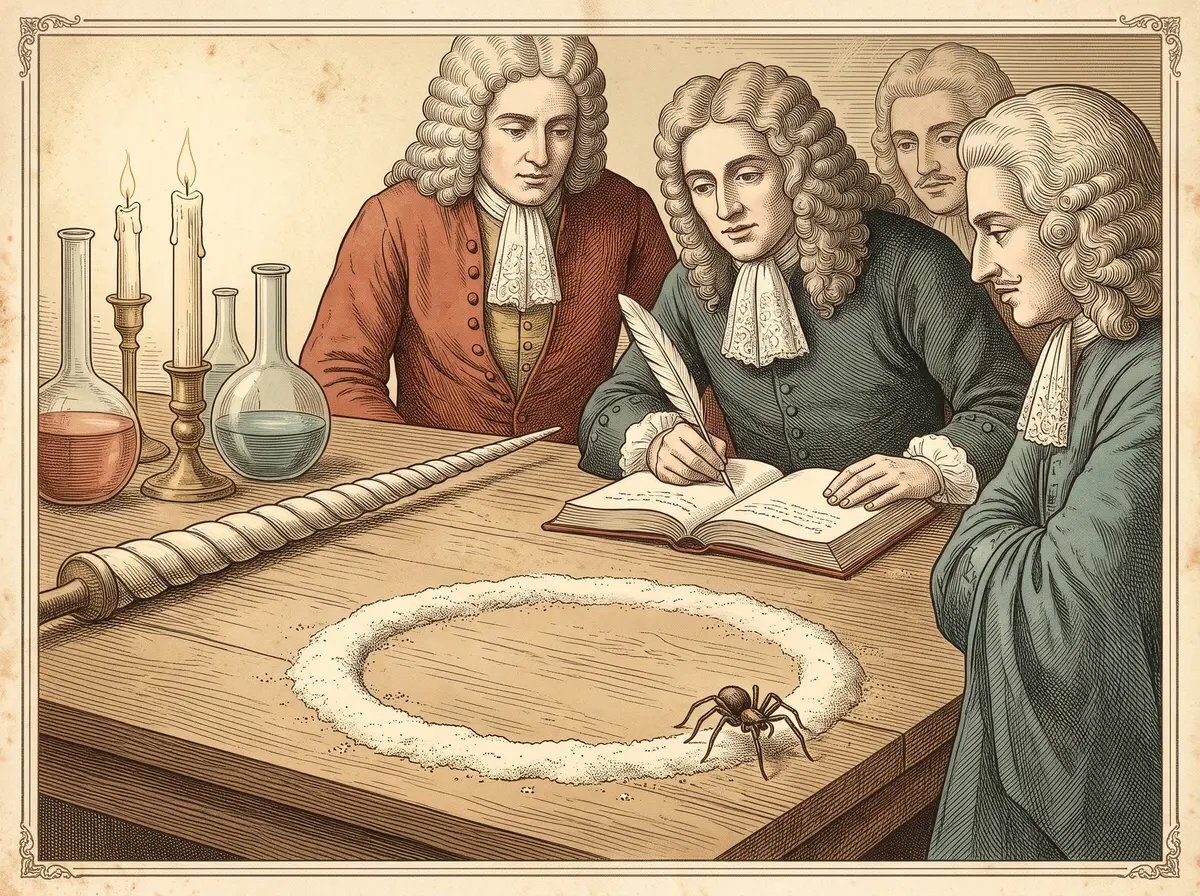
What happened: The Unicorn-Horn Spider Test
The Royal Society of London had been meeting for less than a year. Its founders had gathered at Gresham College in November 1660, and by the summer of 1661 they were filling their weekly meetings with tests of anything that could be tested. The minutes for July 24, 1661, preserved in the Society’s first Journal Book, record a full day: one member reported that a diving engine had been tried at Deptford the previous Friday, with a man staying inside it under water for 28 minutes. Then came the unicorn.
According to the minutes, a circle was made with “powder of Unicornes horne,” and a spider was set in the middle of it. The spider “immediately ran out,” and it did so several times when the trial was repeated. The record does add one small, honest detail: on one try the spider lingered for a while on the powder before leaving. That was the whole experiment. No equation, no apparatus, just a ring of very expensive dust and a spider with somewhere else to be.
The records do not say whose horn it was. A Royal Society history post notes that the Duke of Buckingham had promised to bring one when he was elected a Fellow in June 1661, but treats that only as a possible source.
Why test a unicorn horn on a spider at all? For centuries, Europeans had believed that “alicorn,” the horn of the unicorn, was the ultimate antidote. Powdered horn was taken for poisoning, fevers, plague, and convulsions. Wealthy families drank from horn cups or dipped horn into their food, trusting that it would react if something was poisoned. The French royal surgeon Ambroise Paré described the court practice: if a dish was poisoned, the horn was expected to grow hot and smoke. Since dealers sold plenty of fakes, buyers also used venomous creatures as a quality check. A genuine horn, the thinking went, would drive away or kill spiders and scorpions placed near it.
The stakes were high because the stuff was absurdly valuable. Pieces of horn were reportedly traded for many times their weight in gold. Queen Elizabeth I owned a jeweled horn, and in 1533 Pope Clement VII gave one to King Francis I of France. When London’s physicians published their official drug list, the Pharmacopoeia Londinensis, in 1618, “Cornu Unicorni” was in it, recommended for convulsions.
Why it was strange: The Unicorn-Horn Spider Test
The horn wasn’t a horn, and it didn’t come from a unicorn. Almost all of the “unicorn horns” in Europe were tusks of the narwhal, a small Arctic whale. The male narwhal’s tusk is actually a tooth, an extra-long canine that spirals out through its upper lip and can grow to around 10 feet. Norse and later Danish traders brought the tusks south, and their spiral shape changed how artists drew unicorns. Early unicorns had straight horns; after narwhal tusks reached the market, the unicorn’s horn twisted too.
By 1661, the secret was slipping out. In 1638, the Danish physician and collector Ole Worm argued that the “unicorn horns” in circulation were narwhal tusks, and he could point to a narwhal skull with the tusk still attached. So the Royal Society’s spider test landed at a moment when people already had reason to doubt the horn. What makes it remarkable is how simple it was. A claim that had been repeated by physicians, kings, and popes for generations was put to the plainest possible check, in public, and written down.
The ring-of-powder test has a cousin on this site: The Wound Cure You Rubbed on the Sword Instead of the Patient, another 17th-century remedy built on sympathy and hidden powers.
What scientists learned: The Unicorn-Horn Spider Test
The lesson wasn’t really about narwhals. It was about evidence. The early Royal Society adopted the motto Nullius in verba, roughly “take nobody’s word for it,” and the spider trial is that idea in miniature: if a substance is supposed to repel a creature, put the creature next to it and watch. The members also repeated the trial instead of trusting a single run, and they wrote down the one result that didn’t fit neatly, the time the spider paused on the powder.
Doubters had been building the case for decades. In his 1582 Discours on mummies, unicorns, venoms, and plague, Paré questioned the horn’s powers, while the Italian physician Andrea Bacci had defended it in a 1573 book. The spider didn’t settle the matter alone, but it added a clean, repeatable observation to the pile. Apothecaries kept selling horn chips and powder as antidotes into the 18th century, according to historians of the trade, yet the prestige drained out as the narwhal story spread.
Testing old cures against something you can actually observe would get sharper over the next century, as told in The Fake Metal Rods That Accidentally Invented the Placebo-Controlled Trial. More stories like it live in Medicine, Before It Was Sure.
How it reaches us today: The Unicorn-Horn Spider Test
Modern drug regulation rests on the same instinct the spider test captured: a remedy has to show its effect under conditions you can check and repeat, not on reputation. Today that means controlled trials, measured doses, and published results instead of a ring of powder, but the starting question is identical. Does it actually do what people say?
The narwhal side of the story has a modern echo too. Narwhal tusks are still prized objects, and the trade is now regulated under international wildlife law. Meanwhile, scientists are still working out what the tusk is for. It is packed with nerve endings, and drone footage has shown narwhals using their tusks to tap and stun fish. The “magic horn” turned out to be a sensory tooth on a real animal, which is strange enough on its own.
For another time a famous claim met a simple test, see Science’s Most Embarrassing Mistakes.
Fun fact: The Unicorn-Horn Spider Test
Denmark’s kings were crowned for nearly two centuries on a throne covered in “unicorn horn.” The coronation chair at Rosenborg Castle in Copenhagen, made between 1662 and 1671, is actually built from narwhal tusk, and it was used at coronations from 1671 to 1840.
Sources: The Unicorn-Horn Spider Test
- Royal Society, Minutes of an ordinary meeting, 24 July 1661 (JBO/1/38) — primary record of the unicorn horn and spider trial and the Deptford diving engine
- Royal Society, “Spider men” — on the Gresham College test and the possible Duke of Buckingham horn
- Jeffrey Aronson, “Treating convulsions in 1618 — unicorn’s horn”, The BMJ (2018) — on Cornu Unicorni in the Pharmacopoeia Londinensis
- Cleveland Museum of Art, “Hunting for a Unicorn Horn: Narwhal Tusks in Medieval Monsters” — on the narwhal trade, poison testing, Elizabeth I, and Ole Worm’s 1638 investigation
- The Royal Danish Collection, “The Knights’ Hall” — on the narwhal-tusk coronation chair at Rosenborg Castle