Strange Animals Scientists Studied · Chemistry
The Heap of Ants a Sheffield Man Distilled — and the Acid That Was Named After Them
In a letter dated January 13, 1670, the English naturalist John Wray reported to the Royal Society what happened when he stirred up an anthill and laid blue flowers on top. The ants crawled over the petals, and wherever they went, they left red stains. A Sheffield man named Samuel Fisher, meanwhile, had gone a step further: he had gathered ants, put them in a still, and boiled out a sour liquid that behaved like vinegar.
By the Curiosities Desk · · 5 min read · Filed under Chemistry · Today’s round
Part of Creatures That Changed Science
What happened: Formic Acid
John Wray, born in 1627 in the Essex village of Black Notley, was one of England’s great naturalists. He was elected a Fellow of the Royal Society in 1667 and spent years cataloguing plants, birds, fish, and insects with his friend and patron Francis Willughby.
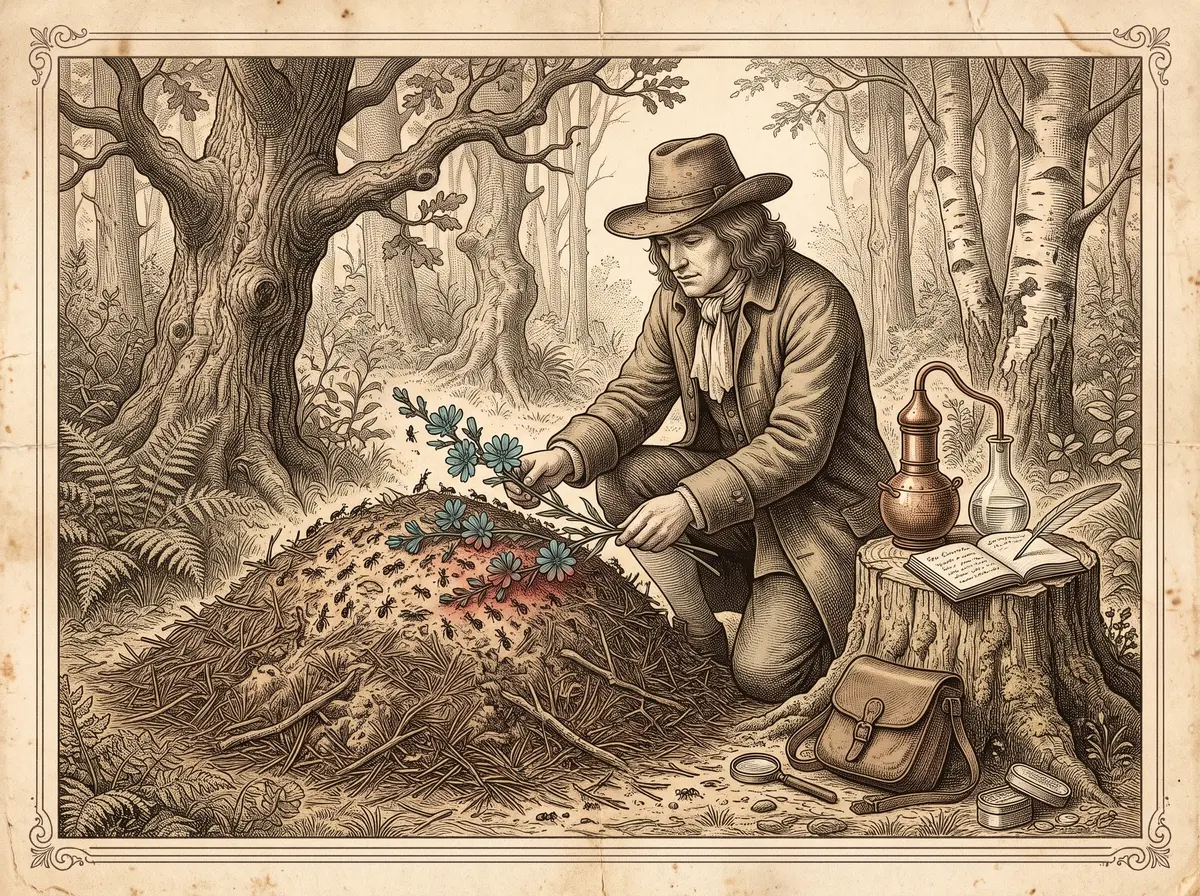
The ant experiments began with a book. A physician Wray calls Dr. Hulse had read in Langham’s Garden of Health, an old English herbal, a curious claim: put chicory flowers into an anthill, and the blue petals turn red. That sounded like the kind of folk wisdom worth checking, so Wray checked it. He disturbed an ant nest, set flowers on it, and watched. The ants left behind drops of liquid, and the petals blushed red wherever the drops landed.
Wray then compared the ants with chemicals he already knew to be acids. Strong “spirit of salt” (hydrochloric acid) and “oil of sulphur” (sulfuric acid) did surprisingly little to whole, unbruised petals, which he put down to a protective skin on the flower. But on bruised petals, the acids turned the blue to red at once. Warm vinegar did the same. Whatever the ants were leaving behind, it acted like an acid.
His letter, printed in the Royal Society’s Philosophical Transactions under the title “Concerning some un-common observations and experiments made with an acid juyce to be found in ants,” also passed along the work of Samuel Fisher of Sheffield. Fisher had found that even a weak “spirit of ants” turned borage flowers red instantly.
Then Fisher went further. He distilled ants, either on their own or with water, and collected what came off. The result was a sharp, sour spirit that reminded him of distilled vinegar. That was odd, because when Fisher’s circle distilled other animal matter (flesh, fish, other insects), they got an alkaline, “urinous” spirit instead, the opposite of an acid.
Fisher kept testing. Lead left in the ant liquid, with live ants still in it, formed “sugar of lead,” the same sweet-tasting compound chemists made by dissolving lead in vinegar. Iron produced a tinted, astringent solution. Fisher also told Wray he had tried the liquid as a medicine on some diseases and thought it worked. Nothing in the letter shows how he judged that, and it should be read as a 17th-century hunch, not evidence.
Wray was candid about how little he understood. As Chemistry World has quoted him, he admitted he did not know what sort of liquor this “Juyce” belonged to. He also wondered whether the ants released the liquid onto surfaces or injected it with their stings, and left that question for later observers.
Why it was strange: Formic Acid
Animals were supposed to yield alkaline spirits when distilled. Ants broke the pattern and produced an acid that smelled and acted like vinegar, a substance people associated with souring wine, not with insects.
The detective work was also unusual for its time. Wray didn’t simply repeat the herbal’s claim or dismiss it. He treated a line of garden lore as a testable statement, ran it on a real anthill, and checked his result against known acids. The ants, without knowing it, had turned a flower into a chemistry experiment.
For another insect that turned out to be carrying a chemistry lab, see The Beetle That Explodes Inside a Predator’s Stomach — and Walks Away.
What scientists learned: Formic Acid
The blue-to-red trick works because many flowers get their color from pigments called anthocyanins, which change color depending on acidity. That makes a petal a natural indicator, a substance that shows by color whether something is acidic or alkaline. Robert Boyle had shown in 1664 that syrup of violets turns red with acids and green with alkalis. The ants were simply supplying the acid.
The acid itself was eventually named formic acid, from formica, Latin for “ant.” Its formula, HCOOH, makes it the simplest member of the carboxylic acids, the family that also includes acetic acid, the sour part of vinegar. Fisher’s comparison to vinegar was closer to the truth than he could have known: the two are chemical cousins.
Later chemists learned to make it without ants. Joseph Louis Gay-Lussac produced it from hydrocyanic acid, and in 1855 Marcellin Berthelot made it from carbon monoxide by a route similar to the one industry uses today.
Many ants, including wood ants of the genus Formica, use formic acid as a weapon, spraying it at attackers and prey.
Chemists spent far longer pinning down another animal’s signature molecule in The Skunk Smell Chemists Got Wrong for 79 Years — and the Lab Recipe That Finally Saved a Coworker’s Cat.
How it reaches us today: Formic Acid
Formic acid is now an industrial chemical made by the ton, and no ants are harmed in the process. In Europe its biggest use is as a preservative for silage and other livestock feed, where it helps keep stored fodder from spoiling. It is used in leather tanning, in textile dyeing, and in rubber processing.
Beekeepers use it too. Formic acid vapor is a recognized treatment against Varroa mites, parasites that weaken honeybee colonies. One insect’s chemical defense is now used to protect another insect.
And the habit Wray modeled, taking a strange claim seriously enough to test it, is still the core of how science works.
For another early scientist who borrowed an idea from insects, see The Scientist Who Told Europe to Make Paper Like Wasps — and Was Ashamed He Never Tried It. The anthill belongs with the other creatures that changed science, in Creatures That Changed Science.
Fun fact: Formic Acid
The 1670 letter is signed “John Wray,” but that same year he dropped the W for good, after learning his family had once spelled the name “Ray.” That’s why most histories credit the ant experiments to John Ray. And because England then started its new year in late March, a letter dated January 1670 was written in what we would now call January 1671, which is why the discovery appears under both years.
Sources: Formic Acid
- Wray, J. “Extract of a letter, written by Mr. John Wray to the publisher January 13. 1670. Concerning some un-common observations and experiments made with an acid juyce to be found in ants.” Philosophical Transactions of the Royal Society, Vol. 5 (1670)
- Full OCR text of Wray’s 1670 letter, Philosophical Transactions archive (JSTOR 101624)
- Senthilingam, M. “Formic acid.” Chemistry in its Element, Chemistry World (Royal Society of Chemistry)
- Formic Acid, Molecule of the Month, University of Bristol School of Chemistry
- John Ray (1627–1705), Science in the Making, The Royal Society