Accidental Discoveries · Medicine
The Hives Pill That Cured a Streetcar Commuter's Motion Sickness — and the Troopship Sent to Test It
In 1947, a Baltimore woman came back to her allergy doctors at Johns Hopkins with a report they had not asked for. The experimental pill they had given her for hives was fine, she said. But something else had happened: for the first time in her life, she could ride the streetcar home without feeling sick.
By the Curiosities Desk · · 5 min read · Filed under Medicine · Today’s round
What happened: Dramamine
The doctors were Leslie Gay and Paul Carliner, allergists at the Johns Hopkins Hospital. In 1947 they were testing a new antihistamine from the drug company G. D. Searle & Co. that still went by a lab number, Compound 1694. Antihistamines were a hot new class of drug in the 1940s, and the hope was that this one would help with hay fever and urticaria, the itchy, raised welts better known as hives.
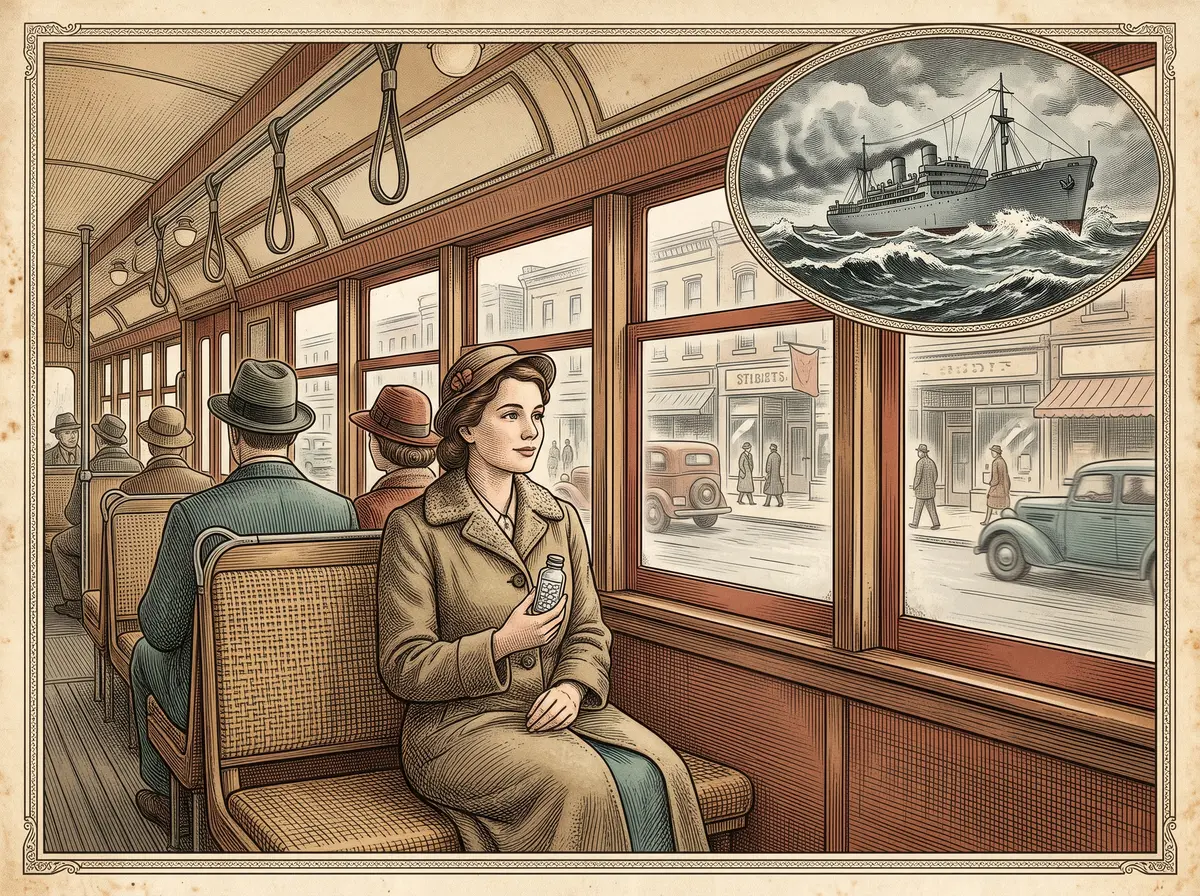
One of their patients was a woman with hives who, as later accounts describe her, was pregnant and had been prone to motion sickness her whole life. The trolley ride between work and home was a daily ordeal. While taking Compound 1694, she noticed that if she swallowed a dose shortly before boarding, the queasiness never came. When she was given a placebo — a dummy pill — instead, the sickness came back.
Gay and Carliner could have filed this away as a pleasant side note. Instead they followed it. They gave the drug to other patients, and to friends, who suffered from car sickness and air sickness, with instructions to take it before travelling. Gay later wrote that they were “completely freed of discomfort.”
A handful of happy commuters is an anecdote, not proof. The doctors needed motion sickness on a large scale, in a setting where they could compare people who got the drug with people who didn’t. They found it on the North Atlantic.
The ship was the General C. C. Ballou, a troop transport originally built as a freighter and known for rolling badly. With approval from Army Chief of Staff Gen. Omar Bradley, a study nicknamed “Operation Seasickness” went aboard in November 1948 as the Ballou carried 1,376 U.S. soldiers from New York to Bremerhaven, Germany, on a rough autumn crossing.
The soldiers were split into groups. One group of 134 men took the drug before the voyage got going and kept taking it. A comparison group of 123 got a look-alike placebo. Everyone else was left alone unless they got sick — at which point they were given the drug as a rescue treatment.
The results were lopsided. In the placebo group, 35 of 123 men became seasick. In the group that took the pill in advance, the Johns Hopkins account reports no cases at all; the published summary of the trial puts it at just two. Among the rest of the passengers, 389 got seasick, and 372 of them were reported fully relieved within an hour of a dose. On the return trip, carrying mostly women service members, the results held up.
Gay and Carliner presented the findings on 14 February 1949 at a meeting of the Johns Hopkins Medical Society and published them in the Bulletin of the Johns Hopkins Hospital. Newspapers across the country picked up the story. Searle named the drug Dramamine, and it reached American drugstores later that year.
Why it was strange: Dramamine
Nobody had gone looking for a seasickness cure. Compound 1694 was being tested on skin, for itching. The clue came from a part of the patient’s life — her commute — that was completely outside the study.
It also flipped an old assumption. Seasickness had been treated for centuries as something to endure, a matter of grit or “sea legs.” The idea that a pill meant for allergies could reach into the inner ear and the brain and calm it seemed unlikely. The scale of the test was unusual, too: a question raised by one woman on a Baltimore tram was answered by more than a thousand soldiers on a ship.
Another discovery that came from a side effect: The Failed Heart Pill That Trial Volunteers Wouldn’t Give Back. More on this shelf: Found While Looking for Something Else.
What scientists learned: Dramamine
The leading explanation for motion sickness is sensory conflict. Your vestibular system — the balance organs in your inner ear — reports that you are pitching and rolling, while your eyes, fixed on a cabin wall or a book, report that nothing is moving. When the brain gets these mismatched signals, nausea and vomiting can follow. Why the body responds this way is still debated.
Dramamine’s active ingredient, dimenhydrinate, turned out to be a pairing of two molecules: diphenhydramine, an antihistamine, and 8-chlorotheophylline, a mild stimulant related to caffeine. Searle added the stimulant to offset drowsiness. Diphenhydramine blocks H1 histamine receptors and also muscarinic receptors (receptors for the messenger chemical acetylcholine) in the balance pathways and the brainstem’s vomiting circuits. That dampens the alarm triggered by the conflicting signals.
The trial also showed something practical: timing matters. The drug worked best when taken before the motion started — exactly what the woman on the streetcar had stumbled onto.
Another case of a scientist’s own body becoming the experiment: The Worm Pill a Scientist Swallowed Before a Dinner Party — and Why His Beer Turned on Him.
How it reaches us today: Dramamine
The Ballou trial helped establish antihistamines as a standard treatment for motion sickness, and it hinted that they might help with other kinds of nausea too. Dimenhydrinate is still sold over the counter in many countries, including as Gravol in Canada. Its “take it before you go” advice is still printed on the packet, and its main side effect — drowsiness — is still the one travellers grumble about.
The problem it tackled also followed people off the ocean. Motion sickness became a serious subject for pilots and, later, for astronauts, whose balance systems get even more confused in weightlessness.
From the sea to orbit: The Senator Who Went to Space and Came Back as a Unit of Nausea.
Fun fact: Dramamine
The drug that became Dramamine was announced to the world on Valentine’s Day, 14 February 1949 — a seasickness cure that made its debut on the most romantic day of the year.
Over-the-counter motion-sickness medicines can cause drowsiness and interact with other drugs. If you’re pregnant, taking other medication, or giving them to a child, it’s worth checking with a pharmacist or doctor first.
Sources: Dramamine
- Gay LN, Carliner PE. “The prevention and treatment of motion sickness; seasickness.” Bulletin of the Johns Hopkins Hospital 84(5) (May 1949): 470–490. PubMed 18120066 — the primary report of the trial.
- Gay LN, Carliner PE. “The Prevention and Treatment of Motion Sickness I. Seasickness.” Science (1949). Scilit record
- Grauer N. “Hopkins History Moments.” Johns Hopkins Medicine, February 2019. Johns Hopkins Medicine
- Sanger GJ, Andrews PLR. “A History of Drug Discovery for Treatment of Nausea and Vomiting and the Implications for Future Research.” Frontiers in Pharmacology 9 (2018): 913. PMC6131675
- “1949: An End to Seasickness.” American Heritage, 1999. American Heritage