The 'Immortal' Chicken Heart That Lived 34 Years in a Dish — and Was Probably Being Topped Up All Along
In 1924, a New York newspaper marked the twelfth birthday of a speck of chicken heart. It had no chicken attached. It had stopped beating years earlier. It lived in a glass dish at the Rockefeller Institute, where technicians fed it, trimmed it, and moved it to fresh dishes every few days, and the public had come to think of it as immortal. For decades, it was one of the most famous experiments in the world. It was also, almost certainly, wrong.
By the Curiosities Desk · · 5 min read · Filed under Medicine · Today’s round
What happened: Carrel's Chicken-Heart Culture
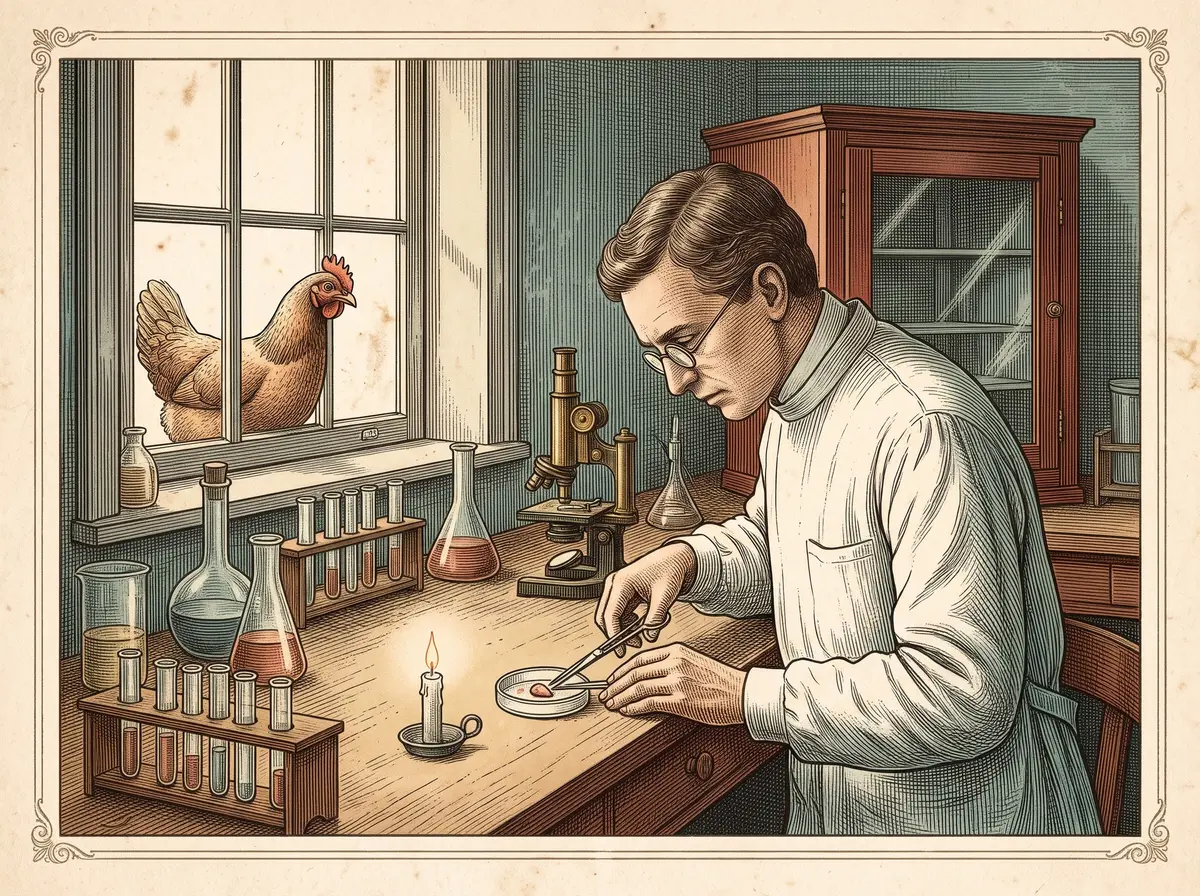
On 17 January 1912, the French-born surgeon Alexis Carrel, working at the Rockefeller Institute for Medical Research in New York, cut small fragments from the heart of a chick embryo and set them growing outside the body. The method came from the American biologist Ross Granville Harrison: a fragment sat in a drop of chick blood plasma on a glass coverslip, kept warm at about 39 °C. Every two or three days, the tissue was cut down and moved to a fresh drop, a step called passaging.
At first the fragments kept pulsing. By April 1912 the beating had stopped, but the cells were growing faster than ever, helped by a new ingredient Carrel added in March: a juice made from mashed chick embryos, called embryo extract. That same year Carrel won the Nobel Prize in Physiology or Medicine — not for the heart culture, but for his techniques for sewing blood vessels together.
In June 1912, Carrel handed daily care of the culture to his assistant, Albert Ebeling. Some dishes became contaminated, but Ebeling kept one line going. By 15 January 1913 he had logged 129 passages. Carrel published updates when the culture was 16 months old and again at 28 months, comparing the cells to single-celled organisms that seem to divide forever.
The press loved it. In April 1921 the New-York Tribune ran a story headlined “Two Nurses and Doctor Attend Carrel’s Living ‘Chicken Heart’.” A writer for The World calculated that if all the tissue had been kept, it would make a rooster “big enough today to cross the Atlantic in a stride.” A 1925 Time article reported that the tissue was “pared down each day” and, if left alone, would have become “a colossal monster overspreading all New York.” The Tribune marked its twelfth birthday in 1924.
Carrel retired in 1939 and went back to France. Ebeling and two technicians took the culture to Lederle Laboratories in Pearl River, New York, where it was used to test whether drugs and germicides were toxic to cells. The last batch was thrown out in 1946, two years after Carrel’s death — 34 years after the experiment began. A chicken usually lives somewhere between six and twelve years.
Why it was strange: Carrel's Chicken-Heart Culture
The culture seemed to show that cells, given perfect care, never had to die. If that were true, aging wasn’t built into living things. It was something done to them from outside — by poor nutrition, perhaps, or a buildup of waste. Fix the environment, and in principle you could fix aging.
That idea shaped biology for half a century. From the 1920s into the 1960s, many textbooks treated normal cells as potentially immortal, and blamed the ones that died in other labs on poor technique.
The strange part is that no one else could do it. Other researchers tried to keep ordinary chick cells dividing for more than a few months and failed. The most famous result in tissue culture was one almost nobody could reproduce.
More results that fell apart on a second look are collected in The Experiment That Did Not Come Out.
What scientists learned: Carrel's Chicken-Heart Culture
In 1961, Leonard Hayflick and Paul Moorhead at the Wistar Institute in Philadelphia published a careful study of normal human cells grown in the lab. Their cells divided roughly 50 times and then stopped, a ceiling now called the Hayflick limit. Normal cells, it turned out, have a built-in limit on how many times they can divide.
So what was going on in Carrel’s dishes? Hayflick suggested an innocent explanation. The embryo extract was made by grinding up chick embryos and spinning out the solids, and Carrel never said how hard it was spun. If live cells slipped through, every feeding would have added fresh young cells to the culture. Hayflick noted that bursts of growth matched the times extract was added.
In 1980 the historian Jan Witkowski raised a less comfortable possibility. He cited a 1930 visit by the biologist Ralph Buchsbaum, who recalled a technician saying they would “add a few embryo cells now and then” to keep the culture going. Whether that happened, and who knew, has never been settled. What is settled is that the “immortal” heart was probably not one unbroken line of cells.
Another animal that seems to cheat aging — with real caveats — is The Jellyfish That Can Reverse Its Own Aging.
How it reaches us today: Carrel's Chicken-Heart Culture
The Hayflick limit became one of the founding ideas of aging research. Scientists later traced it to telomeres, protective caps on the ends of chromosomes that get shorter each time a cell divides. Work explaining telomeres and the enzyme that rebuilds them, telomerase, earned Elizabeth Blackburn, Carol Greider and Jack Szostak the 2009 Nobel Prize in Physiology or Medicine.
Some cells really can divide without limit in a dish, but mostly because something has gone wrong with them. The best-known example, the HeLa line, came from the cervical cancer of Henrietta Lacks, taken without her knowledge in 1951. Cancer cells often switch telomerase back on, which is one reason the old question — why do normal cells stop? — still matters in cancer research.
Carrel’s tissue-culture methods did lasting good, even though his biggest claim did not hold up. His reputation is complicated for other reasons, too: his 1935 bestseller Man, the Unknown promoted eugenics.
Another famous chicken that outlived expectations: The Chicken That Lived 18 Months After Losing His Head.
Fun fact: Carrel's Chicken-Heart Culture
In 1922, Albert Ebeling worked out that if every cell from the chicken heart culture had been kept instead of trimmed away, the mass would by then have been bigger than the sun.
Sources: Carrel's Chicken-Heart Culture
- “Alexis Carrel’s Immortal Chick Heart Tissue Cultures (1912–1946).” Embryo Project Encyclopedia, Arizona State University. embryo.asu.edu
- Witkowski, J. A. “Dr. Carrel’s Immortal Cells.” Medical History 24, no. 2 (1980): 129–142. PMC1082700
- Hayflick, L., and Moorhead, P. S. “The Serial Cultivation of Human Diploid Cell Strains.” Experimental Cell Research 25 (1961): 585–621. PubMed 13905658
- “Reassessment of Carrel’s Immortal Tissue Culture Experiments.” Embryo Project Encyclopedia, Arizona State University. embryo.asu.edu
- “Alessandro Fabbri, the Rockefeller Institute & the Immortal Chicken Heart.” Gotham Center for New York City History. gothamcenter.org