Impossible Inventions · Medicine
The Brass Mechanical Leech That Worked Best After a Real Leech Took the First Bite
In October 1879, a Washington, D.C., eye surgeon named Francis B. Loring stood before his city's medical society to talk about a machine built to replace the leech. It had a spinning steel blade, a glass cylinder, and a brass piston. Then he made a small confession. For the last few years, he said, he had been getting the best results by first letting a natural leech bite the patient, and then putting the machine over the bite.
By the Curiosities Desk · · 5 min read · Filed under Medicine · Today’s round
Part of Built to Do the Impossible
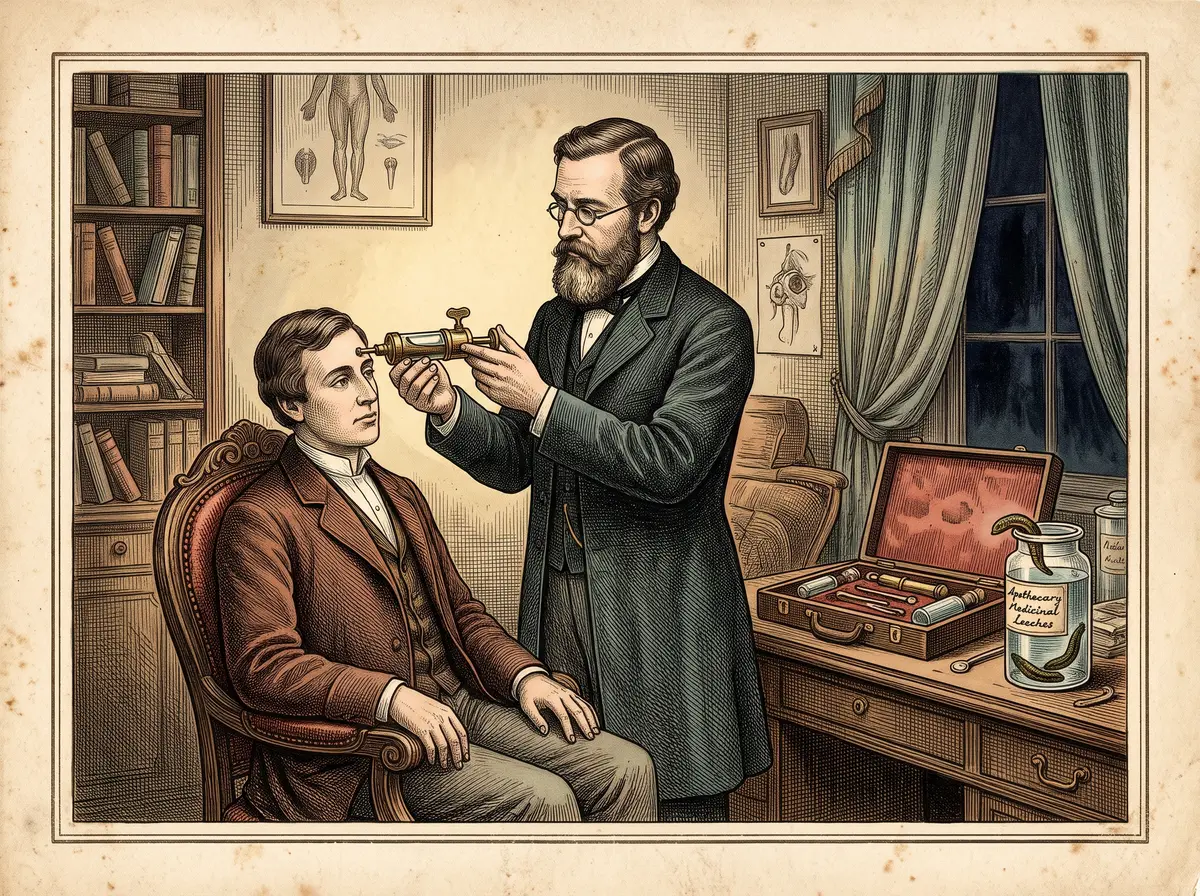
What happened: The Mechanical Leech
In the early 1800s, many European doctors believed that most illness was driven by inflammation and that removing blood would calm it. The medicinal leech, Hirudo medicinalis, was the gentle, precise way to do it: it took a small amount of blood from exactly where you put it. France in particular went through them at an astonishing rate. According to a 2023 study in the journal Medical History, France imported more than fifty million leeches in the single year of 1832, and Paris alone was using two to three million a year in the 1830s. Wild leech populations collapsed from over-collecting and drained marshland, prices rose, and the animals had to be shipped in from as far away as the Ottoman Empire.
Into that shortage stepped Charles Louis Stanislas Heurteloup (1793–1864), a Paris-born surgeon who had already designed instruments for crushing bladder stones without open surgery, and in 1829 performed the first such operation in England. Around 1840, according to the University of Michigan’s medical school, he introduced an “artificial leech.”
His device came in two parts. The first was the “bite”: a tiny circular blade that the operator set spinning, in early versions by pulling a cord, so that it cut a neat ring into the skin. The second was the “suck”: a glass cylinder with a close-fitting piston inside. You pressed the open end of the glass over the cut and turned a screw or key to draw the piston up, creating a partial vacuum that pulled blood out into the tube. Surviving sets in the Science Museum Group collection in London, dated to around 1850, include two glass cylinders with leather-packed pistons, a metal key, and a little pot of grease to keep everything moving.
The machine found its niche on the head. Doctors used it to draw blood from the temple and around the eyes, where a live leech was hard to keep in place, and where a leech crawling toward an eyeball was nobody’s idea of a good afternoon. Eye surgeons were still relying on it in the late 1800s.
Loring ran the Washington Eye and Ear Infirmary, so he used the artificial leech a lot. His October 1879 paper, “Modification of the Artificial Leech,” listed its problems. Its cord-driven blade wobbled sideways as it spun, which he said was “apt to produce a rough and uneven incision” that could leave a scar. The little set-screw that controlled how deep the blade went wore out quickly, until it could no longer be trusted. So, as a workaround, he let a real leech make the cut, then put the cylinder over the fresh bite.
Rather than give up, Loring redesigned the blade so it plunged straight down, rotating like the plunger of a syringe. He replaced the set-screw with a solid sheath that fixed the depth, and he fitted a ring of thick plate glass at the tip so he could see exactly where he was cutting. He reported that patients complained of it “but very slightly,” and that in none of his cases had a scar resulted.
Why it was strange: The Mechanical Leech
Most inventions aim to beat nature. This one spent decades trying to match a worm and kept coming up short. A leech’s bite is a remarkable piece of equipment: three tiny jaws lined with teeth leave a clean Y-shaped mark, and its saliva carries chemicals that keep blood from clotting. Heurteloup’s machine could cut and it could suck, but it could not stop the blood from clotting in the wound, and its cut was cruder than the bite it was imitating.
There was also a deeper irony. All this engineering went into making bloodletting more convenient, at the very time some doctors were starting to count whether it worked at all. The leech craze it was built for was the same one described in The Doctor Who Prescribed 30 Leeches for Everything — and the Paris Dresses Embroidered in His Honor.
What scientists learned: The Mechanical Leech
The leech’s trick turned out to be chemistry, not plumbing. In 1884, the British physiologist John Berry Haycraft reported that extracts of leech heads kept blood from clotting. The substance responsible was later named hirudin, and it proved to be a powerful anticoagulant, a chemical that blocks clotting by switching off an enzyme in the blood called thrombin.
That explains Loring’s workaround. A real leech’s bite leaves hirudin behind in the wound, so blood keeps flowing for hours. A steel blade leaves nothing behind. Put the glass cylinder over a leech bite and you get the leech’s chemistry plus the machine’s measured suction.
Bloodletting itself lost its place in mainstream medicine over the following decades, as doctors tested its supposed benefits and found they did not hold up. For another case of leeches being asked to do a job they were not designed for, see The Twelve Leeches That Were Supposed to Ring a Bell When a Storm Was Coming.
How it reaches us today: The Mechanical Leech
Real leeches came back, for one specific job. In reconstructive surgery, when a finger, ear, or patch of skin is reattached, the arteries are often easier to reconnect than the veins. Blood flows in but cannot get out, and the tissue swells and can die. A leech drains it slowly while its saliva keeps the blood moving. In June 2004, the U.S. Food and Drug Administration cleared leeches sold by the French leech farm Ricarimpex as a medical device for exactly this use.
And Heurteloup’s idea has not gone away either. In 1995, surgeons in the Journal of Reconstructive Microsurgery tested a prototype “mechanical leech” on rats. During the first hour of treatment it restored blood flow in congested tissue better than a real leech did. It has not replaced the animal in hospitals. Hirudin also inspired a family of blood thinners called direct thrombin inhibitors, including bivalirudin, a lab-made drug modeled on it that is still used during heart procedures.
A machine asked to do a leech’s job belongs with the others in Built to Do the Impossible.
Fun fact: The Mechanical Leech
Even at the height of the shortage, real leeches were sometimes recycled: a leech that had eaten its fill could be made to give the blood back up by sprinkling it with salt or vinegar, then put to work again.
Sources: The Mechanical Leech
- Modification of the Artificial Leech — Francis B. Loring, read before the Medical Society of the District of Columbia, October 1879 (U.S. National Library of Medicine digital collections)
- Mechanical leech, Europe, 1850–1900 — Science Museum Group Collection (Heurteloup’s patented leech and its parts)
- Artificial Leech — Medicine at Michigan, University of Michigan Medical School (invention around 1840; use near the eyes and temples)
- “Pearls” of the nineteenth-century: medicinal leeches in the Ottoman Empire — Büşra Arabacı, Medical History 67(2), 2023 (French leech imports and shortages)
- Mechanical leech therapy to relieve venous congestion — E. C. Smoot et al., Journal of Reconstructive Microsurgery 11(1), 1995
This article describes historical medical practices, not health advice. If you have questions about a treatment or a medical device, a doctor or pharmacist is the best person to ask.