Science Gone Wrong · Engineering
The Mirror-Glass Skyscraper That Turned Into a 'Plywood Palace'
On January 20, 1973, Boston's newest skyscraper was supposed to be a sleek blue mirror reflecting the sky. Instead, a winter gale was pulling its windows out. Panes of glass the size of a door and weighing about 500 pounds each cracked loose and dropped toward the sidewalks of Back Bay, and police roped off the streets below. Within months, so much of the tower was covered in black-painted plywood that Bostonians gave it a new name: the Plywood Palace.
By the Curiosities Desk · · 5 min read · Filed under Engineering · Today’s round
Part of When the Experiment Left the Lab
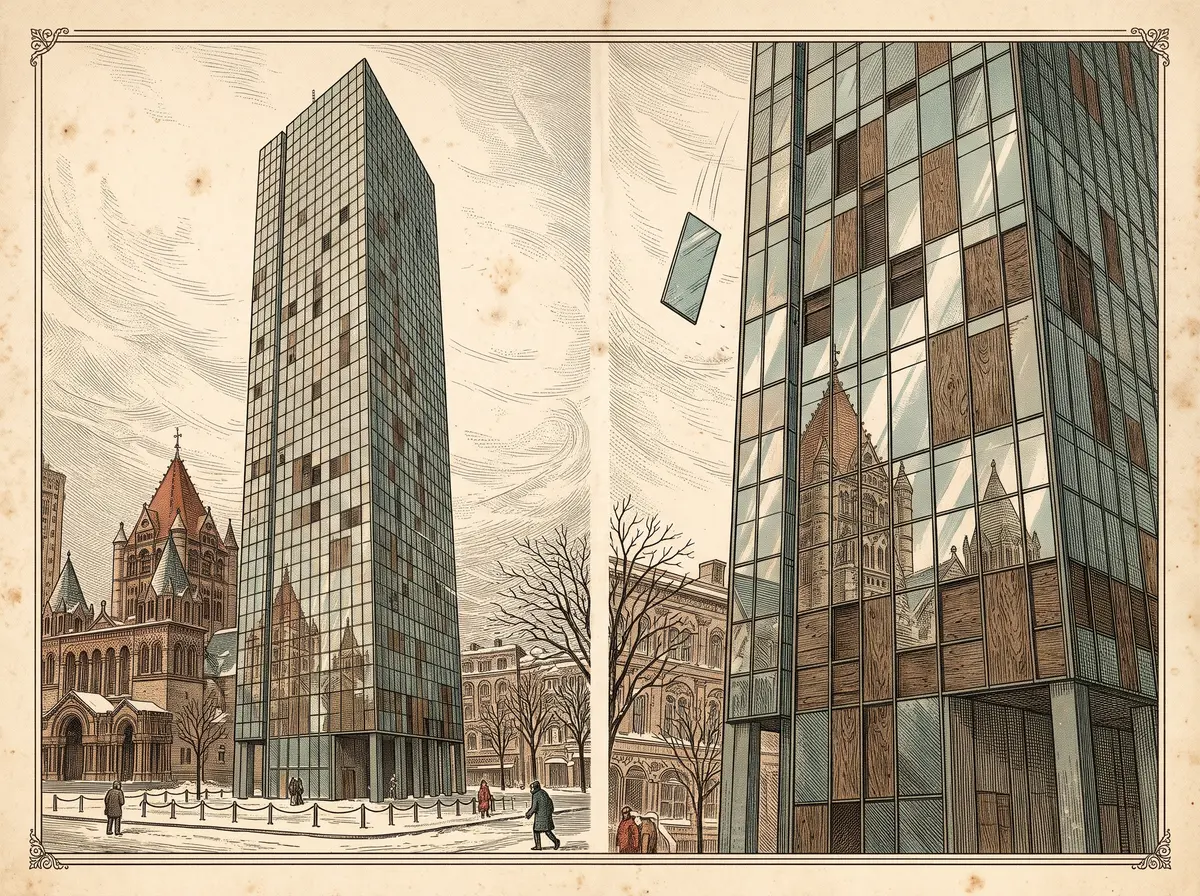
What happened: The Hancock Tower Windows
The John Hancock Tower was meant to be a triumph. Designed by architect Henry N. Cobb of I.M. Pei & Partners for the John Hancock Mutual Life Insurance Company, it rose 60 stories and 790 feet over Copley Square, the tallest building in New England. Its shape was a thin, slanted slab, and its skin was nearly all glass: 10,344 reflective panels, each about 4 feet wide and 11 feet tall. The idea was that it would reflect its famous neighbor, the 1870s Trinity Church, instead of looming over it.
Construction began in 1968, and trouble started underground. The steel walls holding back the soggy fill soil of Back Bay during excavation proved inadequate, and the sides of the pit caved in. The shifting earth cracked nearby buildings, ruptured utility lines, and pushed part of Trinity Church close to collapse. The church later won a lawsuit to pay for repairs.
Then came the windows. Panes began cracking during construction in 1972, often starting with a small J-shaped crack at the edge of the outer glass. The January 1973 storm, with gusts reported at about 75 miles per hour near the upper floors, brought down at least 65 panels at once. From then on, police closed the surrounding streets whenever winds reached 45 miles per hour.
Workers boarded up every gap with plywood painted black, hoping it would blend in. It did not. By April 1973, more than an acre of the tower’s face was wood. Locals called it the “Plywood Palace” and the “Plywood Ranch,” and people joked that Boston now had the world’s tallest wooden building. One construction executive summed up the company’s position to a reporter: a hundred million dollars was tied up in a building nobody could use.
In October 1973, the architects announced the fix: every one of the 10,344 double-pane windows would come out and be replaced with single sheets of tempered glass. The work cost millions, and the window maker reportedly paid about $7 million under a settlement whose terms the parties agreed to keep quiet. The tower finally opened in 1976, about five years late.
Why it was strange: The Hancock Tower Windows
The obvious suspects turned out to be innocent. Bostonians blamed sway, wind “hot spots,” or a sinking foundation. MIT researchers even built a wind-tunnel model of the tower and its Back Bay neighbors to hunt for the culprit. Boston Globe architecture critic Robert Campbell, who dug into the case in 1995, reported that none of those theories held up. The foundation sat on steel piles driven to bedrock and never budged.
The real cause was tiny: a strip of solder. Each window was a sandwich of two glass panes with an air gap, and the reflective coating on the outer pane was bonded to its spacer frame with lead solder. That bond was too rigid. Glass naturally expands, contracts, and vibrates as it heats, cools, and catches the wind. A softer joint would have absorbed that movement. This one passed the stress straight into the glass, until the solder fatigued, cracked, and carried the crack into the pane.
In other words, a skyscraper built to look effortless was undone by a joint that refused to flex.
Its stumbles were part of a longer tradition of structures surprising their builders, like Galloping Gertie: The Bridge That Taught Engineers to Fear the Wind.
What scientists learned: The Hancock Tower Windows
Fixing the windows exposed two more problems, both about motion.
First, the tower moved in a way that made people on the top floors feel queasy. Engineer William LeMessurier, of Cambridge, Massachusetts, solved it with a tuned mass damper: a heavy weight on springs that sways out of step with the building and cancels part of its motion. On the 58th floor, he installed two lead-filled steel boxes of about 300 tons each, sliding on lubricated plates and tied to the frame by springs and shock absorbers. Using two weights meant they could resist the tower’s twisting as well as its back-and-forth sway. The system cost about $3 million.
Second, and more alarming, came a private warning. In March 1975, Swiss engineer Bruno Thürlimann, brought in by Cobb for an independent check, concluded that under rare but possible wind conditions the tower might tip over onto one of its narrow edges, the way a book standing on a table falls onto its spine. The owners added about 1,500 tons of diagonal steel bracing to the building’s core at a cost of around $5 million. No one knows whether it would really have fallen, and Campbell noted it had met every code of its day.
The deeper lesson: tall, slender buildings are dynamic objects. They move, twist, warm, and cool, and every connection has to be designed for that movement, not just for standing still. Stories like this are collected under When the Experiment Left the Lab.
How it reaches us today: The Hancock Tower Windows
LeMessurier used the same kind of device at New York’s Citicorp Center, and the Hancock helped make tuned mass dampers a standard tool. Today, giant dampers steady towers around the world.
The window failure also became a textbook case for curtain walls, the non-load-bearing glass skins hung on modern office towers. Designers now test how glazing joints handle heat, cold, and wind vibration, and Campbell reported that building codes changed after the Hancock’s troubles.
As for the tower itself, it got its happy ending. Renamed 200 Clarendon in 2015, it still stands in Copley Square with its single-pane mirrored skin, reflecting Trinity Church just as Cobb intended. Engineers who have studied it say it is safe today.
Glass towers have had other surprises, too: The Skyscraper That Melted a Jaguar — and Fried an Egg on the Pavement. And crowds once made a London bridge misbehave in The Wobbly Bridge That Closed Two Days After Opening — Because People Walked on It.
Fun fact: The Hancock Tower Windows
About 5,000 of the original windows came off the tower unbroken. Instead of being scrapped, they were sold for about $100 apiece at discount outlets around New England, and some became raw material for artists.
Sources: The Hancock Tower Windows
- Robert Campbell, “Builder Faced Bigger Crisis Than Falling Windows,” The Boston Globe, March 3, 1995 (Pulitzer Prize for Criticism, 1996 — archived entry)
- “A glittering reminder on the Boston skyline that buildings can have hidden problems,” The Boston Globe, June 25, 2021
- “This Month in History: The End of the ‘Plywood Palace’,” Banker & Tradesman
- Spencer Grant, “Photograph: The Plywood Palace, 1974,” Boston magazine, July 29, 2014