The Moth Chrysalis in a Bottle That Sprouted a Fern — and Taught Plants to Cross Oceans
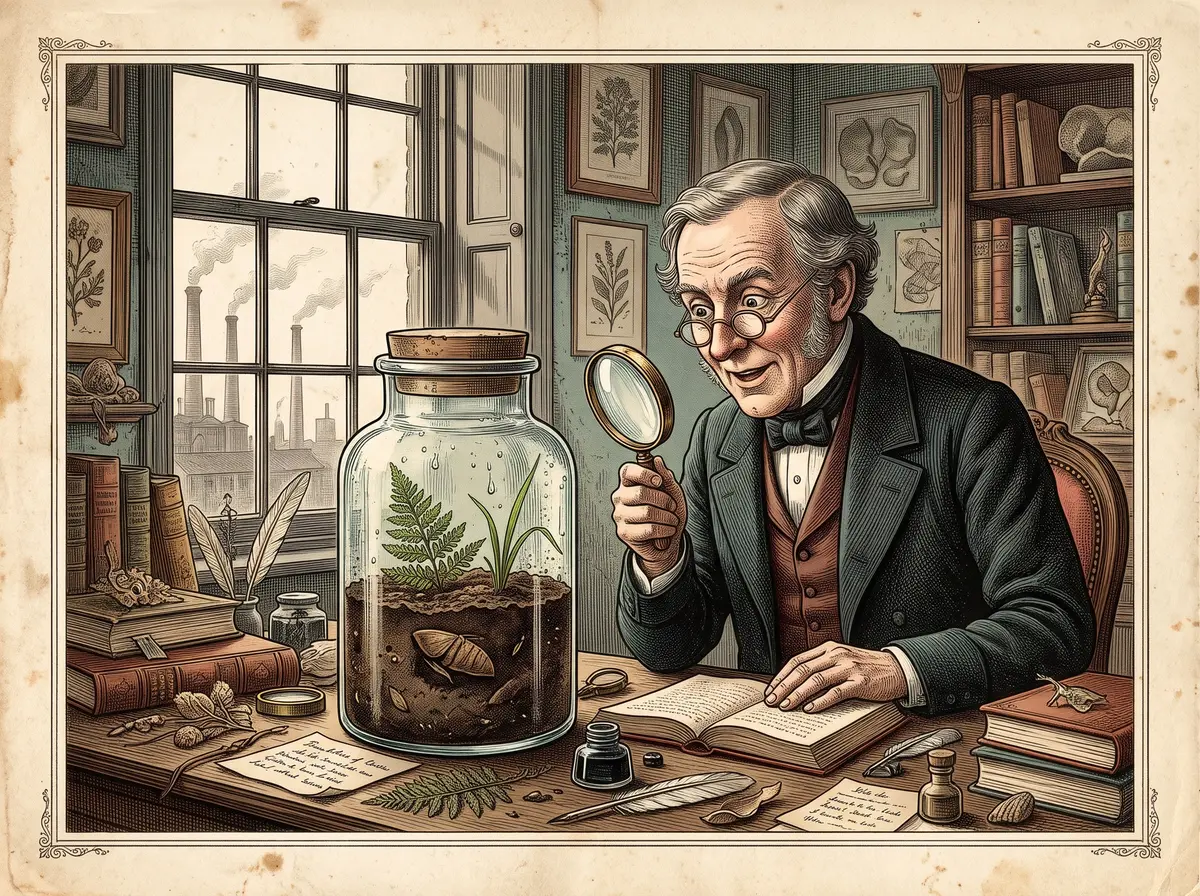
In the summer of 1829, a London doctor named Nathaniel Bagshaw Ward buried a moth chrysalis in a jar of damp soil, closed the lid, and waited for a moth. What came up instead was a fern. Ward had spent years failing to keep ferns alive in his own back garden. Now one had sprouted, unasked, inside a sealed bottle meant for an insect, and it went on living for years without a single drop of water.
By the Curiosities Desk · · 5 min read · Filed under Biology · Today’s round
What happened: The Wardian Case
Ward (1791–1868) was a general practitioner in Whitechapel, in London’s crowded, industrial East End, where he had taken over his father’s medical practice. He lived nearby at Wellclose Square. In his spare time he was a devoted naturalist, and his great love was ferns. He built a rockwork in his garden and transplanted ferns into it. They died. In his own words: “In consequence, however, of the volumes of smoke issuing from surrounding manufactories, my plants soon began to decline.”
The bottle was a side project. In his 1842 book, On the Growth of Plants in Closely Glazed Cases, Ward wrote: “I had buried the chrysalis of a sphinx in some moist mould contained in a wide-mouthed glass bottle, covered with a lid.” (A sphinx is a hawk moth; “mould” was the old word for loose garden soil.) He was watching the jar for the insect. What caught his eye was the soil. Moisture rose from it during the day, beaded on the inside of the glass, and ran back down, so the earth stayed evenly damp.
Then two tiny green specks appeared. One became a seedling grass, Poa annua (annual meadow grass). The other became a male fern, now called Dryopteris filix-mas. Their spores and seeds had been hiding in the soil all along.
Ward set the bottle on a window ledge and left it shut. The grass flowered. The fern put out new fronds every year. Ward said the plants lived “for nearly four years” with no care at all; the historian Luke Keogh puts it at about three. Either way, the experiment ended only when Ward was away from home and the lid rusted through, letting in rainwater, and the plants rotted.
Ward had a carpenter build larger glazed cases and began growing dozens of plants inside them. Then he tried the real test. In June 1833, with the nurseryman George Loddiges, he packed two cases with British ferns, mosses, and grasses and handed them to Captain Charles Mallard. According to Keogh’s research, they sailed from the Thames on the barque Persian, sharing the ship with cargo that included 200 boxes of soap, 218 tierces (casks) of beer, and two pianos. The cases rode on the deck, where they got the most light.
The plants reached Sydney alive. Mallard wrote back that “the complete success of your interesting experiment has been decidedly proved.” In February 1834 the cases were refilled with Australian plants for the trip home. They sweated through heat near 40°C (104°F) at Rio de Janeiro and froze at about −7°C (19°F) off Cape Horn. In November 1834, roughly eight months later, they arrived in England. Ward and Loddiges opened them to find the plants healthy, including a coral fern, Gleichenia, which Ward said was “now for the first time seen alive in this country.”
Why it was strange: The Wardian Case
The best answer to Ward’s problem turned up while he was looking at something else. He had fought London’s air with better soil and better spots in the garden, and lost. A closed jar, set up for a moth, solved it without any help from him.
It also broke a sensible-sounding rule. Gardeners knew plants need fresh air and regular watering. Ward’s plants got neither. Shut away from the city’s air, they did better than plants out in it.
And the stakes were bigger than one doctor’s hobby. Before the cases, most plants shipped across oceans died on the way, killed by salt spray, drought, cold, or sailors with no time to care for them. A sealed glass box changed the odds almost at once.
It belongs on the shelf of The Finds That Started on the Wrong Errand.
What scientists learned: The Wardian Case
The bottle was a miniature version of the water cycle. Plants draw water up through their roots and release it as vapor through tiny pores in their leaves, a process called transpiration. In a sealed case, that vapor has nowhere to go. It condenses on the cool glass and trickles back into the soil. The same water gets used again and again.
Gases also cycle inside the glass. In light, plants carry out photosynthesis, using carbon dioxide and releasing oxygen; at all times they also respire, using oxygen and releasing carbon dioxide. Soil microbes break down dead material and recycle nutrients. A sealed case isn’t a perfect closed world, and it can fail if it gets too hot, too dark, or too wet. But it can be stable enough to keep plants alive for years.
The glass did one more job. It kept out soot, smoke, and salt, the very things that had killed Ward’s garden ferns and countless plants at sea.
Another Victorian who kept living things going in a glass container is the hero of The Victorian Lady Who Kept Corals Alive in Her Drawing Room — With a Maid Pouring Seawater at the Window.
How it reaches us today: The Wardian Case
The “Wardian case” became one of the most important pieces of equipment of the 1800s. Nurseries used it first, then botanical gardens like Kew. Plants that moved in these cases include tea, bananas, cocoa, and rubber. Starting in 1848, the plant collector Robert Fortune used them to carry tea plants out of China to British India, where, according to Keogh, nearly 20,000 were transplanted. That history has a darker side: the cases served empires and, as later critics noted, spread pests and invasive plants such as Japanese honeysuckle around the world.
In drawing rooms, the cases helped spark the Victorian fern craze, known as “pteridomania.” Their direct descendant sits on shelves today: the terrarium, a small sealed or semi-sealed glass garden.
For another everyday lab object that began with a home experiment, see The Pudding Recipe That Gave Microbiology Its Favorite Jelly.
Fun fact: The Wardian Case
About a decade after his India shipments, Robert Fortune sent 26,000 tea seedlings in Wardian cases to Washington, D.C., for the U.S. Patent Office, which hoped to start an American tea industry.
Sources: The Wardian Case
- Ward, N. B. (1842). On the Growth of Plants in Closely Glazed Cases. London: John Van Voorst (Internet Archive)
- Keogh, L. (2017). “The Wardian Case: How a Simple Box Moved the Plant Kingdom.” Arnoldia 74(4): 2–13, Arnold Arboretum of Harvard University (PDF)
- State Library Victoria: Book extract from The Wardian Case by Luke Keogh (2021)
- JSTOR Daily: “The Accidental Invention of Terrariums”