The Naturalist Who Locked Himself in a Jungle Cage to Learn to Speak Chimpanzee
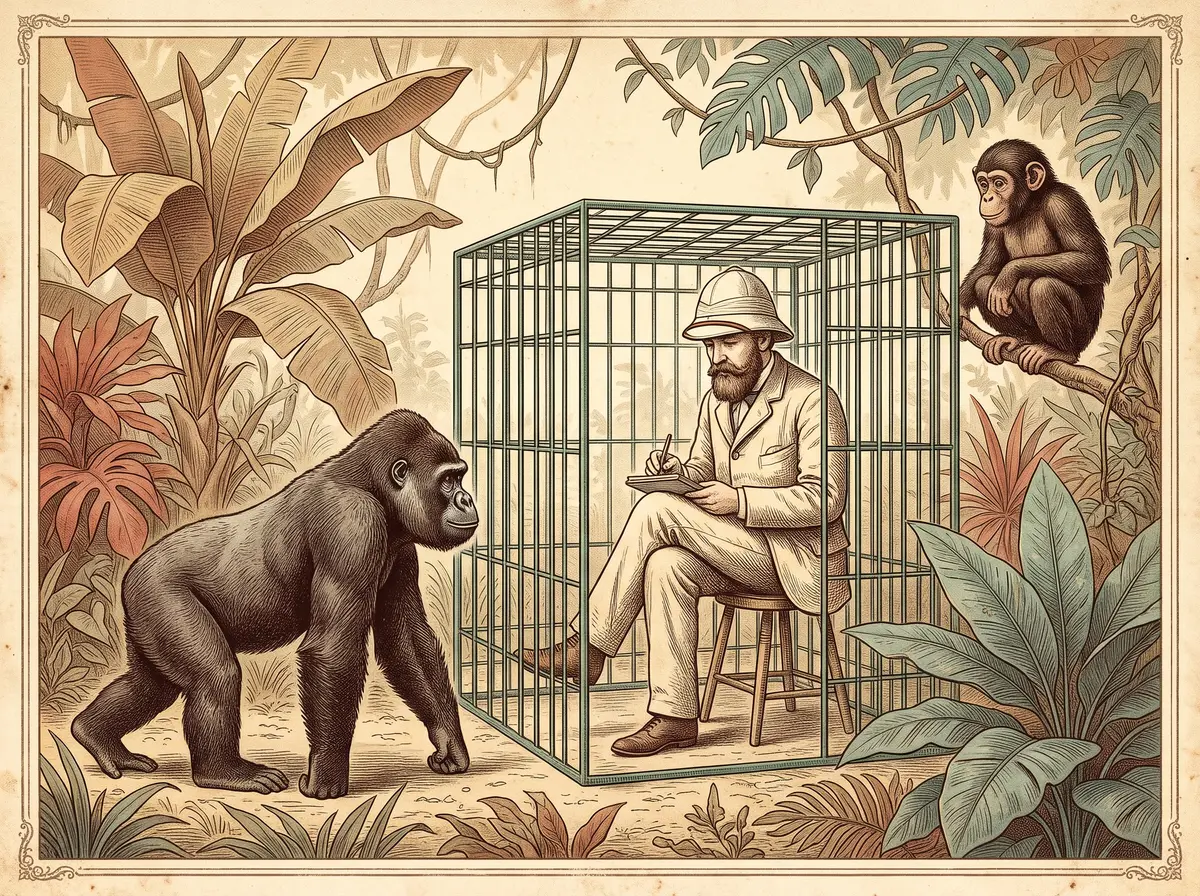
In April 1893, a former Virginia schoolteacher named Richard Lynch Garner moved into a steel cage in the forest of Gabon, painted it a dingy green so the animals wouldn't notice it, and named it "Fort Gorilla." The man was behind bars. The apes were free to come and go. He was there to learn their language.
By the Curiosities Desk · · 5 min read · Filed under Biology · Today’s round
What happened: Fort Gorilla
Richard Lynch Garner was born in Abingdon, Virginia, in 1848. He spent more than a decade as a schoolteacher, and Darwin’s theory of evolution gave him an idea he never let go of: if humans descended from earlier primates, maybe human speech had grown out of monkey sounds. If so, monkeys should have a language of their own, and someone ought to learn it.
He started by listening. In 1884, at the Cincinnati zoo, he sat with the monkeys and tried to sort their calls into meanings. By 1890 he had a better tool: Thomas Edison’s new sound-recording technology. That September, the St. Louis Globe-Democrat reported on what it called “the funniest experiment ever conducted by the Smithsonian Institution.” Garner recorded two monkeys at the zoo behind the Smithsonian building with a graphophone, a wax-cylinder recorder, so he could play one monkey’s calls back to the other and watch what happened. The first results were inconclusive. In December 1891, at New York’s Central Park Zoo, he went further: he recorded a sound he took to be the local rhesus monkeys’ word for a greeting and played it to newly arrived monkeys. When they reacted excitedly, he concluded they had understood.
He published his findings in 1892 as The Speech of Monkeys, and the next step seemed obvious to him. Zoo monkeys were captives. To hear apes really talk, he would go to Africa.
The trip started with a setback. Writing to Edison from Libreville on November 4, 1892, Garner explained that he had failed to get permission from the British phonograph company to bring any machines with him. “I am thus obliged to omit one of the very most important features of my work,” he wrote. The man famous for recording monkeys would record no apes.
He went ahead anyway. On the south side of the lagoon he called Lake Ferran Vaz (today’s Fernan Vaz Lagoon), he set up the cage he’d planned for. In his 1896 book Gorillas & Chimpanzees, he described it as steel wire “woven into a lattice with a mesh one inch and a half wide,” forming a cube “six feet six inches square,” with a floor of thin boards “steeped in tar.” He packed a camera, medicines, and “an ample store of canned meats, crackers, &c.” He moved in during “the latter part of April 1893” and wrote that he stayed “for the greater part of the time for one hundred and twelve days and nights in succession.”
From inside, he said, he watched a gorilla stroll past in search of food, a porcupine waddle into view, a leopard creep through the brush, and a python hunting birds.
His most hopeful pupil came from outside the cage. Moses was a young chimpanzee “found all alone in a wild papyrus swamp of the Ogowe River,” whom Garner bought from a trader. Garner tried to teach him four words: mamma, the French feu (fire), the German wie (how), and nkgwe, a local word for “mother.” By Garner’s own account, feu came out sounding closer to “veu,” and for mamma, Moses “only worked his lips without making any sound.” Moses died young. Garner blamed it partly on himself, writing that his three-week absence on a journey had “hastened his sad and untimely death.”
Back home, the reviews were brutal. Between 1894 and 1896, Henry Labouchère’s London magazine Truth claimed that Garner had spent his time “not in a cage in the forest but in a room at a Catholic mission.” Critics called him “the Munchausen of Monkey-land,” after the famous teller of tall tales. Historian Gregory Radick, who traced the scandal, deliberately leaves open whether those charges were true. What is certain is that Garner came home with no recordings and no ape vocabulary.
Why it was strange: Fort Gorilla
It flipped the usual arrangement between observer and observed. In a zoo, the apes sit in the cage while people peer in. In Gabon, the scientist locked himself up, and the animals were the ones walking past.
It also asked a bigger question than it could answer: the origin of human language, pursued in a single summer from a wire box. His instinct to record animal sounds and play them back was ahead of its time. His leaps from an excited monkey to a translated “word” were not. The same trap, reading too much meaning into an animal’s reaction, caught the owner in Clever Hans: The Horse That Could ‘Do Math’.
What scientists learned: Fort Gorilla
The biggest lesson was about method. Garner’s bold claims landed in the middle of a debate over whether animals could reason at all. Radick argues that the British psychologist C. Lloyd Morgan sharpened his famous rule, now called Morgan’s canon, partly in response to Garner. The canon says you shouldn’t explain an animal’s behavior with a higher mental ability if a simpler one would do. In Radick’s words, Morgan “had a rule for interpreting experiments,” while Garner “had an instrument for doing them.”
Both turned out to be needed. Modern researchers use Garner’s tool, playback, under Morgan’s discipline. For a later attempt to close the gap between apes and people, see The Baby Raised With a Chimpanzee Who Learned to Bark for Oranges.
How it reaches us today: Fort Gorilla
In 1980, Robert Seyfarth, Dorothy Cheney and Peter Marler did what Garner had hoped to do, with careful controls. In Kenya’s Amboseli National Park, they played recorded vervet monkey alarm calls through a hidden speaker when no predator was present. The monkeys answered each call differently: leopard alarms sent them up into trees, eagle alarms made them look up or dive into bushes, and snake alarms made them look down at the ground. The calls carried information about the kind of danger. It wasn’t the full language Garner imagined, but it showed that some monkey calls do refer to specific things.
Playback experiments are now a standard tool for studying animal communication, from birdsong to whale calls. Garner’s story also sits among the other ambitious misfires in The Experiment That Did Not Come Out.
Fun fact: Fort Gorilla
Garner’s papers at the Smithsonian’s National Anthropological Archives include diaries, maps, poetry, and a manuscript titled “An Autobiography of a Pie.”
Sources: Fort Gorilla
- R. L. Garner, Gorillas & Chimpanzees (1896), Project Gutenberg (primary source)
- Gregory Radick, “Morgan’s canon, Garner’s phonograph, and the evolutionary origins of language and reason,” British Journal for the History of Science 33 (2000), White Rose eprint
- Smithsonian Institution Archives — “Can Monkeys Talk?” (St. Louis Globe-Democrat, Sept. 21, 1890)
- Smithsonian Collections Blog — “The Man, the Phonograph, and His Primates” (2010)
- Seyfarth, Cheney & Marler, “Monkey responses to three different alarm calls,” Science 210 (1980), via PubMed