The Rabbits Darwin's Cousin Filled With Borrowed Blood to Prove Him Right — Until Darwin Said He'd Never Mentioned Blood
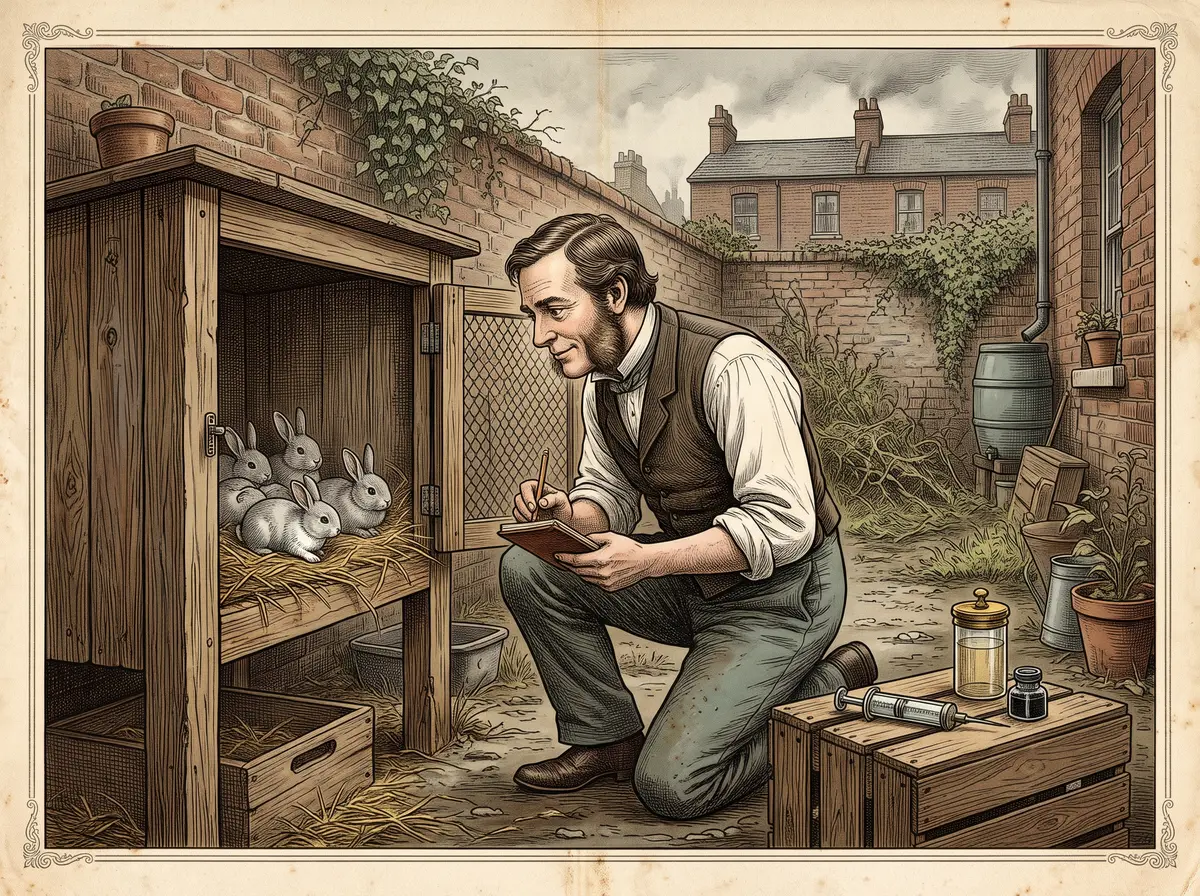
In the winter of 1870–71, in a sturdy little rabbit house he had built in his own London back yard, Francis Galton was waiting for a silver-grey rabbit to give birth to a black-and-white one. He had pumped the parents full of blood from rabbits of other colors, hoping to prove his cousin Charles Darwin's theory of heredity. The babies came out silver-grey. And when Galton announced the result, Darwin wrote to the journal *Nature* to point out, politely, that he had never said a word about blood.
By the Curiosities Desk · · 5 min read · Filed under Biology · Today’s round
What happened: Galton's Rabbit Experiment
In 1868 Charles Darwin published The Variation of Animals and Plants under Domestication. Near the end, he offered what he called a “provisional hypothesis of pangenesis.” His theory of evolution needed a way for traits to pass from parent to child, and nobody yet knew how that worked. Darwin proposed that every part of the body sheds tiny particles, which he called gemmules. These were supposed to gather in the reproductive cells and carry a copy of each part into the next generation.
Francis Galton was Darwin’s half-cousin; both were grandsons of the physician Erasmus Darwin. A restless measurer of everything, he saw a way to test pangenesis. In the book, Darwin described the gemmules as “minute granules or atoms, which circulate freely throughout the system.” If they circulated, Galton reasoned, they must travel in the blood. So if you filled a silver-grey rabbit with the blood of a black-and-white one, the gemmules should come along too, and the next litter ought to show some of the donor’s colors.
Galton started in late 1869, with Darwin’s encouragement and advice on method. The work was fiddly. His letters describe many failed operations before he “greatly improved the method of operation.” His recipients were mostly pure-bred silver-greys. The donors were hare-colored, yellow, black-and-white and grey-and-white. Some of the work took place at the Zoological Gardens in Regent’s Park, and some at home, where he built the rabbit house so he could watch every animal closely.
There were moments of hope. In May 1870 he wrote to Darwin with “good news”: a baby rabbit in a new litter had one white forefoot. In January 1871 he reported a yellow youngster with a slate-grey belly in an otherwise silver-grey litter. He admitted it might be dismissed as a “yellow smut.” A cold snap killed another litter he had been counting on. Several does mated with heavily transfused bucks turned out to be sterile.
On 30 March 1871, Galton read his results to the Royal Society. He had bred 88 rabbits in 13 litters, with no real sign that the borrowed blood had changed the breed. The experiments, he said, were “negativing, in my opinion, beyond all doubt the truth of the doctrine of Pangenesis.”
Four weeks later, on 27 April, Darwin answered in Nature. “I have not said one word about the blood, or about any fluid proper to any circulating system,” he wrote. He pointed out that the simplest animals, such as single-celled protozoa, have no blood at all, and neither do plants, yet both inherit traits. Galton’s conclusion, Darwin said, was “a little hasty.”
Why it was strange: Galton's Rabbit Experiment
The idea was to prove Darwin right, carried out with Darwin’s own advice. Galton then announced that he had proved Darwin wrong, and Darwin replied that the test had been looking in the wrong place.
The two men did not fall out. Galton wrote to Darwin, upset that he had misrepresented the theory, and quoted back the words “circulate freely” and “diffused.” His public reply in Nature on 4 May was a model of grace. “The proper meaning of circulation is evident enough,” he wrote; “it is a re-entering movement.” Then he told a fable about a monkey who runs down onto the plain at his leader’s cry of “hyena,” only to learn the leader had meant a leopard in the trees. He did not “much complain,” he said, of being sent on a false quest. At least he now knew there were no hyenas on the plain. He signed off: “In the meantime, Vive Pangenesis.”
The rabbits kept going too. Some lived at Darwin’s home at Down, cared for by his groom, and Galton once sent a £2 cheque to tip him. In late 1872 the cousins agreed the experiments had run long enough.
Another inheritance experiment that did not go to plan: The Worms That Were Supposed to Learn by Eating Their Teachers.
What scientists learned: Galton's Rabbit Experiment
A negative result still taught something. Galton had shown that whatever carries heredity, it is not simply mixed into the blood. In 1875 he published his own theory of heredity, built around a hereditary bundle he called the “stirp,” which was passed down largely separate from the rest of the body.
The German biologist August Weismann made the same split sharper. In an 1888 lecture he described cutting off the tails of 901 mice over five generations. Every baby was still born with a normal tail. Weismann argued that only the “germ-plasm” in sperm and egg cells carries heredity, and that changes to the rest of the body are not passed on. That idea is now called the Weismann barrier. Pangenesis faded. Gregor Mendel’s pea experiments, published in 1866 and rediscovered in 1900, pointed toward discrete inherited units we now call genes.
For the long version of that story: From Mendel’s Peas to CRISPR: A Short History of Genetics.
How it reaches us today: Galton's Rabbit Experiment
We now know that DNA in the cells, not particles in the blood, carries inheritance. Still, Darwin’s hunch had a strange afterlife. Scientists have since found that cells shed tiny fragments of DNA and small membrane packets called extracellular vesicles into the bloodstream. Doctors use this circulating DNA in “liquid biopsies,” blood tests that look for traces of a tumor or screen a fetus’s chromosomes from the mother’s blood. None of this revives pangenesis, but the blood carries more genetic information than Galton could have known.
Galton’s wider legacy is harder to celebrate. He helped found the statistics of heredity, but he also coined the word “eugenics” and promoted it, a movement now widely condemned for the harm it caused. The rabbit work shows a narrower side of him: a tester willing to publish a result against his own cousin’s theory.
Before a transfusion could help a person, it had a long and messy history of its own: From Lamb’s Blood to Blood Types: A Short History of the Transfusion.
Galton’s rabbits, silver-grey despite the borrowed blood, belong with The Experiment That Did Not Come Out.
Fun fact: Galton's Rabbit Experiment
By January 1872, Darwin was reporting back on the borrowed rabbits at Down: “The Rabbits have lost their patches and are grey of different tints, so you were right.”
Sources: Galton's Rabbit Experiment
- Francis Galton, “Experiments in Pangenesis, by Breeding from Rabbits of a Pure Variety, into Whose Circulation Blood Taken from Other Varieties Had Previously Been Largely Transfused,” Proceedings of the Royal Society of London 19 (1871): 393–410 (Galton.org bibliography)
- Charles Darwin, “Pangenesis,” Nature 3 (27 April 1871): 502–503, via Darwin Online
- Francis Galton, “Pangenesis” (letter), Nature (4 May 1871), via Darwin Online
- Darwin Correspondence Project, letters from Francis Galton of 12 May 1870, 9 January 1871 and 25 April 1871, with editorial notes
- Karl Pearson, The Life, Letters and Labours of Francis Galton, vol. 2 (1924), via Darwin Online