Failed Experiments · Archaeology
The Balloon Built to Prove the Nazca Could Fly — Which Bounced Out Its Pilots and Flew On Without Them
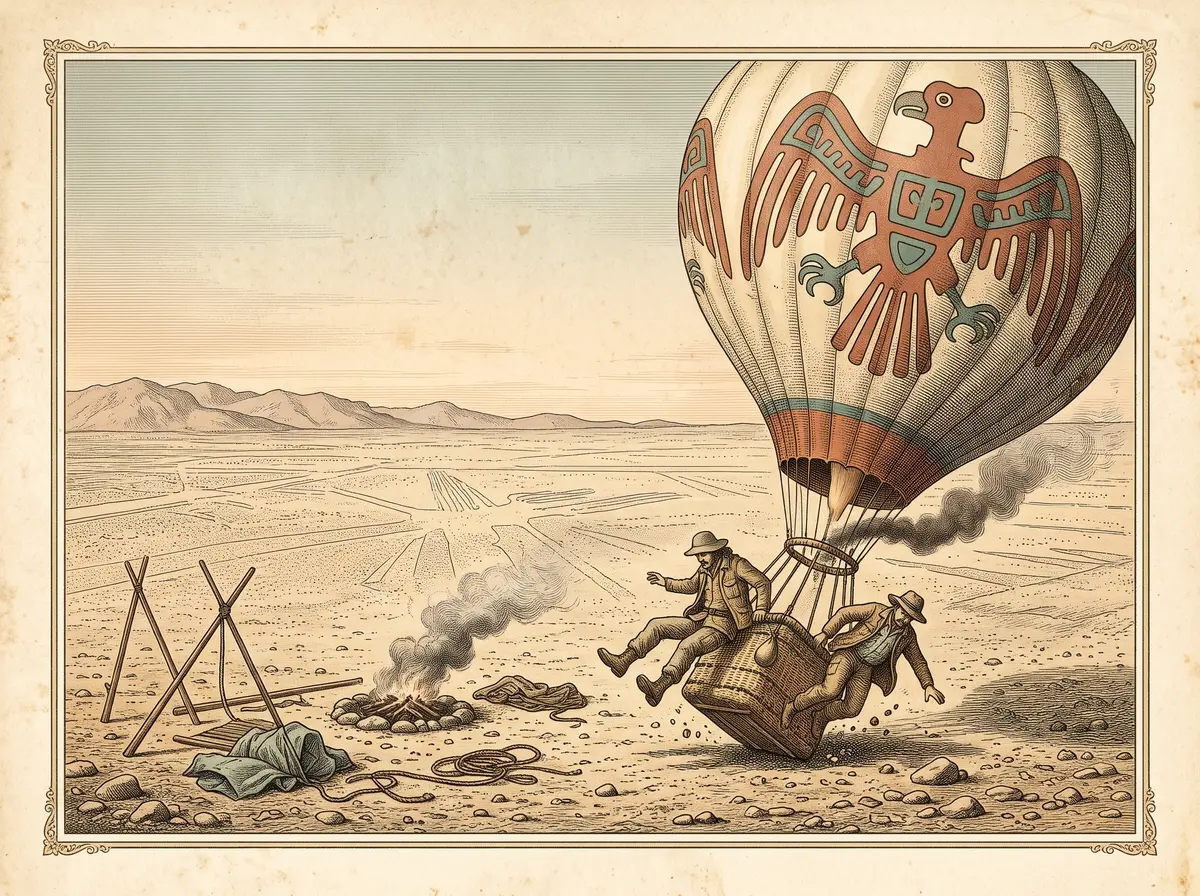
At dawn on November 28, 1975, on the desert plain of Nazca in Peru, a smoke-blackened cotton balloon painted with a giant condor lifted two men in a basket woven from lake reeds. It climbed to about 600 feet. Then it sank, hit the ground, and bounced both pilots out of the gondola. Freed of their weight, the balloon shot back up to roughly 1,200 feet and sailed off across the desert by itself, as if it had decided to finish the experiment alone.
By the Curiosities Desk · · 5 min read · Filed under Archaeology · Today’s round
What happened: The Balloon Built to Prove the Nazca Could Fly — Which Bounced Out Its
The Nazca Lines are one of archaeology’s great puzzles. Between roughly 500 BC and AD 500, people in southern Peru cleared away the dark surface stones of the desert to expose the paler ground beneath, creating straight lines, geometric shapes, and huge drawings of animals and plants. According to UNESCO, they cover about 450 square kilometers. Many of the figures are so large that they are hard to make out from the ground, which raised a nagging question: how did their makers get them right without seeing them from above?
By the 1970s, the most popular answer in bookstores was aliens. Erich von Däniken’s 1968 bestseller Chariots of the Gods? had suggested that some of the lines looked like landing strips. Members of a group called the International Explorers Society wanted a more down-to-earth answer, even if it involved leaving the earth. One of them, Jim Woodman, proposed that the Nazca people might have guided the work from a hot-air balloon.
His evidence was suggestive rather than solid. Graves around Nazca had yielded finely woven textiles and braided rope. Woodman pointed to a painted pot that, to his eye, showed something like a balloon with tie ropes. And he noted that a Jesuit priest, Bartolomeu de Gusmão, had demonstrated a small model hot-air balloon in Lisbon in 1709, more than 70 years before the Montgolfier brothers.
So Woodman teamed up with the British balloonist Julian Nott to build one using only materials and methods the Nazca could have had. The envelope was cotton cloth, modeled on the grave textiles. The gondola was woven from totora reed from Lake Titicaca, by a builder who had previously made a reed boat for the explorer Thor Heyerdahl. An artist painted an ancient-style condor on the fabric, and the balloon was named Condor I.
There was no propane burner, of course. The team dug a pit, filled it with burning wood, and channeled the hot air and thick smoke through a trench into the balloon, which was held up on poles over the fire. On launch morning, the crew released the holding lines, the pilots dropped a sack of ballast, and Condor I climbed quickly past 300 feet.
The crewed part of the flight didn’t last long. Woodman’s own account puts it at roughly two minutes. As the air inside cooled, the balloon came down hard and threw both men out of the basket. According to Time magazine’s report that December, the lightened balloon then rose to about 1,200 feet, drifted roughly two and a half miles, and landed gently, unpiloted and apparently unbothered.
Why it was strange: The Balloon Built to Prove the Nazca Could Fly — Which Bounced Out Its
Here was an experiment that worked and failed at the same time. It proved that 1,000-year-old technology could, in principle, get two people off the ground. It did not prove that anyone at Nazca ever did that. Woodman himself acknowledged that no one had found a piece of ancient cloth anywhere near big enough to make a balloon.
There’s also a delightful irony in the flight itself. The test meant to show that ancient people could control a balloon ended with the balloon making the best flight of the day, with no one on board. And the whole effort shared one assumption with the alien theory it was meant to answer: that the lines needed someone in the sky.
More tests that didn’t go to plan live on The Experiment That Did Not Come Out.
What scientists learned: The Balloon Built to Prove the Nazca Could Fly — Which Bounced Out Its
The physics of the flight was sound. Hot air is less dense than the cooler air around it, so a large enough bag of it pushes upward, the same way a cork floats in water. Nott noticed something else: the quality of the smoke mattered. Soot from the wood fire clogged the pores of the cotton, sealing a fabric that would otherwise leak hot air. Modern balloonists think only about heat, but for a cloth balloon, smoke turned out to be part of the engineering.
The bigger lesson came from a different experiment. In 1982, the investigator Joe Nickell and five of his relatives reproduced the Nazca condor figure, 440 feet long, in a field in Kentucky. They used no aircraft at all. Working from a small drawing, they measured distances from a center line and scaled them up, so that each unit on the sketch became a much larger unit on the ground. Scientific American called the result remarkable in its exactness. Most archaeologists today think the Nazca made their figures in much the same way, on foot, with planning, cord, and stakes, with no need to see the finished picture from above.
For another reconstruction that proved something could be done without proving it was, see Kon-Tiki: The Raft That Crossed an Ocean to Prove a Theory That Was Wrong.
How it reaches us today: The Balloon Built to Prove the Nazca Could Fly — Which Bounced Out Its
Condor I is now a classic case in experimental archaeology, the practice of rebuilding ancient objects and techniques to test ideas about the past. Its lesson is a useful one for anyone in the field: showing that something was possible is not the same as showing it happened. Archaeologists still need the physical evidence, and for the Nazca balloon, it never turned up.
The flight had a practical side effect, too. Time reported that the publicity drew attention to the damage tourists’ footprints and tire tracks were doing to the lines. The geoglyphs became a UNESCO World Heritage Site in 1994, and researchers are still finding new ones, now with drones and computer-assisted analysis of aerial images. Nott, meanwhile, never quite let the idea go: he flew a recreation of the balloon over Nazca again in 2002 for Japanese television.
The gondola’s builder links this story to a Heyerdahl voyage of its own: The Papyrus Boat That Sagged Across the Atlantic for Want of One Rope.
Fun fact: The Balloon Built to Prove the Nazca Could Fly — Which Bounced Out Its
One of the directors of the explorers’ society behind Condor I was Michael DeBakey, the pioneering heart surgeon. After the flight, he told Time it showed the Nazca could have had the skill, the materials, and the need to fly.
Sources: The Balloon Built to Prove the Nazca Could Fly — Which Bounced Out Its
- “Science: Nazca Balloonists?” Time, December 15, 1975
- Julian Nott: “Nazca” (project account by the balloon’s designer and pilot)
- UNESCO World Heritage Centre: Lines and Geoglyphs of Nasca and Palpa
- “Nazca ‘Spaceport’,” Encyclopedia.com
- Nickell, J. (1992). Ambrose Bierce Is Missing: And Other Historical Mysteries. University Press of Kentucky