Failed Experiments · Archaeology
The Papyrus Boat That Sagged Across the Atlantic for Want of One Rope
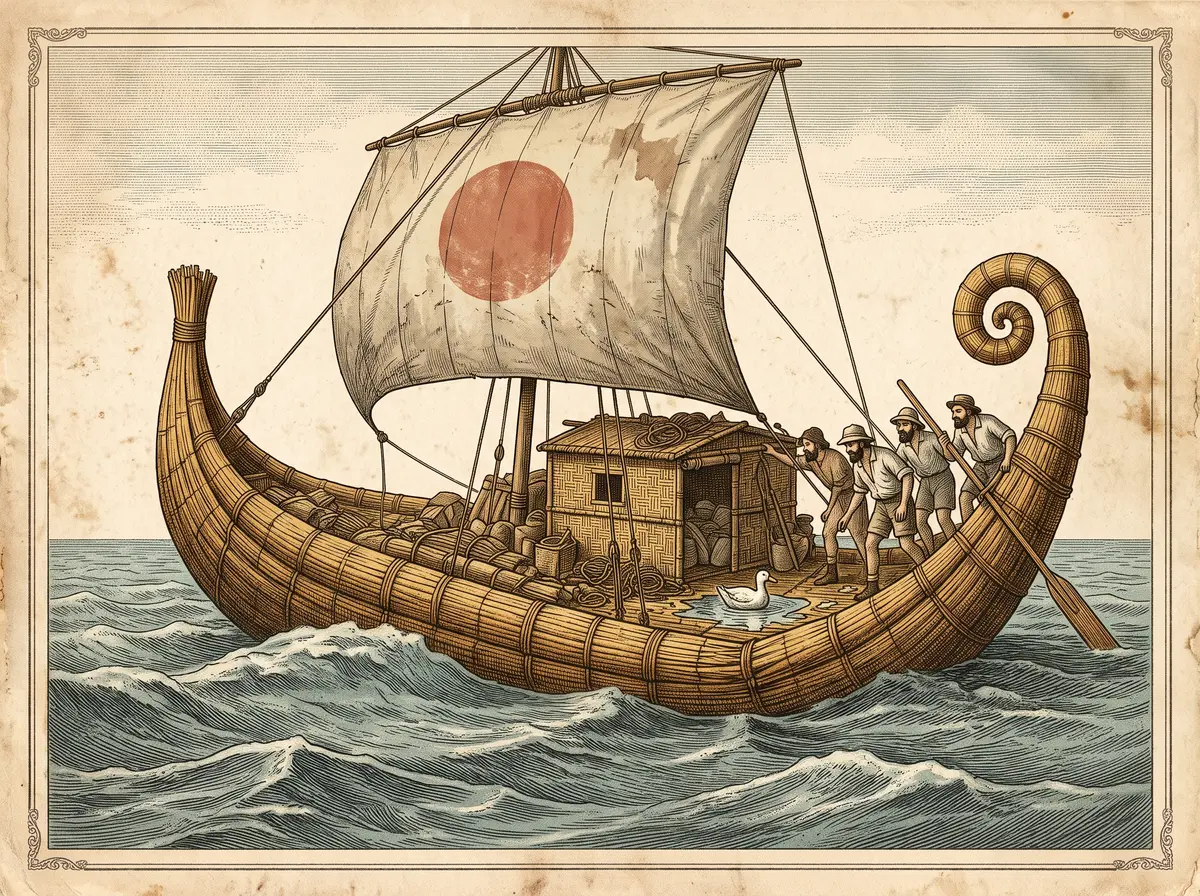
In June 1969, three weeks into an Atlantic crossing, the crew of a boat made of papyrus reeds noticed a kink. Just behind their wicker cabin, the whole back end of the vessel had begun to droop toward the sea, while the elegant curled tail above it stayed perfectly in shape. The boat had been copied from ancient Egyptian tomb art. The crew was starting to suspect that they had copied it wrong.
By the Curiosities Desk · · 5 min read · Filed under Archaeology · Today’s round
What happened: Heyerdahl's Ra
The boat was called Ra, after the Egyptian sun god, and it was the idea of Norwegian explorer Thor Heyerdahl. In 1947 he had sailed the balsa raft Kon-Tiki across the Pacific. Now he wanted to test another hunch: that reed boats like the ones painted in Egyptian tombs could have crossed an ocean.
Heyerdahl built Ra in Egypt, in front of the Great Pyramid of Giza, because, as he later wrote, Egypt is where papyrus boats are “represented in detail on the tombs.” The papyrus itself came from Lake Tana in Ethiopia. Ancient Egypt had no living reed-boat builders left, so Heyerdahl hired boatmen from Lake Chad in central Africa, including Abdullah Djibrine, who still built small papyrus craft for use on their lake. Swedish maritime historian Björn Landström copied the mast and rigging from Egyptian wall paintings.
The build had its own comic hazards. Heyerdahl recalled that camels wandering past tried to eat the side of the boat, which convinced skeptics that the reeds would make a fine meal for sea creatures too.
Ra was trucked to Morocco and launched from the port of Safi on May 25, 1969. Its seven-man crew came from seven countries: Heyerdahl (Norway), navigator Norman Baker (United States), cameraman Carlo Mauri (Italy), doctor Yuri Senkevich (Soviet Union), anthropologist Santiago Genovés (Mexico), Georges Sourial (Egypt), and Djibrine himself (Chad). A duck named Sinbad came along as well.
For weeks the reeds floated just as Heyerdahl had hoped. Then came the kink. Georges spotted the bottom beginning to sag aft of the cabin, and the stern slowly settled lower toward the waterline. Steering oars snapped; Senkevich counted five broken and one lost. Waves washed over the sunken afterdeck. As the lashings began to fail, the crew voted to cut their rubber life raft into strips shaped like papyrus bundles and tie them under the stern to prop it up.
It bought time, but not enough. In July 1969, after roughly 5,000 kilometers (about 3,000 miles) and eight weeks at sea, Heyerdahl decided the boat might sink with everyone aboard. He called off the expedition about a week’s sailing short of Barbados, and the crew was taken off by a yacht.
Why it was strange: Heyerdahl's Ra
The failure did not come from papyrus being a bad material. It came from a single detail everyone had misread.
Egyptian art shows reed boats with a high, curving tail and a rope running from the tip of that tail down to the deck. Heyerdahl’s team assumed the rope was there to bend the tail into its graceful curl, a decoration, more or less. The Lake Chad builders left it out, and at the time, as Heyerdahl recounted in his book The Ra Expeditions, the crew thought they had “fortunately dispensed with that.”
Out on the ocean, the team worked out the rope’s real job. The tall tail was meant to act as a spring. The rope’s purpose, Heyerdahl concluded, was not to pull the tail down but to hold the afterdeck up. Without it, every wave trough let the back of the boat sag, and the reeds slowly gave way. The ancient builders had left the instructions in plain sight. The modern ones read them as ornament.
More voyages that did not go to plan live on The Experiment That Did Not Come Out.
What scientists learned: Heyerdahl's Ra
Ra is a good example of experimental archaeology, the practice of rebuilding ancient objects and using them to see how they really worked. Its most useful lesson was a humbling one: a feature that looks decorative to modern eyes can be structural. Pictures preserve what a thing looked like, not why each part was there.
The team applied the lesson quickly. About ten months later, Heyerdahl tried again with Ra II, built by four Aymara reed-boat makers from Lake Titicaca in South America. Ra II was shorter and far sturdier. It left Safi on May 17, 1970, and reached Bridgetown, Barbados, on July 12, 1970, after 57 days and about 6,100 kilometers.
It is worth being precise about what that proved. Ra II showed that a reed boat could cross the Atlantic. It did not show that ancient Egyptians or anyone else actually did, and most archaeologists today see no evidence of such voyages. Heyerdahl’s earlier raft had a similar fate, as told in Kon-Tiki: The Raft That Crossed an Ocean to Prove a Theory That Was Wrong.
How it reaches us today: Heyerdahl's Ra
The Ra voyages left a surprising legacy far from archaeology. On the first crossing, the crew kept sailing through clumps of oil floating on the open Atlantic. They reported it to the United Nations, and on Ra II, at the request of UN Secretary-General U Thant, they logged ocean pollution every day. The Kon-Tiki Museum in Oslo, which displays Ra II, notes they found oil clumps on 43 of the 57 days.
The “decoration that was really a part” lesson is one that anyone rebuilding an ancient object can borrow: before dismissing a detail as ornament, test it. For another reconstruction that taught its builders the hard way, see The Bluestone Bound for Stonehenge That Sank 17 Miles Into a 240-Mile Trip.
Fun fact: Heyerdahl's Ra
When Heyerdahl asked the Soviet Academy of Sciences for an expedition doctor, he requested one who would speak English and “have a good sense of humor.” They sent 32-year-old Yuri Senkevich, who later became one of the Soviet Union’s best-known TV travel hosts.
Sources: Heyerdahl's Ra
- Heyerdahl, Thor. “The Slender Reeds” (excerpt from The Ra Expeditions). Saudi Aramco World, January/February 1972. https://archive.aramcoworld.com/issue/197201/the.slender.reeds.htm
- Kon-Tiki Museum. “Ra, 1969 – Ra II, 1970.” https://www.kon-tiki.no/en/heyerdahls-expeditions/ra-1969-ra-ii-1970
- Encyclopaedia Britannica. “Ra (boats).” https://www.britannica.com/topic/Ra
- UNESCO Moscow Office. “On Papyrus Across the Atlantic.” https://unesco.ru/en/news/heyerdahl-journey/
- Barbados Today. “Remembering the Ra II” (July 15, 2020). https://barbadostoday.bb/2020/07/15/btcolumn-remembering-the-ra-ii/