Weird Medical History · Physics
The Neurologist Who Built a Bumpy Train Ride You Could Sit In — and the Humming Helmet That Came Next
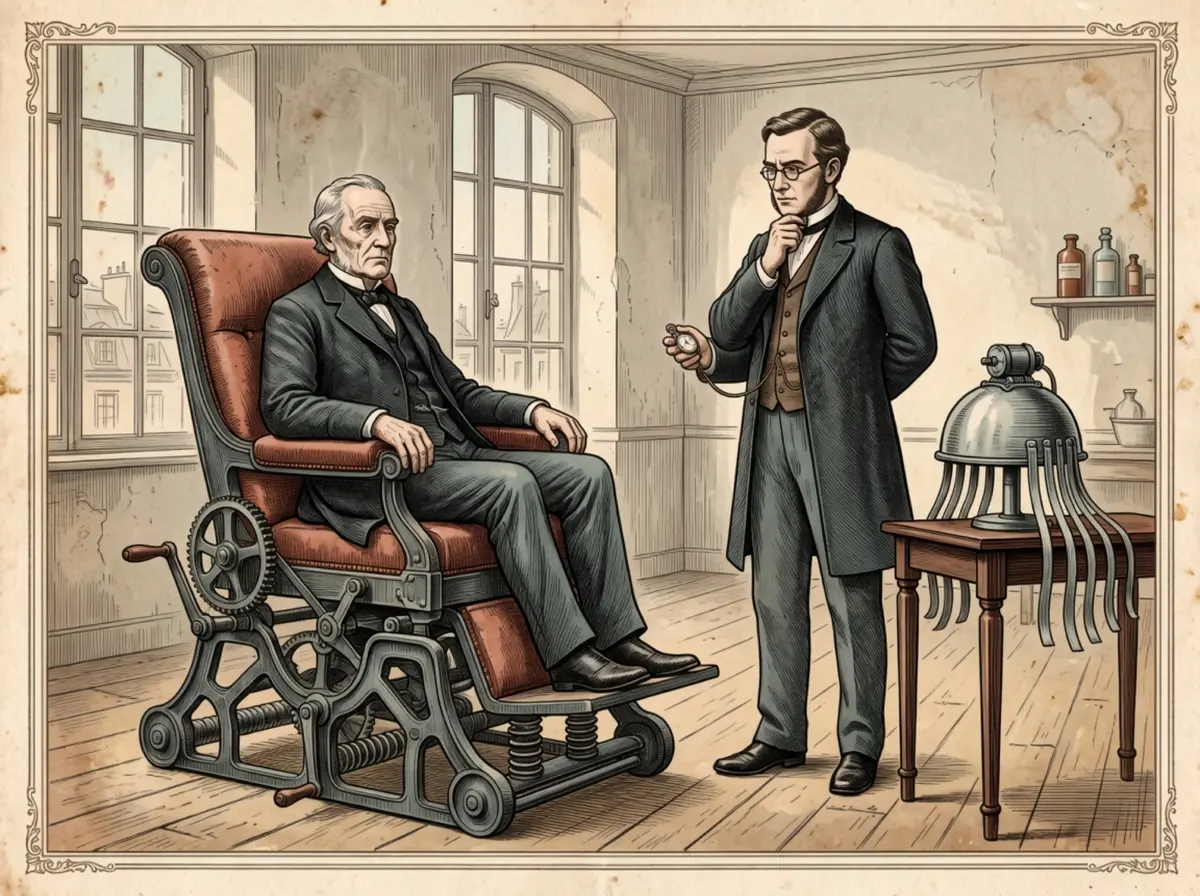
Some of Jean-Martin Charcot's patients had noticed something odd in the early 1890s: after a long, rattling trip by train or carriage, the stiffness and trembling of their illness seemed to ease, and they slept better that night. So the most famous neurologist in Paris took them at their word. He built a chair that shook like a train, so patients could take the bumpy ride without going anywhere at all.
By the Curiosities Desk · · 5 min read · Filed under Physics · Today’s round
What happened: The Neurologist Who Built a Bumpy Train Ride You Could Sit In — and the
Charcot (1825–1893) ran the neurology service at the Salpêtrière, a sprawling hospital in Paris, and he spent much of his career studying paralysis agitans — the “shaking palsy” we now call Parkinson’s disease. There was little anyone could offer these patients. So when several of them reported that their symptoms faded during long carriage rides or train journeys, and that the relief lingered for a while afterward, Charcot listened.
In a lecture published in Le Progrès médical in 1892, written up by his student Georges Gilles de la Tourette, Charcot described his answer: the fauteuil trépidant, or shaking armchair. A mechanism rocked the seat rapidly, back and forth and side to side, and the combined jolts imitated the feeling of sitting on the bench of a moving train. The recommended routine was about half an hour a day.
Charcot was pleased with what he saw. Patients who used the chair, he reported, stood up feeling lighter and less stiff, walked better, and slept more calmly at night. He described these effects as almost constant.
Then Gilles de la Tourette — yes, the Tourette of Tourette syndrome — moved the idea from the seat to the skull. If shaking the body could calm the nerves, why not shake the head directly? He had a vibrating helmet built. A small motor on top spun fast enough to send a steady vibration through a set of metal strips that rested against the head, with a soft, continuous hum. In an 1892 paper, he reported that after seven or eight minutes, wearers usually felt a spreading drowsiness that almost always ended in sleep. He and Charcot tried it for migraine, headaches, insomnia, some cases of depression, and “neurasthenia,” a catch-all 19th-century diagnosis for nervous exhaustion.
Charcot concluded that rapid vibration was a powerful sedative for the nervous system. But he died in August 1893, and the shaking chair never got the fuller evaluation it needed. It slipped quietly into medicine’s attic.
It stayed there for more than a century. Then Christopher Goetz, a neurologist at Rush University Medical Center in Chicago and a longtime historian of Charcot, wrote about the chair in the journal Neurology in 2009 — and decided to actually test it. His team randomly assigned 23 people with Parkinson’s disease to sit either in a modern vibrating chair or in the very same chair with the vibration switched off. Both groups listened to a relaxing CD of nature sounds, 30 minutes a day, for four weeks.
The results, published in the Journal of Parkinson’s Disease in 2012, were a twist. The vibration group’s movement scores improved significantly. So did the no-vibration group’s — not quite as much, but significantly. Both groups improved about equally in depression, anxiety, fatigue, and nighttime sleep, and both reported being highly satisfied.
Why it was strange: The Neurologist Who Built a Bumpy Train Ride You Could Sit In — and the
Nobody in this story was foolish. The patients really did feel better after their train rides. Charcot really did see patients improve in his chair. And in 2012, people in the vibrating chair really did move better.
The surprise is that a chair that didn’t shake did nearly the same job. “We did not find the effect specific to vibration,” Goetz said when the results came out. Much of the benefit seemed to come from something else: half an hour of rest, soothing sounds, a daily ritual, the attention of researchers, and the hope that comes with joining a study. Charcot’s careful observation was real; his explanation for it was the part that didn’t hold up. A century earlier, doctors had stumbled onto the same lesson with a different gadget: The Fake Metal Rods That Accidentally Invented the Placebo-Controlled Trial.
What scientists learned: The Neurologist Who Built a Bumpy Train Ride You Could Sit In — and the
Vibration is simply rapid back-and-forth motion, measured by its frequency — how many cycles happen per second. Your skin and muscles are full of mechanoreceptors, sensors that respond to pressure, stretch, and movement, and some are especially sensitive to vibration. So a shaking chair or a humming helmet is not doing nothing; the body definitely notices it.
But noticing isn’t the same as treating. What Goetz’s team showed is why a control group matters. Without the non-vibrating chair, the 2012 study would have looked like a clean win for Charcot. With it, the vibration’s own contribution shrank to a modest edge at most.
Parkinson’s turns out to be a condition where expectation is especially powerful. In a 2001 brain-imaging study published in Science, researchers found that a placebo injection triggered the release of dopamine — the brain chemical that Parkinson’s depletes — in patients who believed they might be getting real medicine. That doesn’t make symptoms imaginary. It means hope and relaxation can have physical effects, and any treatment has to beat them to prove its worth. Another treatment that leaned on the dazzle of a new machine: The Mechanical Horse That Trotted So You Didn’t Have To.
How it reaches us today: The Neurologist Who Built a Bumpy Train Ride You Could Sit In — and the
Charcot’s idea never fully went away. Researchers still test vibration for Parkinson’s, from whole-body vibration platforms to vibrating gloves and wrist-worn devices. The evidence so far is limited and mixed: Parkinson’s UK notes that a 2025 review of six whole-body vibration studies found no improvement in Parkinson’s symptoms compared with control groups, though it did find better stability while standing still. Several small trials of wearable devices are still underway, and the charity is clear that vibration is not an approved therapy for Parkinson’s.
The more lasting legacy may be the 2012 study itself: a modern lab taking a 120-year-old observation seriously enough to test it fairly. Goetz noted one practical upside, too. Doctors could now point patients who were curious about vibration chairs toward at least one apparatus shown to be safe. More stories of medicine finding its footing: Medicine, Before It Was Sure.
Fun fact: The Neurologist Who Built a Bumpy Train Ride You Could Sit In — and the
Charcot wasn’t the first to prescribe a good shake. In 1734, the French writer Charles-Irénée Castel, the Abbé de Saint-Pierre, described a vibrating chair called the trémoussoir — roughly, “the jiggler” — meant to be used for hours a day to keep people healthy when they couldn’t get enough exercise.
Sources: The Neurologist Who Built a Bumpy Train Ride You Could Sit In — and the
- Christopher G. Goetz, “Jean-Martin Charcot and his vibratory chair for Parkinson disease,” Neurology (2009), PubMed record.
- A. S. Kapur, G. T. Stebbins, and C. G. Goetz, Journal of Parkinson’s Disease 2 (2012): 23–27, the randomized test of a vibrating vs. non-vibrating chair; summarized in Rush University Medical Center’s April 2012 news release via ScienceDaily.
- Olivier Walusinski, “Jean-Martin Charcot (1825–1893), thérapeute fourvoyé ?” (in French), quoting Charcot’s 1892 lecture “La médecine vibratoire” in Le Progrès médical and Gilles de la Tourette’s 1892 paper on the vibrating helmet in La Nouvelle Iconographie de la Salpêtrière.
- Carmel Raz, “Of Sound Minds and Tuning Forks: Charcot’s Acoustic Experiments at the Salpêtrière”, Musicology Now (American Musicological Society).
- Parkinson’s UK, “Vibration and Parkinson’s: can it improve symptoms?”
If you or someone you love is living with Parkinson’s and curious about vibration devices or other add-on therapies, a neurologist or Parkinson’s nurse can help sort the promising from the unproven. Groups like Parkinson’s UK and the Parkinson’s Foundation also run free helplines.