Accidental Discoveries · Biology
The New Insect Species a Scientist Found While Scrolling Flickr
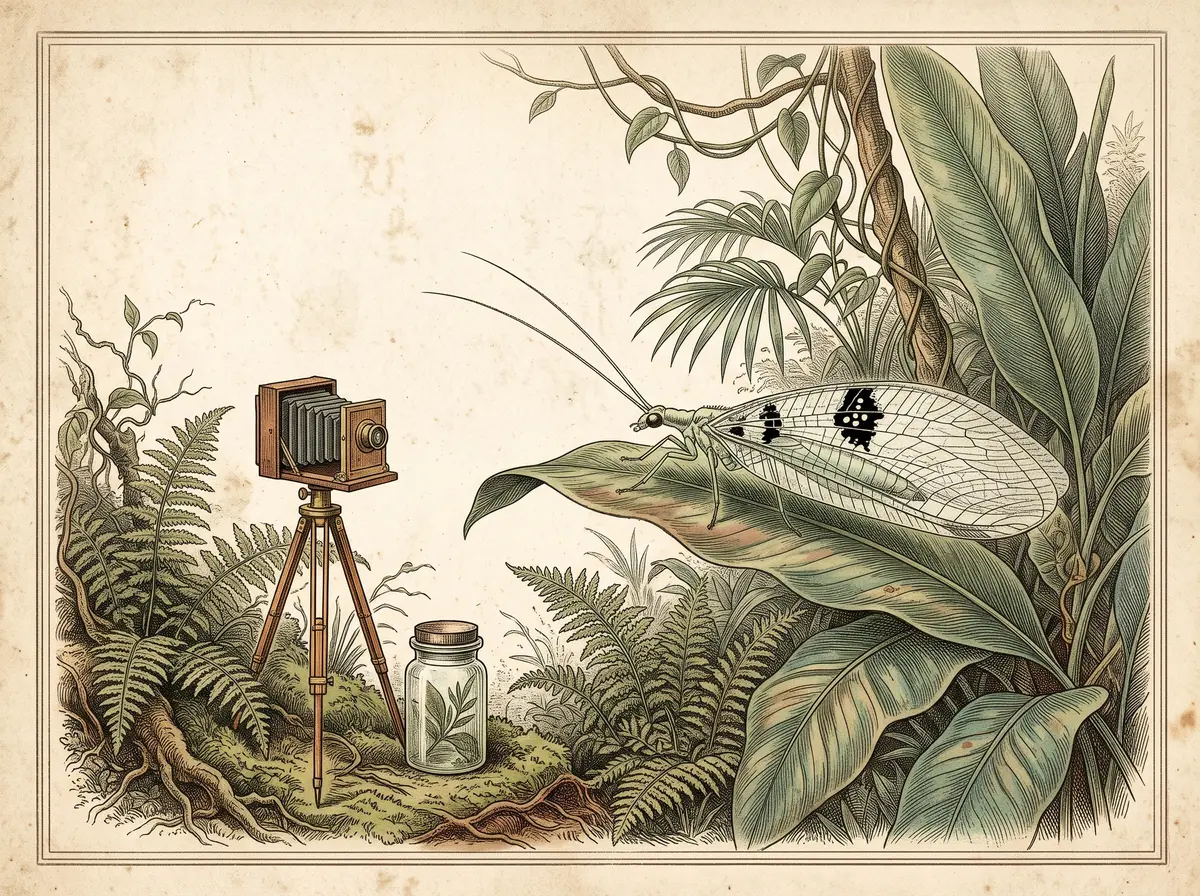
In 2011, an entomologist in California was clicking through strangers' insect photos on Flickr when one picture stopped him cold. It showed a delicate green insect on a leaf in Malaysia, its see-through wings marked near the base with a bold black pattern pierced by little white windows. He knew lacewings for a living. He had never seen this one. Neither, it turned out, had anyone else in science, and the only person who had was a hobby photographer who had already let it fly away.
By the Curiosities Desk · · 5 min read · Filed under Biology · Today’s round
What happened: A New Insect on Flickr
The photographer was Guek Hock Ping, an amateur macro photographer from Kuala Lumpur who liked to hike the forests near the city with his camera. In May 2011, in forest at the edge of Selangor State Park, he photographed a green lacewing, a fragile, flower-visiting insect in the family Chrysopidae. He didn’t identify it. He took his pictures, released the insect, and posted the images to Flickr for comment.
Shaun Winterton, a senior entomologist with the California Department of Food and Agriculture who specializes in lacewings, came across the photos while browsing at random. The wing markings didn’t match any species he knew. “I realized: This thing’s new,” he later told NPR. He sent the link to a few colleagues who also study lacewings. None of them recognized it either.
There was a problem, though. Naming a new animal species has traditionally required a physical specimen: a real, preserved individual that other researchers can examine. A photograph, however sharp, can’t show everything a taxonomist needs to see. And the insect in the picture was long gone.
So Winterton emailed Guek and asked whether he could find another. Guek went back to the same spot, and about a year after his original photos, he succeeded. The specimen that became the official reference for the species was a female, collected on January 27, 2012, along a road less than a kilometer from the park entrance. According to Winterton, Guek’s message was charmingly practical: he had one in a container on his kitchen table, and what should he do with it?
The insect went to Stephen Brooks, a lacewing specialist at the Natural History Museum in London, who confirmed it was new to science. Then came the twist. Searching the museum’s own collection, Brooks found a matching lacewing that had been there all along. It had been collected on July 8, 1981, in Tawau, Sabah, on the island of Borneo, and had sat unclassified for about three decades.
The three men then wrote up the species together from three continents, drafting the scientific paper in a shared Google document. It appeared in the journal ZooKeys on August 7, 2012, with the photographer listed as a co-author. Winterton named the insect Semachrysa jade, and in 2013 it was chosen for the International Institute for Species Exploration’s annual Top 10 New Species list.
Why it was strange: A New Insect on Flickr
We tend to picture new species being found the hard way: an expedition, a remote ridge, a net, a lot of mosquitoes. This one was spotted by a man sitting in front of a computer more than 8,000 miles from the forest where it lived. Its discoverers didn’t meet in a field station. They met in a comments-and-email trail.
It’s also strange in a quieter way. The species wasn’t hiding in some unreachable place. It was living near a major city, and one had already been sitting in one of the world’s great natural history collections since 1981. What was missing wasn’t the insect. It was the right expert looking at it at the right moment. The paper’s authors called the find “incidental,” which is the scientific way of saying nobody was looking for it.
It belongs on the shelf of discoveries that came sideways, alongside The Fish Extinct for 66 Million Years That Rode to the Museum in a Taxi and the rest of Found While Looking for Something Else.
What scientists learned: A New Insect on Flickr
At the level of the insect itself, the paper laid out what makes Semachrysa jade different from its relatives. Besides the black-and-white patch at the base of the wings, the key details are small and technical: the arrangement of crossveins (the tiny struts that divide a lacewing’s wing into cells), two dark spots on the face below the antennae, and the shape of a plate on the female’s abdomen. Details like those are exactly why a physical specimen mattered. Adult green lacewings mostly visit flowers, while their larvae are hungry predators of other small insects.
The bigger lesson was about process. The authors framed the discovery as “the confluence of citizen scientist, online image database and cybertaxonomy.” Cybertaxonomy is the use of online tools to find, describe, and share species. Their point was that millions of photos of insects are being posted by amateurs, and some of them almost certainly show animals no scientist has named yet. As Winterton put it, “There’s thousands of images a minute uploaded on Flickr.”
The story also showed the limits of that idea. The photo raised the alarm, but the species still couldn’t be formally described until someone went back into the forest and brought one home. Online images can be the tip-off. The specimen is still the proof.
Naming the find came with its own traditions, which you can read about in From a Sticky Weed Named for a Critic to a Beetle Named for Kate Winslet: A Short History of Naming Species.
How it reaches us today: A New Insect on Flickr
Most of the world’s insect species are widely thought to be still undescribed, and there aren’t nearly enough taxonomists to go looking for all of them. Semachrysa jade became an early, widely shared example of how amateurs with cameras can help close that gap.
Today, that model is everywhere. Nature-photo platforms like iNaturalist let anyone upload a picture of a bug, plant, or fungus and have it seen by specialists around the world. Researchers regularly report range extensions, rediscoveries, and occasionally new species that first surfaced as someone’s casual photo. The lacewing’s story is a good reminder of how that collaboration works best: the amateur notices and documents, the expert recognizes, and both get credit.
For another discovery that started with a scientist noticing something nobody expected, see The Jellyfish Extract Tossed Down a Lab Sink That Flashed Blue — and Lit Up Biology.
Fun fact: A New Insect on Flickr
The “jade” in Semachrysa jade isn’t a nod to the insect’s pale green color. Winterton named it after his daughter, Jade.
Sources: A New Insect on Flickr
- Shaun L. Winterton, Hock Ping Guek, and Stephen J. Brooks, “A charismatic new species of green lacewing discovered in Malaysia (Neuroptera, Chrysopidae): the confluence of citizen scientist, online image database and cybertaxonomy”, ZooKeys 214 (2012): 1–11.
- NPR, “A New Species, Discovered On Flickr”, The Picture Show, August 11, 2012.
- Mongabay, “Scientists discover beautiful new insect species after stumbling upon photos on Flickr”, August 2012.
- Plazi TreatmentBank, “Semachrysa jade Winterton, Guek & Brooks, 2012”, taxonomic treatment record.