The Scientist Behind It · Physics
The Physicist Who Made Sand Dance With a Violin Bow — and Let Napoleon Try His Keyboard
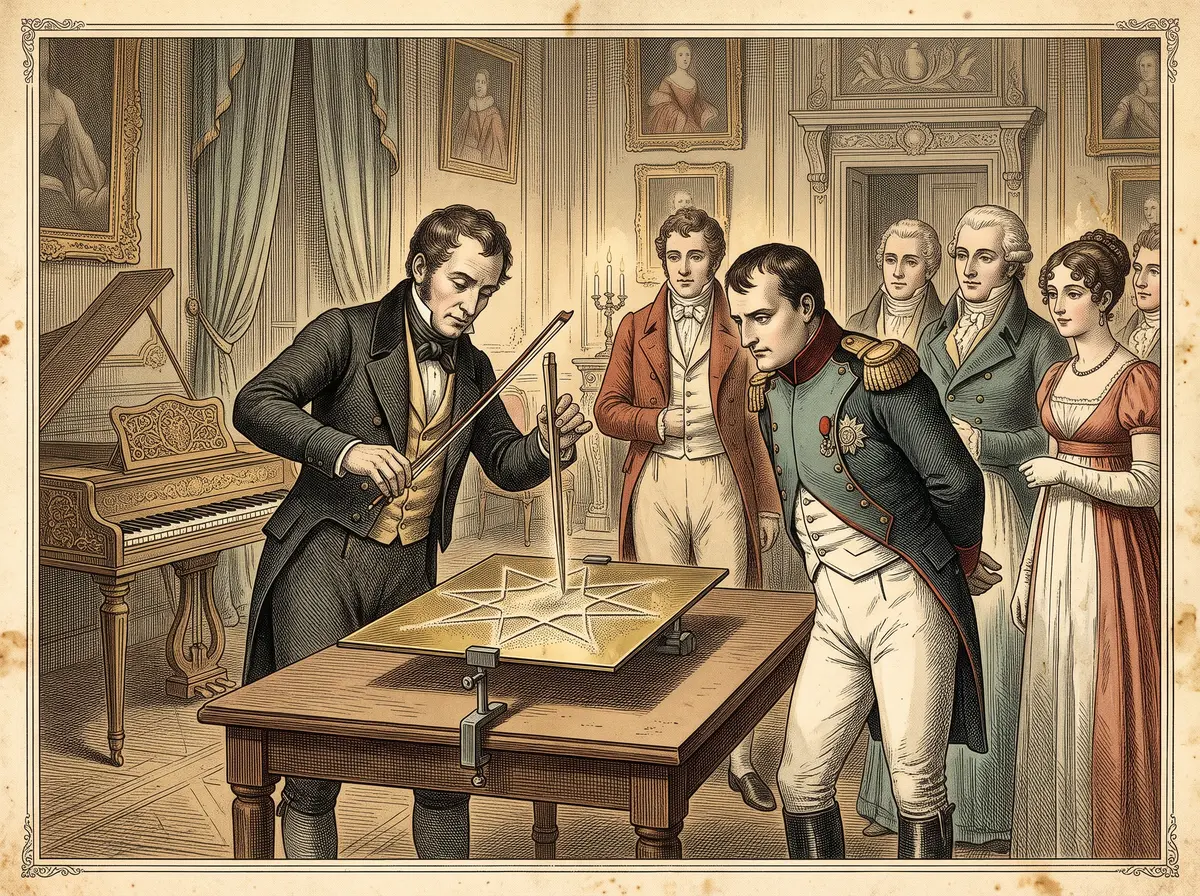
On a February evening in 1809, inside the Tuileries Palace in Paris, Napoleon Bonaparte sat down at an odd keyboard instrument and tried to play it. He pressed the keys too hard. The instrument's inventor, a traveling German physicist named Ernst Chladni, later wrote that the moment showed how the emperor's "energy dominated his softness." But Chladni hadn't come to the palace to show off his keyboard. He had come because he could make sound draw pictures in sand.
By the Curiosities Desk · · 5 min read · Filed under Physics · Today’s round
Part of The Person Who Would Not Drop It
What happened: Chladni's Sand Figures
Ernst Florens Friedrich Chladni was born in Wittenberg, in what is now Germany, in 1756. His father, a law professor, disapproved of his interest in science and insisted that his only son become a lawyer. He earned a law degree from Leipzig in 1782. His father died that same year, and Chladni turned to physics.
Part of his inspiration came from the physicist Georg Christoph Lichtenberg, who scattered powder over electrically charged cakes of resin and watched it settle into branching patterns, now called Lichtenberg figures. Chladni wondered whether sound could leave marks of its own. He sprinkled sand on a thin brass plate, held it still at one point, and drew a violin bow along its edge. The plate rang out a note. The sand bounced away from the parts that were shaking and gathered along lines that stayed still, forming stars, crosses, rings, and grids. Change the note, or hold the plate in a different spot, and a new pattern appeared.
In 1787 he published his results as Discoveries in the Theory of Sound (Entdeckungen über die Theorie des Klanges), with 166 figures on 11 engraved plates. He was not quite the first to see such patterns. The English scientist Robert Hooke had noticed similar ones on vibrating glass in July 1680. Chladni was the one who studied them systematically, shape by shape.
He never held a university post. For almost 30 years he made his living on the road, lecturing, demonstrating his sand figures, and playing two instruments he invented: the euphon, which was sounded by stroking glass rods, and the clavicylinder, a keyboard instrument.
In 1808 the tour reached Paris, where Chladni stayed until 1810 and performed his experiments for the city’s leading scientists. The mathematician Pierre-Simon Laplace arranged an invitation to the palace. According to Chladni’s own account, he rode to the Tuileries in a carriage with Laplace and the scientists Lacépède and Berthollet. The Empress Josephine and Napoleon’s mother were present. Napoleon greeted him standing in the middle of the room, tried the clavicylinder, and then asked for a thorough explanation of the sand figures. Chladni was struck that the emperor already knew mathematicians could not yet calculate the motion of a surface that curves in more than one direction.
The next morning Chladni received 6,000 francs, along with a request to publish his book on acoustics in French. The Traité d’acoustique appeared in November 1809, dedicated to Napoleon. Napoleon also offered 3,000 francs to anyone who could explain the sand patterns mathematically.
One caution: Chladni wrote his account of the evening in 1826, long after Napoleon had died in exile, so some details may have been polished by memory.
Why it was strange: Chladni's Sand Figures
Sound is invisible. Chladni’s sand showed that a ringing plate does not simply shake as a whole. Different regions move in opposite directions at the same moment, separated by lines that hardly move at all. The sand was a map of that hidden motion. The poet Johann Wolfgang von Goethe, unimpressed when the two first met in 1803, later wrote that “the world owes him gratitude, since he made the sound visible.”
The patterns also exposed a gap in mathematics. The Paris Academy of Sciences set the prize problem with a two-year deadline, and the great mathematician Joseph-Louis Lagrange doubted it could be solved with the methods of the day. When the first deadline came, only one entry arrived. It came from Sophie Germain, a mathematician who had largely taught herself. Her first two attempts were turned down, and the deadline was extended twice. On her third try, in 1816, she won a kilogram of gold, even though the judges noted gaps in her mathematics. She refused to attend the award ceremony, in part because one of the judges, Siméon Denis Poisson, had largely ignored her work.
Napoleon’s fascination with scientific marvels went beyond sand. He once sat down to play The Chess-Playing Machine That Beat Napoleon (With a Man Hidden Inside).
What scientists learned: Chladni's Sand Figures
Chladni’s figures are pictures of standing waves, patterns of vibration that stay in place rather than traveling. The still lines where the sand collects are called nodal lines. Every plate has many possible patterns, called modes, and each one rings at its own pitch. Chladni found a simple rule of thumb for round plates: the pitch rises roughly with the square of a count based on the number of straight lines and circles in the pattern.
Germain’s prize essay laid early groundwork for the theory of elasticity, the mathematics of how solid materials bend and spring back. Later physicists added a twist of their own. In 1831 Michael Faraday noticed that very fine powder on a vibrating plate does the opposite of sand, drifting toward the spots that shake the most, carried by tiny air currents.
Chladni also had a second, entirely separate career as a meteorite pioneer. In 1794 he argued that stones and lumps of iron fall from space, an idea many scientists ridiculed at first. That story is part of From a Thunderstone Chained in a Church to a Meteorite That Dented a Chevy: A Short History of Meteorites.
How it reaches us today: Chladni's Sand Figures
Violin and guitar makers still use Chladni’s method. Before assembling an instrument, some sprinkle fine particles on a carved top or back, vibrate it with a speaker, and read the patterns to judge how the wood will resonate.
The idea is still producing surprises. In 2016, researchers in Grenoble, France, reported in Physical Review Letters that tiny beads in liquid on a vibrating silicon membrane collect at the points of strongest motion, forming “inverse” Chladni patterns. The work points toward new ways to sort tiny particles.
Chladni is one of the stubborn self-made scientists gathered in The Person Who Would Not Drop It.
Fun fact: Chladni's Sand Figures
In 1813, during the wars that followed Napoleon’s retreat from Russia, a military fire rocket struck the house next to Chladni’s flat in Wittenberg, and his home burned. He managed to rescue his euphon and his clavicylinder.
Sources: Chladni's Sand Figures
- Ernst Chladni, Entdeckungen über die Theorie des Klanges, Leipzig, 1787 (digitized at the Internet Archive)
- H.-J. Stöckmann, “Chladni Meets Napoleon,” European Physical Journal Special Topics, vol. 145, 2007
- “This Month in Physics History: First Experiments on Chladni Figures,” APS News, American Physical Society, July 2017
- “This Month in Physics History” (Sophie Germain and the elasticity prize), APS News, American Physical Society, May 2004
- “Scientist of the Day: Ernst Chladni,” Linda Hall Library