The Scientist Behind It · Physics
The Physicist Who Packed a Thermometer for His Honeymoon
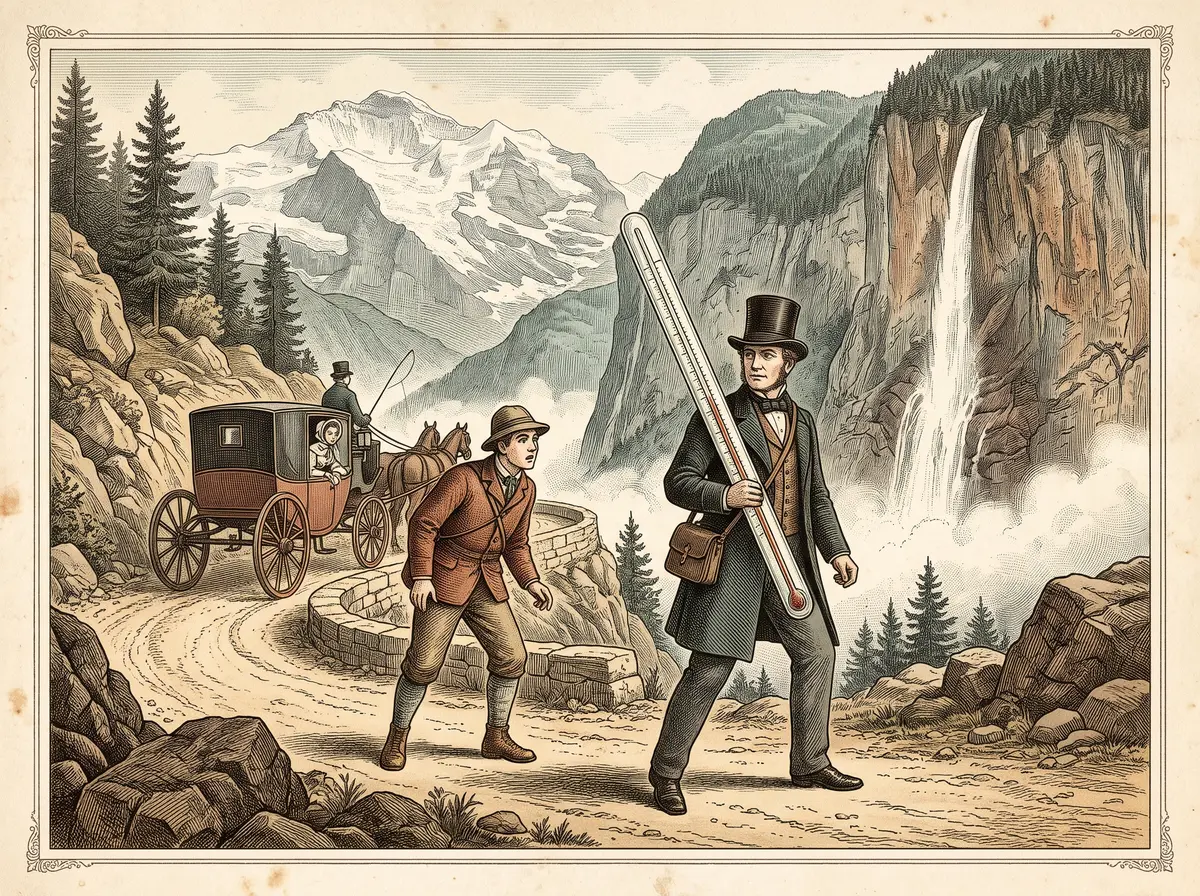
In the late summer of 1847, William Thomson was walking down a mountain road near Chamonix, in the French Alps, when he spotted a man he had met at a conference that June. The man was walking up the road holding a very long thermometer. A little way behind him was a carriage with a lady in it. He was on his honeymoon, and he had come to take the temperature of a waterfall.
By the Curiosities Desk · · 5 min read · Filed under Physics · Today’s round
Part of The Person Who Would Not Drop It
What happened: James Joule's Honeymoon
The man with the thermometer was James Prescott Joule, a 28-year-old from a brewing family in Salford, near Manchester. He had no university post. He had been tutored as a teenager by the chemist John Dalton, and he did his experiments at home.
For several years Joule had been chasing one idea: that heat and motion are two forms of the same thing, and that a fixed amount of work always produces a fixed amount of heat. His best-known test used a falling weight to spin a paddle wheel inside an insulated barrel of water. The churning warmed the water slightly, and measuring that rise let Joule put a number on how much work equals how much heat. He reported the paddle-wheel results to the British Association for the Advancement of Science at Cambridge in June 1845.
In a letter to the Philosophical Magazine that same year, he followed the idea outdoors. If he was right, falling water should warm up when it crashed to the bottom, because the energy of the fall had to go somewhere. By his figures, “a fall of 817 feet” would generate one degree Fahrenheit of heat, and the Niagara River should be about “one fifth of a degree” warmer below its 160-foot falls than above them.
In June 1847, Joule presented his work again, at the British Association’s meeting in Oxford. In the audience was William Thomson, a 23-year-old who had just become professor of natural philosophy (what we’d now call physics) at the University of Glasgow. Thomson later admitted he “felt strongly impelled at first to rise and say that it must be wrong.” Instead he waited and talked with Joule after the session. The two became friends.
Joule did not mention that he was about to get married. On August 18, 1847, he wed Amelia Grimes, the daughter of a Liverpool customs official, and the couple set off on a wedding tour of the Alps. Thomson was walking down from Chamonix to begin a hike around Mont Blanc when he ran into them. In Thomson’s telling, Joule “told me he had been married since we had parted at Oxford!” and explained that “he was going to try for elevation of temperature in waterfalls.”
The two physicists arranged to meet a few days later at Martigny and look at the Cascade de Sallanches, a waterfall in the valley below Mont Blanc, to see whether it would work. It didn’t. “We found it too much broken into spray,” Thomson recalled.
The popular version of this story, in which Joule spends his honeymoon measuring waterfalls, goes a little further than the record. The evidence is Thomson’s recollection, written about 35 years later: Joule brought the thermometer, the two men inspected one fall together, and the plan was dropped because the water was unsuitable. Thomson added that Joule’s young wife “took complete interest in his scientific work” for as long as she lived.
Why it was strange: James Joule's Honeymoon
Part of the strangeness is plain comedy: precision equipment packed for a wedding trip, and a friend who had no idea he was even engaged. But the bigger surprise is the idea itself.
In the 1840s, many scientists still thought of heat as a kind of invisible fluid, called caloric, that flowed from hot things to cold things and could be neither created nor destroyed. Under that view, there was no reason a waterfall should be warmer at the bottom. Joule was claiming that motion could turn directly into heat, at a fixed exchange rate, everywhere in nature A waterfall was simply a paddle-wheel experiment the landscape had already built.
The tiny size of the effect made the idea hard to see and easy to doubt. Joule was reportedly able to read temperatures to about 1/200 of a degree Fahrenheit, a claim some of his contemporaries doubted. The same suspicion about energy appearing from nowhere runs through The Perpetual Motion Machine Secretly Powered by an Old Man Upstairs Eating Bread.
What scientists learned: James Joule's Honeymoon
What Joule was measuring is now called the mechanical equivalent of heat: how much work it takes to produce a given amount of heat. By 1850, after years of refinement, he published a value of about 772 foot-pounds of work to raise one pound of water by one degree Fahrenheit. The modern figure is about 778, so his paddle wheel came within about 1 percent.
That exchange rate is one expression of the first law of thermodynamics, the principle that energy is never created or destroyed, only converted from one form to another. Thomson, the skeptic at Oxford, came around and helped build the new science of heat. From 1851 he and Joule worked together on how gases cool as they expand, an effect still called the Joule–Thomson effect.
The waterfall idea was also correct in principle. Ignoring losses to spray and air, water warms by roughly one degree Fahrenheit for every 778 feet it falls, no matter how much water there is. That’s why Joule’s number for Niagara, about a fifth of a degree, holds up.
How it reaches us today: James Joule's Honeymoon
Every food label, electricity bill and engine rating rests on the idea that energy can be counted across its forms. In 1882, Wilhelm Siemens proposed naming a unit of energy “the Joule, after the man who has done so much to develop the dynamical theory of heat.” The International Electrical Congress adopted the joule on August 31, 1889, about six weeks before Joule died on October 11. Today it is the international unit of energy. It sits beside a much older standard in The Cylinder in a Paris Vault That Defined the Kilogram.
Thomson, later Lord Kelvin, gave his name to a unit too: the kelvin, the scientific scale of temperature. Another everyday puzzle about heat that started with one stubborn observation is The Schoolboy Who Noticed Hot Ice Cream Freezes Faster. Joule belongs with the other people who would not put the experiment down, in The Person Who Would Not Drop It.
Fun fact: James Joule's Honeymoon
Joule’s falling-water rule works out to roughly one degree Fahrenheit for every 778 feet of drop, so even the world’s tallest waterfall, Angel Falls in Venezuela at about 3,200 feet, could in theory warm its water by only about four degrees.
Sources: James Joule's Honeymoon
- J. T. Bottomley, “James Prescott Joule,” Nature, reprinted in Scientific American Supplement, December 16, 1882, including William Thomson’s letter recalling the Oxford meeting and the Chamonix encounter — https://www.gutenberg.org/files/8452/8452-h/8452-h.htm
- J. P. Joule, “On the Mechanical Equivalent of Heat,” letter to the Philosophical Magazine, series 3, vol. 27 (1845), p. 205 (transcription) — https://www.chemteam.info/Chem-History/Joule-Heat-1845.html
- “Joule, James Prescott,” Dictionary of National Biography (1885–1900) — https://en.wikisource.org/wiki/Joule,_James_Prescott_(DNB00)
- Institute of Physics, “James Prescott Joule and energy conservation,” IOPSpark — https://spark.iop.org/james-prescott-joule-and-energy-conservation
Related stories: James Joule's Honeymoon
- The Perpetual Motion Machine Secretly Powered by an Old Man Upstairs Eating Bread — A machine that seemed to make energy from nothing
- The Cylinder in a Paris Vault That Defined the Kilogram — How a metal lump became a unit, and was replaced by a constant
- The Schoolboy Who Noticed Hot Ice Cream Freezes Faster — A strange observation about heat that scientists still argue over