The Prank Skull That California's State Geologist Called the Oldest Human in America
In July 1866, Josiah Whitney, the state geologist of California and a Harvard geology professor, stood before the California Academy of Sciences with a crusty brown human skull. Miners, he said, had pulled it from a shaft 130 feet under Bald Mountain in Calaveras County, beneath a layer of old lava. If he was right, it was the oldest human ever found in the Americas. Back in the gold camps around Angels Camp, at least a few people were trying very hard not to laugh.
By the Curiosities Desk · · 5 min read · Filed under Archaeology · Today’s round
Part of The Version Everyone Remembers
What happened: The Calaveras Skull
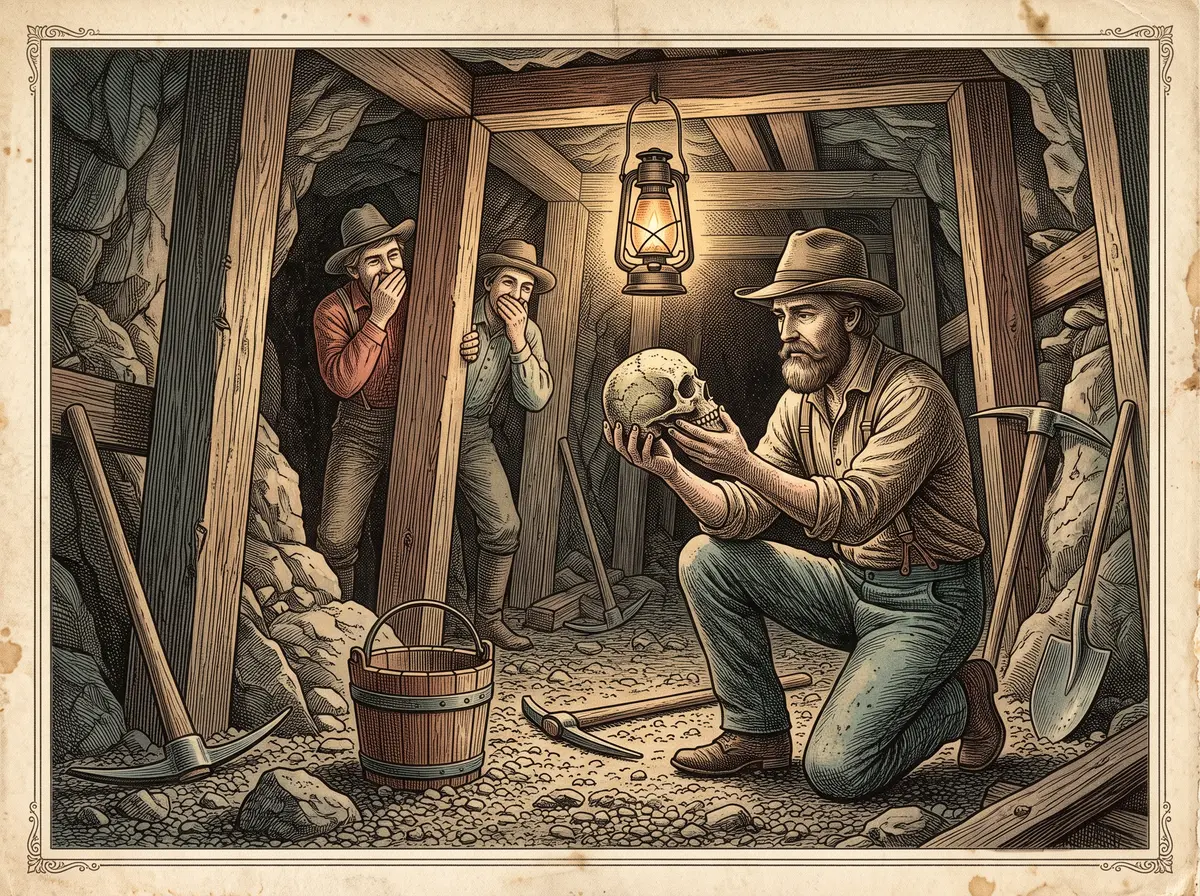
The story Whitney heard went like this. On February 25, 1866, a miner named James Mattison was working gold-bearing gravels deep in his shaft on Bald Mountain, near Angels Camp. He struck something he took for a tree root, and it turned out to be a skull caked in gravel and lime. The skull passed from Mattison to a local merchant, then to a physician in nearby Murphys, Dr. William Jones, and finally to Whitney’s state geological survey, which received it at the end of June.
Whitney had reasons to be excited. A year earlier he had published his view that people had lived in California alongside mastodons and mammoths. The gravels under Bald Mountain’s lava were very old, and Whitney dated them to the Pliocene, the geological epoch that, by modern reckoning, ended about 2.6 million years ago. A human skull sealed beneath them would mean that people had been in North America almost unimaginably early. He presented the find to the Academy, and later made it a centerpiece of his big 1879 report on California’s gold-bearing gravels.
The doubts started almost at once. Bret Harte, then a young San Francisco writer, answered the announcement with a mock-solemn comic poem, “To the Pliocene Skull,” in which the skull is asked to tell its ancient story and does not deliver what the scientist hopes. In 1869 a San Francisco newspaper reported that a minister had heard from miners that the whole thing was a practical joke on Whitney.
Over the next four decades, the local accounts multiplied, and they don’t all agree. One version, passed along by a minister around 1901, said Angels Camp storekeeper John Scribner had confessed to planting the skull. Another resident, postmaster George Stickle, said it had come from an old Native American burial site in nearby Salt Spring Valley. Some tellings say the original target of the joke was Dr. Jones, not Whitney, and that the prank simply got away from its authors. Which of these stories is exactly right is still unclear. What they share is the claim that the skull was put into the mine, not found there.
There was a further twist. Several people who had handled the skull in Calaveras County said the one Whitney showed off was not the one they remembered. A hotelkeeper recalled Dr. Jones turning up with a dusty, cobwebbed skull that looked as though it had been sitting on a shelf for years. Investigators came to suspect that two skulls had been swapped somewhere along the chain of hand-offs, possibly by accident.
Whitney never backed down, and he died in 1896 still believing the skull was genuine. Even his successor at Harvard, the archaeologist Frederic Ward Putnam, would not call it a fake after he visited Calaveras County in 1901 and heard the planting stories for himself.
Why it was strange: The Calaveras Skull
Whitney was no amateur. He was one of the most accomplished geologists in the United States; Mount Whitney is named after him. His geology was largely sound, too: later investigators agreed that the gravels and the extinct plants and animals in them really were ancient. The problem was the one object that mattered most. The skull looked like that of a Native American person who had lived in the area not long before, and the gravel clinging to it did not match the deposit it supposedly came from. A careful expert with a theory he already favored was handed exactly the evidence he was hoping for, and he took the story of where it came from on trust.
It sits on the same shelf as another prank that outgrew its pranksters: The Fake Fossils Carved to Humiliate a Professor — Who Then Published a Book About Them.
What scientists learned: The Calaveras Skull
The skull became a lesson in context. In archaeology, an object is only as old as the proof that it truly belongs in the layer where it was found, which is why modern excavators record exact positions and photograph finds before anyone lifts them. The Smithsonian’s William Henry Holmes, reviewing the case around the turn of the century, found the skull and stone tools from the “ancient” gravels matched those of recent California Native Americans. He argued that accepting humans unchanged over millions of years would amount to believing in a miracle. In a 1910 article, paleontologist John C. Merriam pointed out that the crust on the skull, along with the snail shells and small rodent bones stuck to it, looked like material from a cave, not from a riverbed of gold-bearing gravel.
The final word came from a technique Whitney never had. In 1992, a team led by R. E. Taylor published radiocarbon dates on the skull, which is held by Harvard’s Peabody Museum. Radiocarbon dating measures how much of a slowly decaying form of carbon is left in once-living material. The answer was the late Holocene, the most recent slice of geological time. The skull is most likely under about a thousand years old.
Science’s best-known skull hoax came decades later, in England: Piltdown Man: The Fake Fossil That Fooled Science for 40 Years.
How it reaches us today: The Calaveras Skull
The Calaveras skull helped set American archaeology’s high bar for any claim of very early humans in the Americas. When later sites were proposed, researchers asked the questions Whitney hadn’t pressed: who saw the object in place, what exactly surrounds it, and can it be dated directly? That skepticism is still why claims about when people first reached the Americas get checked so closely. And because the skull still turns up in some fringe and creationist writing as “evidence” scientists supposedly ignore, it remains a useful example of how one good story can outlive the facts that sank it.
For more stories that stuck around longer than the facts, see The Version Everyone Remembers.
Fun fact: The Calaveras Skull
Harte’s poem became so well known that it is still reprinted in collections of his verse, which means a comic poem about one California skull has had a longer public life than the scientific theory it poked fun at.
Sources: The Calaveras Skull
- R. E. Taylor, Louis A. Payen, and Peter J. Slota Jr., “The Age of the Calaveras Skull: Dating the ‘Piltdown Man’ of the New World,” American Antiquity 57, no. 2 (1992): 269–275
- John C. Merriam, “The True Story of the Calaveras Skull,” Sunset Magazine, February 1910 (UC Berkeley Archaeological Research Facility reprint)
- “The Notorious Calaveras Skull,” Archaeology Magazine (Archaeological Institute of America)
- “Calaveras Skull,” Calaveras County Historical Society
- “The Calaveras Skull,” Museum of Hoaxes
#hoaxes #radiocarbon dating #archaeology #19th century history