Accidental Discoveries · Engineering
The Press That Sliced Thousands of Seed Bags — and Invented the Cardboard Box
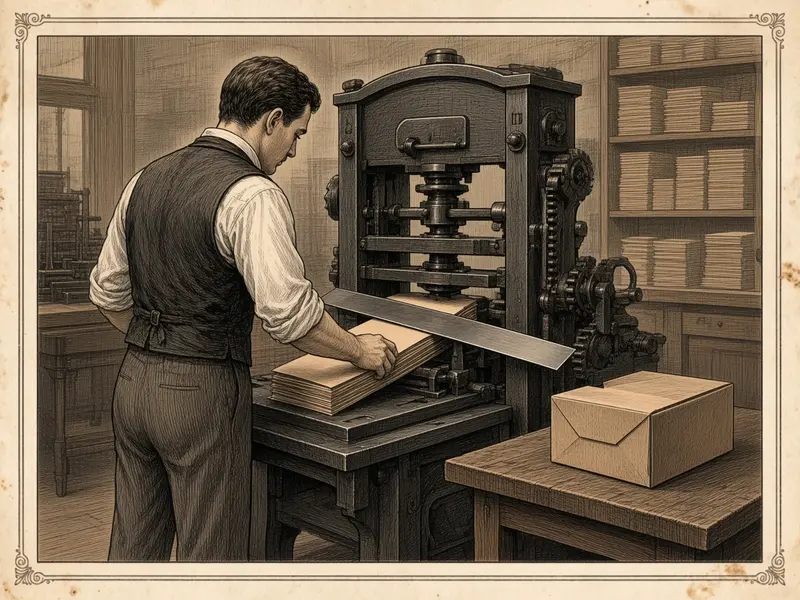
In 1879, the year his company later celebrated, a metal strip in Robert Gair's Manhattan print shop sat a hair too high. It was supposed to press a neat fold line into each paper seed bag. Instead it sliced every bag open, and nobody caught it until several thousand ruined bags had piled up. Gair looked at the damage and realized the machine had just done something nobody had asked it to: it had cut and creased paper in a single stroke.
By the Curiosities Desk · · 5 min read · Filed under Engineering · Today’s round
What happened: The Cardboard Box
Robert Gair was born in Edinburgh, Scotland, in 1839 and came to the United States at 14. After serving in the Civil War, he started a small paper business in lower Manhattan in 1864. Paper bags were a good trade, since cotton and burlap sacks had been scarce during the war. Gair’s shop made bags and printed them, too, stamping labels and names onto paper for customers such as seed sellers.
Printing presses of the day could do more than print. A pressman could set thin strips of metal, called rules, into the press bed alongside the type. A blunt rule pressed a groove into the paper, which made it fold cleanly in the right place. That was the job these rules were doing on a run of small seed bags.
The story the Gair company later told, recorded in a 1953 issue of its in-house magazine Gair Today and retold by the Smithsonian’s Lemelson Center, goes like this. A machinist let one rule “stand up a little too high.” Instead of creasing, it “cut neat, but ruinous slits through several thousand paper seed bags” before anyone noticed.
Gair saw a method in the mess. If a rule set slightly higher could cut, and a rule set slightly lower could crease, then one press could do both at once. He deliberately raised the cutting strips in a whole pattern of rules, ran a sheet of paperboard through, and, in the company’s telling, watched the press cut out the complete, ready-to-fold outline of a box.
The usual date for all this is 1879, and that’s the year the company celebrated. But it’s worth treating the details as company lore rather than a lab notebook. Gair’s 1927 New York Times obituary told a similar slit-bag story but placed it in 1870, and the Smithsonian notes there’s no evidence the process was patented in 1879. Gair’s own box patents came later, including one granted May 8, 1894, for what the patent calls “knockdown boxes,” cut “from a single blank.”
What isn’t in doubt is what came next. Gair’s folding cartons caught on, and the business grew enormous. In 1888 he moved his headquarters across the East River to Brooklyn’s waterfront and bought or leased so many waterfront buildings that the Brooklyn Daily Eagle was calling the district “Gairville” by 1916. In the late 1890s, the newly formed National Biscuit Company began selling Uneeda Biscuits in small paperboard cartons instead of cracker barrels, and Gair’s factory is widely credited with making those early boxes. By his death in 1927, according to his Times obituary, Gair ran six factories and employed about 3,000 people.
Why it was strange: The Cardboard Box
Before Gair, a box was a small piece of furniture. The common kind, called a set-up or rigid box, was assembled from stiff board, glued and covered, and shipped already built. A delivery of empty boxes was mostly a delivery of air. In the 1840s, according to packaging histories, many cartons were still made by hand and held together with tacks and string, which is why they were used for pricey goods like jewelry rather than crackers.
The fix didn’t come from a careful design program. It came from a misadjusted strip of metal on a machine built to make bags. The “mistake” and the invention were literally the same motion; all Gair changed was his attitude toward the result. In 1924, New York historian William Thompson Bonner called the folding box the “fit survivor” to the old set-up box, as if it had evolved.
For another time a ruined batch turned into a product: The Wallpaper That Failed and Became Bubble Wrap.
What scientists learned: The Cardboard Box
The lesson was mechanical, and it still runs packaging plants. Paperboard is a mat of layered plant fibers. Bend it with no guide, and the outer layers crack and the fold wanders. Press a groove first, and you crush the fibers along a line so the board bends there neatly, the way a scored sheet of paper folds along the score.
Gair’s insight was that cutting and creasing are the same operation at different depths. A sharp rule that reaches all the way through the board cuts it. A blunter rule that stops short only dents it. Lock both into one pattern, called a die, and a single press stroke turns a flat sheet into a flat box blank: outline cut, flaps scored, ready to be folded and glued.
That changed the math. Blanks could be stacked flat by the thousands, shipped cheaply, and folded into shape only when it was time to fill them.
Another accident that a sharp observer refused to throw away: The Hot Soldering Iron That Bumped a Syringe of Ink — and Invented the Inkjet Printer.
How it reaches us today: The Cardboard Box
Look at a cereal box, a toothpaste carton, or a medicine package, and you’re holding a descendant of Gair’s sliced seed bags. Modern die-cutters still pair sharp cutting rules with lower, rounded creasing rules, the same principle at far higher speed. The cereal and detergent boxes made at Gair’s later mill in Piermont, New York, were turned out fast: workers there recalled pressure to produce 600 boxes a minute.
The folding carton also helped create branded packaging as we know it. Once a box was cheap, it could carry a company’s name and a printed design, and shoppers started buying a package instead of a scoop from a barrel. (The heavier corrugated shipping boxes that arrive at your door are a related technology; Gair’s company moved into those in the early 1900s.)
Brooklyn still carries his name: many old factory buildings in the neighborhood now called DUMBO bear “Gair” on their facades.
For another kitchen staple born from a slip: The Overheated Glass Plate That Bounced Off the Floor — and Became CorningWare. The box belongs with the other accidents that became things you still use, in The Mistakes That Became Things You Still Use.
Fun fact: The Cardboard Box
At the old Gair paper mill in Piermont, New York, a giant steam-engine flywheel from 1902 was meant to be cleared away when the site was redeveloped. A wrecking ball couldn’t budge it, so the town kept it, and it now stands as a monument in Flywheel Park.
Sources: The Cardboard Box
- Smithsonian Lemelson Center — “Boxed” (the 1879 seed-bag account from Gair Today, 1953, and Gair’s patents)
- Google Patents — US 519,451, Robert Gair, “Paper Box” (granted May 8, 1894; primary source)
- The New York Times — “Robert Gair Dies of a Stroke at 88” (August 2, 1927)
- Barry Popik — “Gairville” (excerpts from the Brooklyn Daily Eagle, 1916, and Gair’s Times obituary)
- Piermont Public Library — “What Is That Piece of Junk in Flywheel Park?”