Strange Animals Scientists Studied · Archaeology
The Rat-Nibbled Seeds That Settled a Thousand-Year Argument About New Zealand
In 2008, a team of New Zealand scientists published one of the most important clues in the country's history, and it was a pile of chewed-up seeds. Tiny tooth marks gouged into the hard shells of forest seeds, left by rats that had stowed away on Polynesian voyaging canoes, finally told researchers when people first stepped ashore.
By the Curiosities Desk · · 5 min read · Filed under Archaeology · Today’s round
Part of Creatures That Changed Science
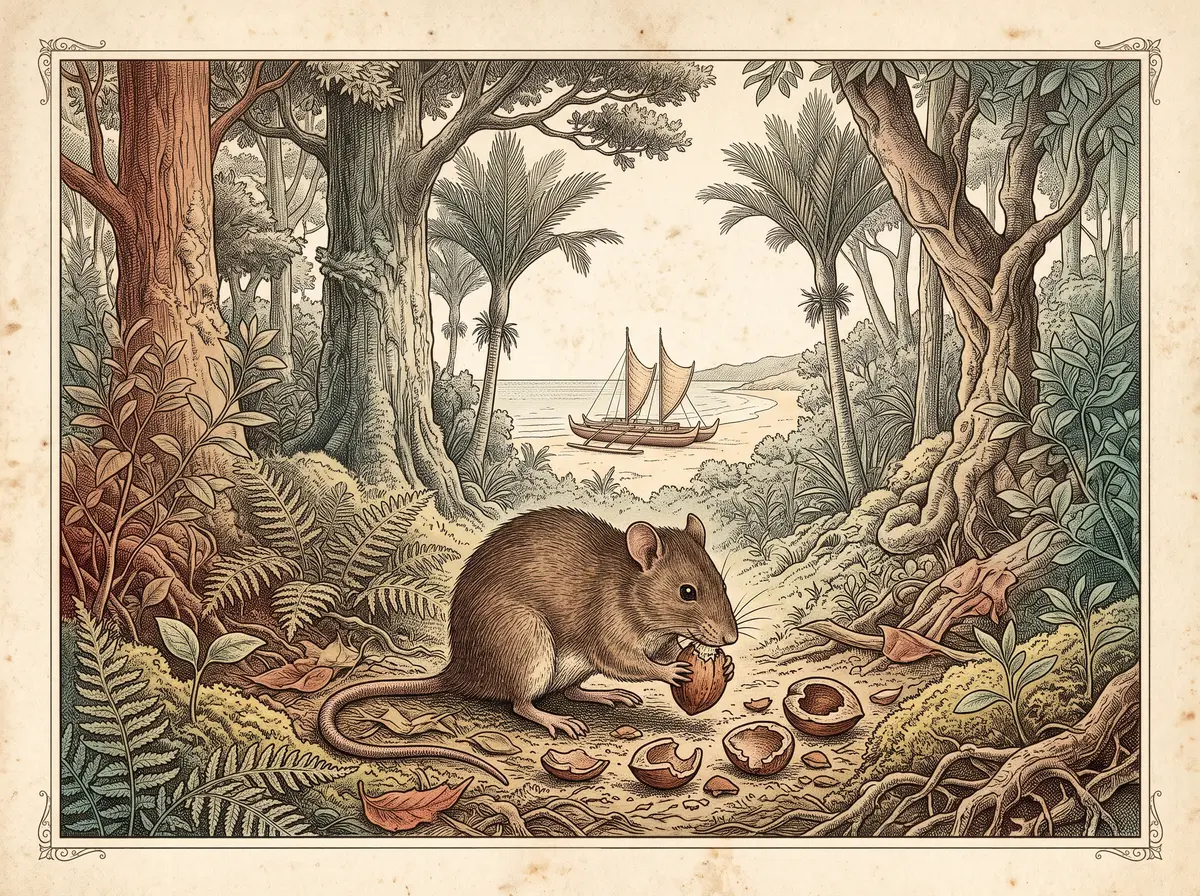
What happened: The New Zealand Rat Seeds
New Zealand was the last large landmass on Earth that people settled. The first arrivals were East Polynesian voyagers, ancestors of Māori, who crossed thousands of miles of open Pacific in double-hulled canoes. Pinning down when they arrived turned out to be surprisingly hard. Radiocarbon dating (measuring how much of a slowly decaying form of carbon is left in once-living material) depends on picking the right material to date.
By the 1990s most archaeologists put first settlement at around AD 1250 to 1300. Then, in 1996, paleobiologist Richard Holdaway published a short paper in Nature titled “Arrival of rats in New Zealand.” Holdaway had radiocarbon-dated bones of the Pacific rat, Rattus exulans, known in Māori as kiore, recovered from natural fossil deposits rather than human campsites, including places where birds of prey had dropped the remains of their meals. Some of the bones came back as much as about 2,000 years old.
That mattered because kiore could not have reached New Zealand on their own. They are small (under half a pound) and poor swimmers, native to Southeast Asia, and they spread across the Pacific only aboard human canoes. A 2,000-year-old rat implied a 2,000-year-old boat. Holdaway argued that people had made brief visits long before permanent settlement and either left or died out, while their rats stayed and multiplied.
The idea set off a long dispute. Archaeologist Atholl Anderson and others pointed out that nothing else backed it up: no early campsites, no early forest clearance in the pollen record, no early wave of bird extinctions. At some sites, rat bones dated more than 1,000 years older than charcoal, eggshell, and other material from the very same layer. Anderson ran a blind test, sending rat bones of already-known age to three radiocarbon labs. One returned results more than 1,000 years too old.
Ecologist Janet Wilmshurst of Landcare Research and radiocarbon specialist Tom Higham of Oxford tried a different route. Kiore gnaw open the hard woody cases of native tree seeds to reach the kernel inside, leaving distinctive chew marks that ordinary seed-eaters don’t make. In 2004 they dated rat-gnawed seeds from three North Island sites, one on the Coromandel Peninsula and two in Taranaki. Every gnawed seed was younger than about 750 years.
In June 2008, Wilmshurst, Anderson, Higham, and paleontologist Trevor Worthy published a larger study in the Proceedings of the National Academy of Sciences. They dated freshly collected rat bones and gnawed seeds from South Island sites, carefully pretreating the bones to strip away contaminating old carbon. The seeds in their samples spanned roughly 100 to 3,000 years old, but the ones with rat tooth marks were all less than about 780 years old. Both lines of evidence pointed the same way: the Pacific rat reached both main islands around AD 1280, “a millennium later than previously assumed,” in the paper’s words.
Holdaway did not simply concede. He told Nature’s news blog that the team had misread him, stressing that he had always said any early visitors didn’t stay, and he restated his reasoning plainly: “If rats arrived [2000 years ago], people obviously arrived.” Most researchers, though, now treat the late-13th-century date as the best estimate.
Why it was strange: The New Zealand Rat Seeds
Archaeologists usually date people by the things people leave: tools, hearths, bones, houses. Here, the most reliable timestamp came from an animal that was never supposed to be part of the story. The kiore was a stowaway, a pest, and also, for Māori, a food source. Its chewing turned into a calendar.
The twist is that the rats’ own bones were the problem. Bone is a tricky material to date: the carbon in it reflects what the animal ate, and tiny rat jawbones hold very little datable material to begin with, so small amounts of contamination or uneven lab preparation can push a date far off. A woody seed sidesteps most of that. Its carbon came from the air the tree took in while the seed grew, and the rat’s teeth simply mark that it was eaten after rats were present.
For the method behind all of this, see From Baltimore Sewer Gas to the Shroud of Turin: A Short History of Radiocarbon Dating.
What scientists learned: The New Zealand Rat Seeds
The study gave New Zealand a tighter, cleaner chronology. Settlement around 1280 lines up with the earliest securely dated archaeological sites, with the start of large-scale forest burning, and with the extinction of moa and other birds. The authors argued there was no long, invisible stretch when people (or their rats) were present but leaving no trace.
It also demonstrated a general tool. Because kiore traveled only with people, their earliest presence on an island marks human arrival, whether or not archaeologists have found the first campsite. Rat genetics has done similar work. In 1998, anthropologist Lisa Matisoo-Smith and colleagues used mitochondrial DNA (genetic material passed down from mother to offspring) from Pacific rats to trace voyaging routes between Polynesian islands, finding that New Zealand’s kiore had arrived in more than one introduction.
A raft built to test a very different theory of Pacific settlement appears in Kon-Tiki: The Raft That Crossed an Ocean to Prove a Theory That Was Wrong.
How it reaches us today: The New Zealand Rat Seeds
The date matters well beyond academic arguments. It shapes how New Zealand tells the story of Māori arrival, and how quickly humans transformed a land that had never known people or land mammals beyond bats. Ecologists studying the collapse of native birds lean on it: if people and rats arrived around 1280, the extinctions that followed happened remarkably fast.
It is also a useful reminder that a famous lab method is only as good as the material put into it. Choosing a seed over a bone changed the answer by about a thousand years.
The kiore belongs with the other animals that ended up doing science’s work, in Creatures That Changed Science.
Fun fact: The New Zealand Rat Seeds
According to Natural History magazine, a Pacific rat can’t swim across a gap of water much wider than about 200 yards — so every kiore that ever lived in New Zealand descends from rats that rode there in a canoe.
Sources: The New Zealand Rat Seeds
- Wilmshurst, J. M., Anderson, A. J., Higham, T. F. G., & Worthy, T. H. “Dating the late prehistoric dispersal of Polynesians to New Zealand using the commensal Pacific rat.” Proceedings of the National Academy of Sciences 105 (2008): 7676–7680: the gnawed-seed and rat-bone study that dated the rat’s arrival to about AD 1280
- Landcare Research, “New Zealand’s Colonization 1000 Years Later Than Previously Thought?” via ScienceDaily, June 4, 2008: summary of the 2008 findings and the earlier 200 BC claim
- Lowe, D. “Old bones tell new tales.” New Zealand Skeptic, February 2007: the history of the rat-bone controversy, the blind lab test, and the 2004 seed study
- “When did humans get to New Zealand?” Nature news blog, 2008: the PNAS findings and Richard Holdaway’s response
- Holdaway, R. N. “Arrival of rats in New Zealand.” Nature 384 (1996): 225–226: the original paper proposing a 2,000-year-old rat arrival