Weird Medical History · Engineering
The Sealed Pipe You Dropped in Ice Water to Breathe Oxygen Through Your Ankle
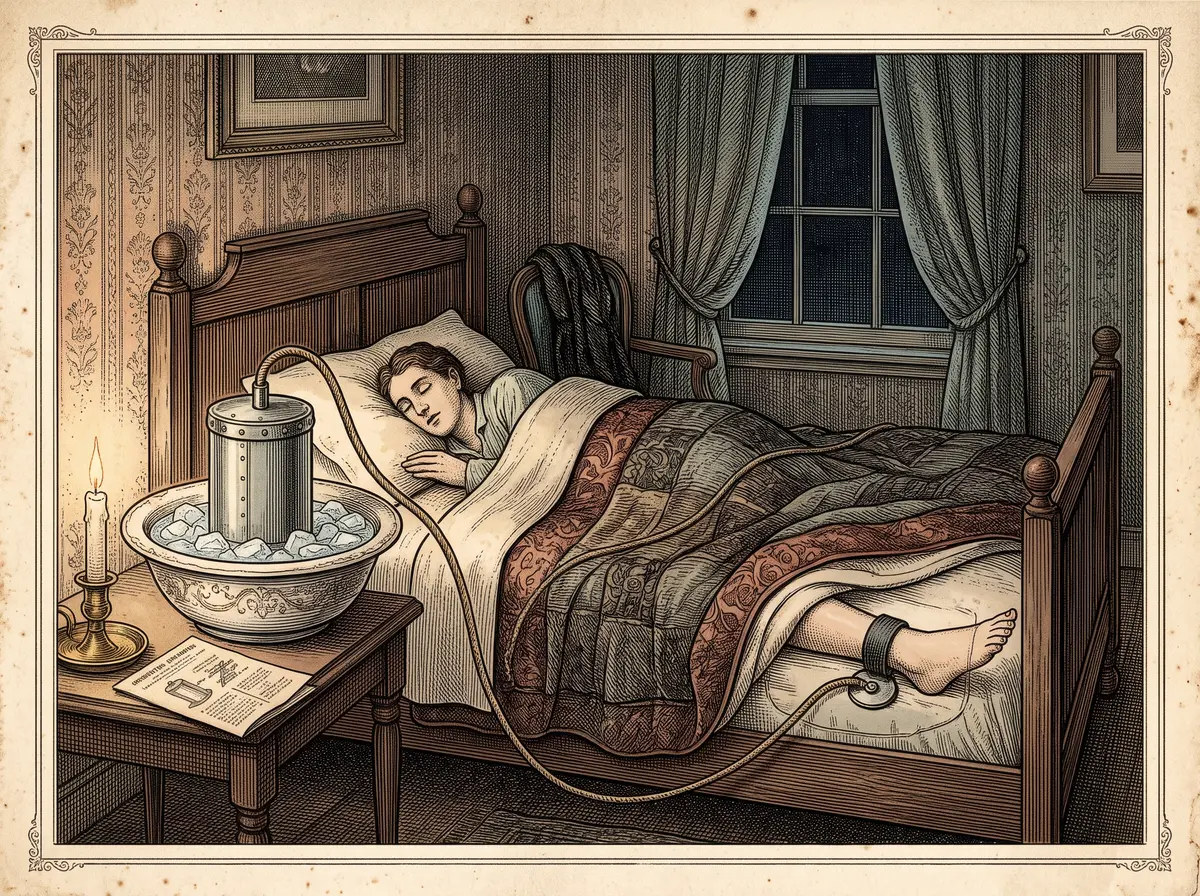
Around 1887, before bed, a buyer of Hercules Sanche's device would fill a bowl with ice water and lower a sealed, nickel-plated metal cylinder into it. A cloth-covered cord runs from the cylinder, over the edge of the bowl, under the covers, and ends in a small metal disc strapped to your ankle with an elastic band. Then you go to sleep, while the pipe supposedly helps your body drink in oxygen through your skin. Colder water, users were told, worked better. Nothing plugs in. Nothing hums. That was the whole treatment.
By the Curiosities Desk · · 5 min read · Filed under Engineering · Today’s round
Part of Medicine, Before It Was Sure
What happened: The Electropoise
The gadget was the brainchild of Hercules Sanche, born in Quebec in 1838, who styled himself the “Discoverer of the Laws of Spontaneous Cure of Disease.” Sources disagree about whether he had real medical training; the Canadian Museum of Health Care describes him as an itinerant businessman who posed as a doctor.
Sanche’s first version, developed around 1887, was called the Electropoise. Its patent rights went to a Birmingham, Alabama, businessman named John N. Webb, and the Electrolibration Company was incorporated in Alabama in October 1888 to sell it. The device was a sealed tube called the “polarizer,” joined by a flexible cord to a disc worn on the wrist or ankle. The tube went into cold water, with temperatures and treatment times set by an elaborate system of disease tables. An 1895 Cosmopolitan ad said the tube held “a composition, the nature of which is not made public.”
Despite the name, the instructions told users: “Do not expect any sensations of current or shock.” Ads advertised “an electrical force simulating the nervous current.” A pocket model sold for around $25, a substantial sum at the time.
Then people started cutting them open. In 1893, the magazine Science Siftings reported that its tube held “plumbago and sulfur” — plumbago being an old name for graphite. On December 1, 1900, a physician named N. C. Morse reported in the Journal of the American Medical Association that he’d had one sawed into sections, and concluded that “there is nothing in the carcass!” Three years earlier, another doctor had called the device in the same journal “one of the most glaring frauds of this decade.”
By then, Sanche had moved on to a new model: the Oxydonor. Its tube was renamed the “vocor,” and it now held a stick of carbon. The electrical talk faded, and the pitch became oxygen. The body, Sanche explained, would absorb large quantities of it through a process he named “diaduction.” The flagship Oxydonor “Victory” sold for $35, and its marketing promised to “cure all form of Disease quickly, intangibly, pleasantly, infallibly, during sleep or while awake.” Two-cord models let two people treat themselves at once.
Sanche was also very protective of his invention. Each genuine device warned, “Caution: There is but one Genuine Oxydonor.” When a rival firm began selling a look-alike called the Oxygenor — whose cylinder investigators later found held mostly sand, with some sulfur and charcoal — Sanche sued to stop it. It backfired. The court ruled in 1899 that he hadn’t shown his invention was useful enough to deserve protection, and, as one judge put it, diaduction was “merely a pretense, that is to say, a theory not entertained by the inventor in good faith.”
The pressure kept building. Harvey W. Wiley, the chemist who had championed America’s 1906 food and drug law, attacked the Oxydonor in a 1914 Good Housekeeping piece titled “The Apotheosis of the Inert.” In 1915, a federal fraud order was issued against Dr. H. Sanche & Co., cutting off its use of the U.S. mail. But Sanche also had a Montreal operation, and Montreal-made Oxydonors kept selling for years.
Why it was strange: The Electropoise
Most fake cures of the era at least made you feel something: a battery’s tingle, a bitter taste, a warm glow from alcohol. The Oxydonor asked you to do almost nothing and feel absolutely nothing, then credited itself with whatever happened next. Its makers even turned the lack of sensation into a selling point.
The details sound like a parody of engineering: a sealed pipe that couldn’t exchange anything with the water, a cord with no current to carry, and a company suing a copycat over who owned the real empty tube. Critics at the time named the reasoning error behind the testimonials: post hoc ergo propter hoc, Latin for “after this, therefore because of this.” You slept with the pipe, you felt better, so the pipe must have done it.
It sits on a long shelf of hopeful gadgets alongside The ‘Electric’ Hairbrush With No Electricity in It.
What scientists learned: The Electropoise
Your body gets oxygen almost entirely through the lungs, where it passes from the air into the blood across extremely thin membranes. The skin isn’t sealed off from the air: a 2002 study in the Journal of Physiology found that the skin’s outer layers take in a meaningful share of their own oxygen directly from the atmosphere. But that oxygen feeds those thin top layers. It isn’t pumped into your bloodstream, and no pipe in a bowl of water could speed it up. A sealed tube can’t send anything through a cord. A cold one just sits there being cold.
The Oxydonor era also showed doctors a practical lesson about evidence. Testimonials pile up easily for any treatment, because many illnesses ease on their own and people who feel cared for often feel better. Only a fair comparison against a look-alike with no supposed active ingredient can tell the difference. That idea reaches back to experiments like The Fake Metal Rods That Accidentally Invented the Placebo-Controlled Trial.
How it reaches us today: The Electropoise
Gas-pipe devices were sold mostly by mail, which is why some of the earliest crackdowns came from the Post Office rather than from health officials. The U.S. Food and Drug Administration got authority over medical devices only with the 1938 Federal Food, Drug, and Cosmetic Act, and devices didn’t generally need evidence of safety and effectiveness before sale until the Medical Device Amendments of 1976. Gadgets like the Oxydonor are part of why those rules exist. You’ll find more stories like this in Medicine, Before It Was Sure.
If you’re managing an ongoing illness, it’s worth talking with a doctor or pharmacist before trying a device that promises to fix everything — there are treatments with real evidence behind them.
Fun fact: The Electropoise
One rival, the Oxygenor King, tried to out-engineer the Oxydonor by adding a third cord. Its makers called it the “force controlling cord.”
Sources: The Electropoise
- Canadian Museum of Health Care, “Dr. Hercules Sanche and the Gas-Pipe Fraud”.
- Science Museum Group, “The ‘Oxydonor’, Canada, 1898–1930”, object 2006-212.
- Rebecca Baumann, “The Curious Story of the Electropoise”, Lilly Library, Indiana University, 2013.
- Denver Public Library Special Collections, “A Product of its Time: Oxydonor”, 2017.
- Micaela Sullivan-Fowler, “The giver of oxygen: Hercules Sanche and the oxydonor”, Journal of Medical Humanities 17, no. 1 (1996): 31–43.