Weird Medical History · Engineering
The Plug-In 'Magic Horse Collar' Sold by the Man Who Named Wilshire Boulevard
In 1926, customers of Gaylord Wilshire, all over the Pacific Coast, were sitting in their living rooms with a fat leather ring about the size of a car's steering wheel draped around their necks, its cord plugged into the wall socket. To prove the thing was doing something, a salesman would hold a second, smaller coil nearby, and a little flashlight bulb would glow. The ring was called the I-ON-A-CO. The man selling it was Gaylord Wilshire, the same Wilshire whose name is on one of the most famous streets in Los Angeles.
By the Curiosities Desk · · 5 min read · Filed under Engineering · Today’s round
Part of Medicine, Before It Was Sure
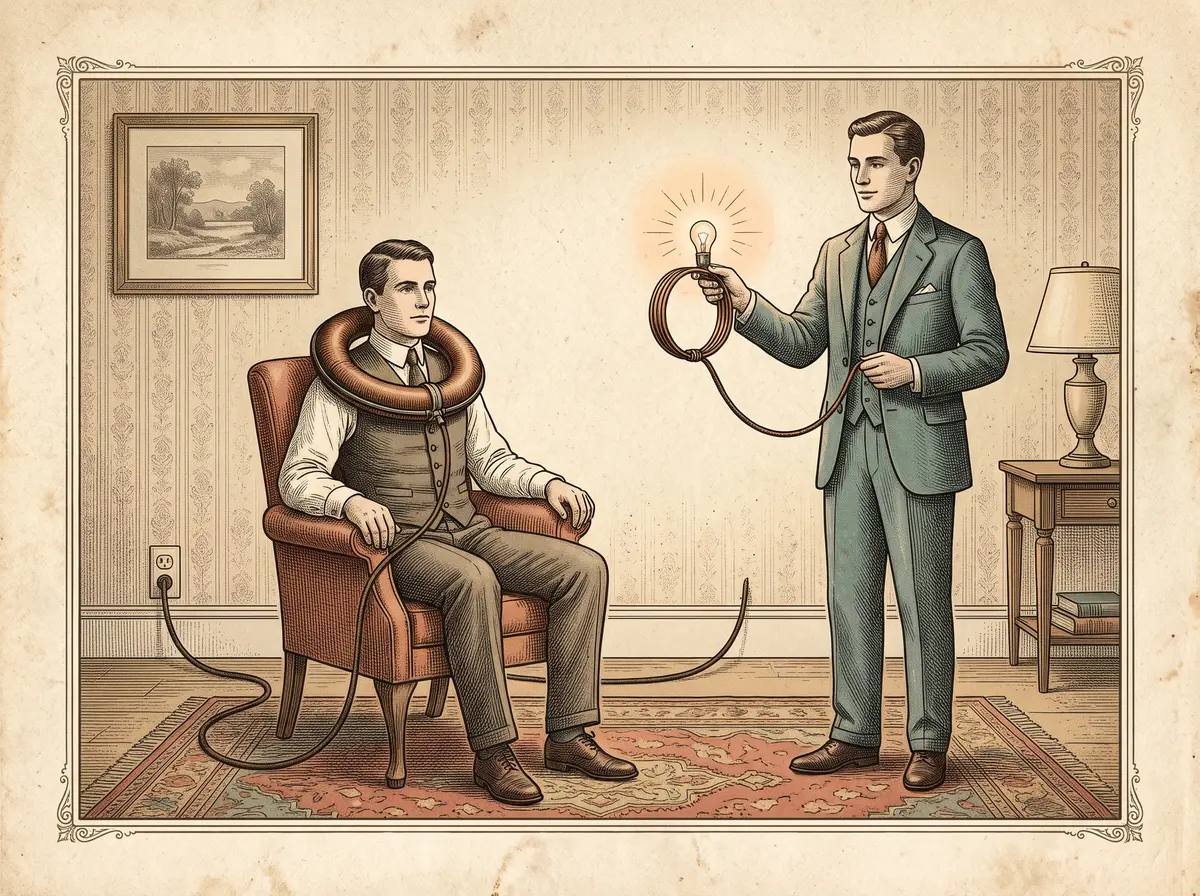
What happened: The I-ON-A-CO Collar
Henry Gaylord Wilshire was born in Cincinnati in 1861 and arrived in Southern California in 1887. That year he paid about $52,000 for a 35-acre barley field west of downtown Los Angeles. In the mid-1890s he turned it into an upscale housing tract and ran a wide road through it, about four blocks long, which he named after himself and later donated to the city. That stub grew into Wilshire Boulevard.
Wilshire was not a typical land baron. He was known as the “millionaire socialist.” He ran for office in the U.S. and, later, for Parliament in Britain, losing both times. By around 1914 his fortune was largely gone.
In his sixties, Wilshire turned to health, trying radium-infused clothing and a health bread called “Ex-cell-o.” He suffered from severe headaches that doctors hadn’t relieved, and historians disagree about whether he was chasing his own cure, his lost fortune, or both. In 1925, he tried a device of his own design on himself and reported that it worked. He founded the Iona Company in Los Angeles to sell it.
The I-ON-A-CO (also written Ionaco) was simple. It was a thick coil of insulated wire wrapped in leather, 15 to 18 inches across and about six and a half pounds. Plugged into ordinary household alternating current, it produced a weak magnetic field. A surviving example in the Oregon Health & Science University’s medical museum carries printed directions: place it around the body over your clothing and use it for 10 minutes once or twice a day. Users wore it around the neck or waist, which is how it earned the nickname “the magic horse collar.”
Wilshire’s marketing claimed it could help cancer, diabetes, tuberculosis, arthritis, neuritis, and insomnia. It sold for $65, or $5 a month on credit; one critic later reported a $55 cash price. Historians estimate each one cost about $3.50 to make. Radio and newspaper testimonials and door-to-door “demonstrators” did the selling. By 1927 the company had 23 regional offices, and historians estimate roughly 50,000 collars were sold between 1925 and 1927.
Then the investigators arrived. Health groups in Washington State, a Seattle business bureau, and the Rockefeller Institute all looked into the device. On November 18, 1926, Wilshire answered with a full-page ad in the Los Angeles Times, an open letter daring the California medical profession to test it. The American Medical Association’s Arthur J. Cramp published a critical analysis, and the AMA reported that many of the testimonials had been falsified. Sales slumped in the summer of 1927. Wilshire died in New York that same year, at 66, and the Iona Company dissolved soon after.
Why it was strange: The I-ON-A-CO Collar
Many quack devices of the era were boxes of nothing. The I-ON-A-CO really did make a magnetic field, and the glowing bulb was no trick. That’s what made it so persuasive. The demonstration proved that electricity was flowing and a field was present. It said nothing at all about whether that field could touch a tumor or a joint.
The theory also borrowed from real science. Wilshire said he was inspired by the work of German physiologist Otto Warburg, who was studying how iron helps cells use oxygen, research that would win Warburg a Nobel Prize in 1931. Wilshire’s leap was to reason that if there’s iron in your blood, a magnet should be able to stir it up and push more oxygen into your tissues.
It shared that trick with an 1880s gadget: see The ‘Electric’ Hairbrush With No Electricity in It, which came with a tiny compass as its built-in proof.
What scientists learned: The I-ON-A-CO Collar
The glowing bulb is a lovely little physics lesson called electromagnetic induction. Alternating current flips direction 60 times a second, so the big coil’s magnetic field keeps growing, collapsing, and reversing. A changing magnetic field passing through a second loop of wire pushes current around that loop. That current lit the bulb. It’s the same principle behind a transformer or a wireless phone charger.
The body is a different story. The iron in your blood isn’t like the iron in a nail. It sits inside hemoglobin, the protein that carries oxygen, bound up in a way that keeps it from acting like a tiny magnet you can tug around. In 1936, the chemists Linus Pauling and Charles Coryell measured hemoglobin’s magnetic behavior and found that it changes very slightly depending on whether it’s carrying oxygen. The effect was real but faint. Nothing like a leather coil plugged into the wall could push oxygen into tissues or melt a tumor.
When the Los Angeles County Medical Association Library displayed two I-ON-A-COs in 1985, its curator suggested that any benefit people felt most likely came from believing in the device.
For a device that tried to do something similar with light bulbs, see The Box of Light Bulbs the Corn Flakes Doctor Said Cured a King.
How it reaches us today: The I-ON-A-CO Collar
The collar didn’t vanish with its inventor. A former Iona manager launched a copy called the Theronoid in 1928, others followed, and magnetic bracelets and insoles are still sold today with similar promises.
The faint magnetism Pauling measured, though, turned out to be enormously useful. Because blood that has given up its oxygen is slightly more magnetic than oxygen-rich blood, an MRI scanner, with a magnet hundreds of times stronger than a fridge magnet, can detect the difference. That is the basis of functional MRI, which lets neuroscientists watch which parts of a working brain are drawing fresh blood. Magnets and blood really do interact. It just took a far stronger field, and a machine built to listen rather than to heal.
For another healer who swore by electricity, see The Preacher Who Ran Free Electric-Shock Clinics in Four Corners of London. The collar belongs with the other treatments from before medicine was sure, in Medicine, Before It Was Sure.
Fun fact: The I-ON-A-CO Collar
The I-ON-A-CO’s own label never called it a collar. The device in Oregon’s medical museum is labeled the “Magnetic Life Buoy.”
If you’re weighing a device or product that promises to treat a serious illness, it’s worth running it past a doctor you trust first. They can help you sort out what’s likely to help.
Sources: The I-ON-A-CO Collar
- Donald G. Davis, “The Ionaco of Gaylord Wilshire”, Southern California Quarterly 49, no. 4 (1967): 425–453
- Oregon Health & Science University Historical Collections, “I-ON-A-CO ‘Magnetic Life Buoy,’ ca. 1926” (surviving device and its printed directions)
- Morris Fishbein, Fads and Quackery in Healing (Covici Friede, 1932), pp. 153–155
- Los Angeles Conservancy, “Henry Gaylord Wilshire (1861–1927)”
- Kara L. Bren, Richard Eisenberg, and Harry B. Gray, “Discovery of the magnetic behavior of hemoglobin: A beginning of bioinorganic chemistry”, PNAS 112, no. 43 (2015)