Weird Medical History · Physics
The Preacher Who Ran Free Electric-Shock Clinics in Four Corners of London
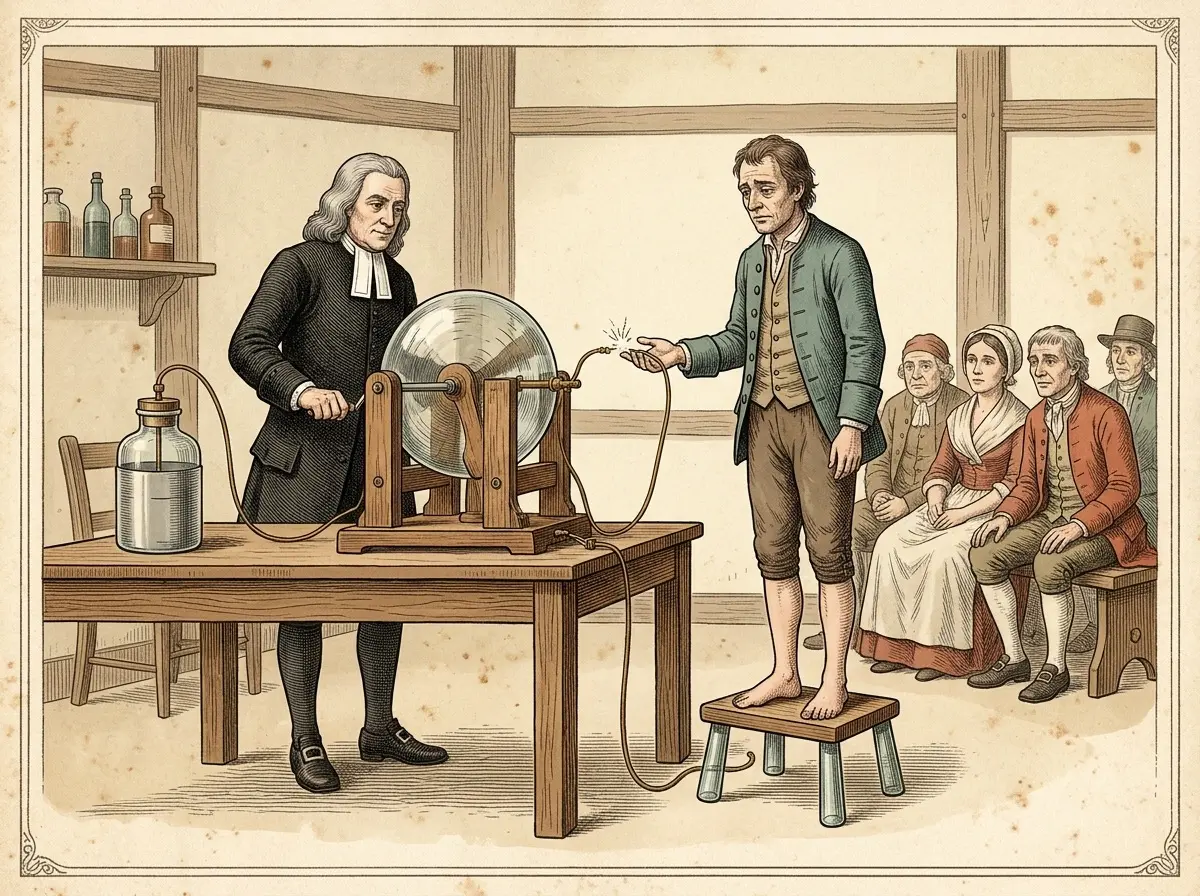
In 1756, John Wesley, the founder of Methodism and one of the busiest preachers in Britain, got hold of a machine that made sparks. Soon he was setting aside an hour every day so that anyone in London with a toothache, a headache, or a "nervous disorder" could come in, stand on a block of resin, and be given a small electric shock. For free.
By the Curiosities Desk · · 5 min read · Filed under Physics · Today’s round
Part of Medicine, Before It Was Sure
What happened: Wesley's Shock Clinics
Electricity was the most exciting science of the 1740s. Nobody yet knew what it was, but lecturers had learned to make it. Rubbing a spinning glass globe or tube against a leather cushion or a dry hand built up a charge of static electricity, and a new invention called the Leyden jar (a glass jar coated with metal foil inside and out) could store that charge and release it all at once. Touch the wrong wire and you felt a jolt. Wealthy audiences paid to watch sparks leap from fingertips and to feel the shock pass through a line of people holding hands.
Wesley, who had already written a best-selling book of home remedies for poor families called Primitive Physick (1747), took an interest in electricity in the late 1740s. Historian Paola Bertucci has shown that his interest was tied to his charity work: doctors were expensive, and Wesley spent much of his life looking for cheap remedies that ordinary people could use without one.
His journal entry for Tuesday, November 9, 1756, tells what happened next. “Having procured an apparatus on purpose,” he wrote, he had several sick people electrified. Some, he said, improved at once and some gradually. He set aside “some hours in every week,” then “an hour in every day,” for anyone who wanted to try “this surprising medicine.”
Demand grew. “Two or three years after,” Wesley wrote, there were so many patients that he split them across London: some were treated in Southwark, some at the Foundery (the old cannon foundry that served as Methodism’s London headquarters), some near St Paul’s, and some near Seven Dials. The Museum of Methodism says Wesley kept four electrical machines in different parts of the city, and that offering the treatment free was unusual for London at the time.
In 1760 he gathered the case reports he trusted into a 72-page book with a magnificent title: The Desideratum: or, Electricity Made Plain and Useful. (“Desideratum” means something badly needed.) It explained how to rub the glass, charge the jar, and run wires to the patient, who stood on resin or glass so the charge would not leak away into the floor. Then sparks could be drawn from the sore spot, or a shock passed through the head, arms, or legs. The book listed dozens of complaints that electricity had supposedly helped, from gout and sciatica to deafness, toothache, and “hysterics.”
Wesley never lost his faith in it. In March 1788, when his brother Charles was gravely ill, John wrote that he “earnestly” advised that Charles be electrified, “not shocked, but only filled with electric fire.” Charles died later that month. One of John’s machines survives today in his house on City Road in London.
Why it was strange: Wesley's Shock Clinics
It is not every day that the founder of a major church also runs a chain of free physics clinics. But the stranger part is how confident Wesley was. He wrote that “hundreds, perhaps thousands” had “received unspeakable good,” and that he had not known a single person harmed. When doctors warned about the dangers, he put it down to a lack of judgment or honesty. In The Desideratum’s preface he predicted that electricity would cure more nervous disorders in a year than the whole English Materia Medica (the standard list of medicines) would in a century.
Wesley was not a fraud. He charged nothing and believed what he saw. That is exactly what makes the story worth telling: a kind, careful, well-read man watched patients walk away happier and concluded the machine had worked.
For another 18th-century spectacle built on sparks, see The £50-a-Night Electric Bed That Promised Couples a Baby.
What scientists learned: Wesley's Shock Clinics
The physics was real. A friction machine separates electric charge, and a Leyden jar is an early capacitor, a device that stores charge on two conductors separated by an insulator. Discharging it through a body sends a brief pulse of current through nerves and muscles, which is why a shock makes you twitch.
What Wesley could not tell was whether the shock caused the cure. Many complaints on his list, like toothache, headache, and rheumatic pain, come and go on their own. People tend to seek treatment when they feel worst, so they often improve afterward no matter what was done. A dramatic, crackling treatment from a respected man can also produce a strong placebo effect, real relief that comes from expectation rather than the treatment itself. Without a comparison group of untreated patients, there was no way to separate these. Wesley’s results, as modern historians note, do not meet scientific standards.
Medicine eventually learned to test that kind of claim with fake treatments, as in The Fake Metal Rods That Accidentally Invented the Placebo-Controlled Trial.
How it reaches us today: Wesley's Shock Clinics
Wesley guessed right about one thing: electricity and the body are deeply linked. Nerves signal with electrical impulses, and modern medicine uses carefully measured currents in pacemakers, defibrillators, cochlear implants, and nerve stimulators for some kinds of pain. The difference is that these devices were tested in controlled trials, with known doses and honest comparison groups, rather than judged by grateful letters.
His other legacy is the conviction behind the clinics: that useful science should reach people who cannot pay for it. The hunger he was answering, for cheap, trustworthy help, never went away.
The sparks that started it all have their own odd history in The Abbé Who Shocked 200 Monks in a Line a Mile Long to Time the Speed of Electricity.
Wesley’s free hour with the spark machine sits with the other chapters of Medicine, Before It Was Sure.
Fun fact: Wesley's Shock Clinics
The Desideratum didn’t carry Wesley’s name on its title page. It was signed only “By a Lover of Mankind, and of Common Sense.”
Sources: Wesley's Shock Clinics
- The Journal of John Wesley, entry for November 9, 1756 — Christian Classics Ethereal Library
- The Desideratum: or, Electricity Made Plain and Useful (3rd ed., 1790) — Wesley Scholar (PDF)
- Paola Bertucci, “Revealing sparks: John Wesley and the religious utility of electrical healing,” British Journal for the History of Science (2006)
- Electricity machine — Museum of Methodism & John Wesley’s House
- John Wesley 1703–1791 — Science Museum Group Collection
If you’re living with pain or a long-term condition, a doctor can talk through treatments that have been tested and shown to help, including modern nerve-stimulation devices where they’re appropriate.