Impossible Inventions · Biology
The Snail Telegraph That Promised to Replace the Wires — and Spelled 'Gymnasium' Wrong
At noon on October 3, 1850, in a Paris apartment, a journalist named Jules Allix reached toward a wooden machine taller than a man and touched the letters G-Y-M-N-A-S-E. Each letter sat beside a small zinc trough, and in each trough, stuck fast by its shell, was a live snail. Across the room, a second snail-studded machine was supposed to spell the word back. It replied: GYMOATE.
By the Curiosities Desk · · 5 min read · Filed under Biology · Today’s round
Part of Built to Do the Impossible
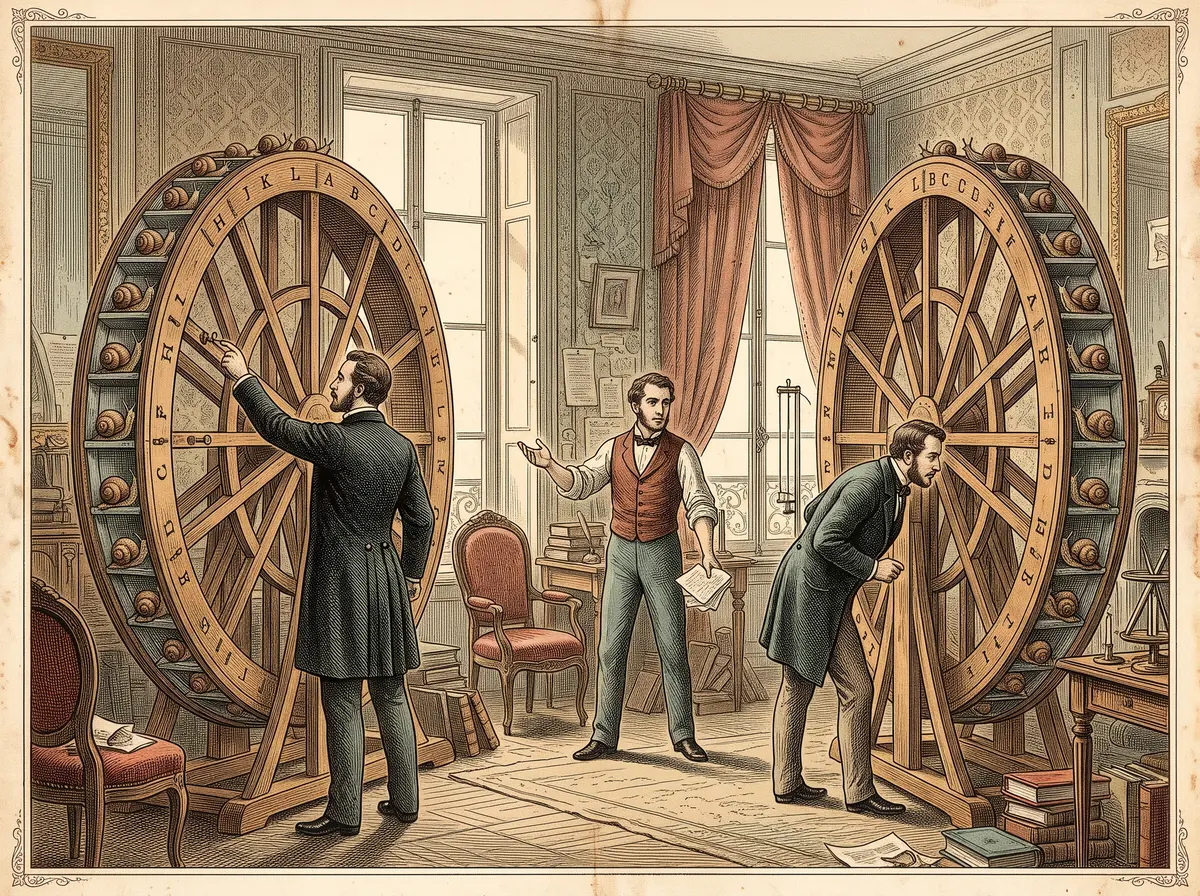
What happened: The Snail Telegraph
The man who owned the snails was Jacques-Toussaint Benoît, an occultist from the Hérault region near Montpellier. Benoît claimed to have spent more than a decade on a discovery that would make the electric telegraph obsolete. His partner, he said, was an elderly American, Monsieur Biat-Chrétien, who was conveniently in America at the time. No one else seems to have ever seen him.
The timing was good for a wild pitch. On August 28, 1850, the first telegraph cable had been laid across the English Channel between Dover and Calais. It worked for a day or so — reports differ on whether it was one day or three — and then went silent. Wires were expensive, fragile, and stopped at the water’s edge. Benoît offered something with no wires at all.
His theory went like this. Certain snails, once paired, stay in permanent “sympathy” with each other, no matter how far apart they are. In later retellings, the pairing came from mating. Touch one snail and its partner, even across an ocean, would feel a jolt that Benoît and Allix called the “escargotic commotion.” Give every pair of snails a letter of the alphabet, put one snail from each pair in Paris and the other in New York, and you could spell out messages faster than any telegraph.
The device built on this idea was called the “pasilalinic-sympathetic compass.” (Pasilalinic was a coinage meaning, roughly, “speaking to everyone.”) According to Allix’s own description, each machine was a wheel of zinc troughs lined with cloth soaked in copper sulfate, a snail glued at the bottom of each one, with a spring underneath to register the snail’s movement like a telegraph key. There were about two dozen troughs per machine, one for each letter. Benoît’s two prototypes stood more than two meters tall.
His backer was Hippolyte Triat, founder of a well-known Paris gymnasium, who gave him lodging and an allowance. After about a year with nothing to show for it, Triat wanted a demonstration. Benoît invited Triat and Allix to his rooms. That likely explains the test word: gymnase is French for “gymnasium,” a polite nod to the man paying the bills. (Many retellings date the test to October 2. Allix’s letter says that was the evening Benoît sent the invitation, and the trial took place at noon the next day.)
Both machines sat in the same room. To rule out a hidden wire, the visitors swapped their positions. Benoît stood between them. Allix tapped out GYMNASE, and Triat read GYMOATE off the other machine: the N had come out as an O and the S as a T. A second phrase, LUMIÈRE DIVINE (“divine light”), arrived as LUMHERE DIVINE.
Allix was thrilled anyway. In a long letter dated October 17 and printed in the newspaper La Presse later that month, he called the test conclusive. He also predicted pocket-sized snail compasses that ladies might one day wear on their waist-chains.
Triat was less impressed. According to later accounts, chiefly the Victorian writer Sabine Baring-Gould’s (which may be embellished), he had noticed how often Benoît stepped between the two machines. He asked for a second, properly controlled test. Benoît agreed and a date was set. When the day came, Benoît was gone. He was reportedly seen wandering Paris in poverty afterward and died within a couple of years, around 1852.
Why it was strange: The Snail Telegraph
The snail telegraph wasn’t strange because it failed. It was strange because of how good the packaging was. Benoît borrowed the look of real electrical science: voltaic piles, copper sulfate, zinc, spring-loaded keys arranged like a dial. In 1850, real telegraphs used exactly those materials. All he had to add was one unproven ingredient, the snail, and the whole thing looked like a laboratory instrument instead of a séance.
It also came with a built-in alibi: the one man who could have confirmed the long-distance link was always on the far side of the Atlantic.
The snails were not the only animals asked to run a machine in the 1850s: The Twelve Leeches That Were Supposed to Ring a Bell When a Storm Was Coming.
What scientists learned: The Snail Telegraph
Benoît’s “sympathy” grew out of animal magnetism, the 18th-century idea from Franz Mesmer that an invisible fluid flows between living things. A French royal commission had already tested that idea in 1784, with Benjamin Franklin and Antoine Lavoisier among its members. They found that patients reacted strongly when they believed they were being “magnetized,” and not at all when they were magnetized without knowing it. Blindfolds and hidden conditions revealed what was really going on.
That is the lesson of the snail telegraph too. Triat’s instinct to ask for a second, stricter trial was exactly right. A claim that only works when its inventor walks back and forth between the sender and the receiver hasn’t been tested yet. Separate the operator from the result, and the effect has to stand on its own.
As for the snails themselves: land snails really are hermaphrodites, meaning each one has both male and female reproductive organs, and Allix’s letter mentions this. But nothing in snail biology links two animals once they’re apart. Snails sense the world through touch and chemistry, close up.
The commission’s blindfold method has its own story: The Blindfolded Boy Who Fainted at the Wrong Apricot Tree.
How it reaches us today: The Snail Telegraph
Wireless messaging did arrive, about half a century later, when radio telegraphy in the 1890s sent signals through the air using electromagnetic waves. It rested on physics anyone could measure and repeat.
The snail telegraph lives on mostly as a cautionary tale about demonstrations. It’s a reminder that “it worked when I showed you” and “it works” are different claims. It also lives on in pop culture: the telephone snails in the manga One Piece are often said to echo it.
More machines that promised more than they could deliver: Built to Do the Impossible.
Fun fact: The Snail Telegraph
Jules Allix never quite gave up on snails. In exile on the island of Jersey in 1854, he sat in on Victor Hugo’s famous “talking table” séances and reportedly tried to bring escargotic force into the conversation with the spirits.
Sources: The Snail Telegraph
- Jules Allix, “Communication universelle et instantanée de la pensée … Boussole pasilalinique sympathique”, La Presse, October 1850 (letter dated October 17, 1850), English translation by Justin E. H. Smith, Cabinet 58 (Summer 2015) (primary source)
- Justin E. H. Smith, “The Internet of Snails: Escargotic Commotion and the Wood-Wide Web”, Cabinet 58 (Summer 2015)
- Toby Howard, “From the archives: Jacques Benoit’s (failed) experiments with telepathic snails”, The Skeptic 2(6), 1988
- “1850 Dover–Calais Cable”, History of the Atlantic Cable & Undersea Communications
- Rachel Rosen, “Psychic Snail Sex Couldn’t Replace the Telegraph, But One Frenchman Sure Tried”, Atlas Obscura, 2016