Strange Animals Scientists Studied · Medicine
The Snail Venom That Put Mice to Sleep, Made Them Shake — and Turned a Timid Lobster Into 'King Kong'
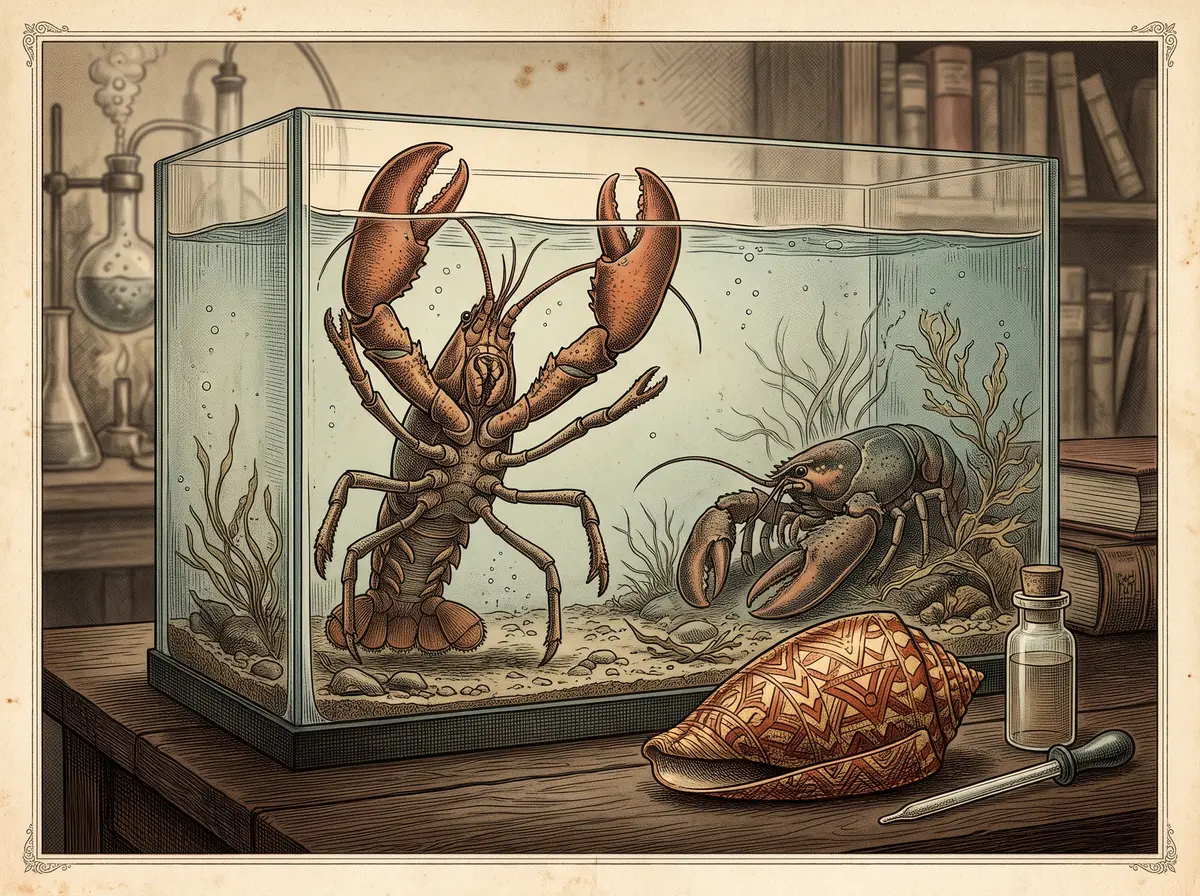
In a 1989 paper, Baldomero Olivera's group described a lobster that had just lost a fight and then, after a few drops of snail venom, reared up into an exaggerated show of dominance, as if it owned the tank. The scientists who found the molecule behind this gave it the only name that seemed to fit: the King Kong peptide.
By the Curiosities Desk · · 5 min read · Filed under Medicine · Today’s round
Part of Creatures That Changed Science
What happened: The King Kong Peptide
The story starts in Manila in the early 1970s. Baldomero “Toto” Olivera, a Filipino biochemist trained at Caltech and Stanford, had come home to set up a lab with his colleague Lourdes “Luly” Cruz at the University of the Philippines. He had been studying DNA, but that work needed equipment and supplies that were hard to get there. So he picked a project he could do cheaply, inspired by his shell-collecting days as a boy: the venom of cone snails.
Cone snails are slow, pretty, and deadly. There are hundreds of species, and many hunt worms, other snails, or even fish by firing a harpoon-like tooth loaded with venom. One species, Conus geographus, can kill an adult human within hours. Its old nickname is the “cigarette snail,” supposedly because a victim has just enough time to smoke one last cigarette. That part is folklore, not a measurement.
Olivera’s first goal was to find the component in the venom that killed people. He moved to the University of Utah in 1972, and the work split across two continents: Cruz’s lab in Manila supplied crude venom, and Utah supplied the analysis. The team found that the active ingredients were small peptides, short chains of amino acids, the building blocks of proteins. Injected under the skin or into the belly of mice, the venom fractions mostly just caused paralysis. It looked like a simple story.
Then an undergraduate named Craig Clark, about 19 years old and curious about the brain, made a suggestion in the mid-1970s: inject the fractions directly into the mouse’s central nervous system instead. Olivera was skeptical. Clark learned the technique from colleagues at the medical school and tried it anyway.
The results were startling. Fraction after fraction did something different. Some mice shook. Some scratched. Some ran in circles, climbed, convulsed, or went sluggish. One peptide put young mice under three weeks old to sleep for 12 to 24 hours, yet made adult mice hyperactive. The lab began naming the peptides after what they did, which is how they ended up with a “sleeper” and a “shaker.”
The shaker belongs to J. Michael McIntosh. In 1979, at 18, he joined Olivera’s lab the summer before his freshman year at Utah. He purified the peptide that made mice tremble, from the fish-hunting magician’s cone, Conus magus, and worked out its chemical structure. It became known as omega-conotoxin MVIIA.
The King Kong peptide came from a different species, the snail-hunting cloth-of-gold cone, Conus textile. In a 1989 paper in Biochemistry, Olivera’s group described a 27-amino-acid toxin that caused convulsion-like activity in snails and, in lobsters, made a subordinate animal adopt an exaggerated dominant posture. It does nothing noticeable in mammals.
Why it was strange: The King Kong Peptide
Venom is supposed to be blunt. A predator needs its prey to stop moving, so you might expect one or two knockout chemicals. Cone snail venom turned out to be the opposite: a cocktail of many small molecules, each aimed at one particular target in the nervous system, usually a channel that lets calcium, sodium, or potassium in and out of nerve cells.
That precision is why a single drop could produce such a range of odd behaviors. The shaker peptide paralyzed fish and frogs but not mice. The King Kong peptide, made by a snail that hunts other snails, left mammals alone but changed how a lobster carried itself. Each molecule only looked strange because it was hitting a target the scientists hadn’t yet learned to see.
The team never set out to make a drug. As Olivera later put it, an NIH grant “allowed us to discover things that were unexpected.”
Another oddball animal that turned out to matter for medicine: The Armadillo Pitched as a Leprosy Lab — and the Researchers Who Laughed Until It Worked.
What scientists learned: The King Kong Peptide
Omega-conotoxin MVIIA blocks a specific type of calcium channel, a pore in the nerve cell membrane. Fish and frogs use these channels to move their muscles, which is why the toxin paralyzes them. Mammals rely on related channels to pass pain signals along the spinal cord, so in a mouse the same molecule made the animal shake rather than freeze. Utah biologist Doju Yoshikami helped show that the toxin blocks signals at certain synapses, the junctions where one nerve cell talks to the next.
More broadly, conotoxins became precision tools. Because each one sticks to a single kind of channel or receptor, neuroscientists use them like labeled keys to find out which channels do what. The University of Utah now estimates that cone snail venoms may hold more than 100,000 pharmacologically active peptides.
A different researcher who learned what an animal’s toxin could do the hard way: The ‘Rubbish Bird’ a Grad Student Discovered Was Poisonous by Licking His Own Scratch.
How it reaches us today: The King Kong Peptide
McIntosh’s shaker became a medicine. Developed by the company Neurex and later Elan, a synthetic copy called ziconotide (brand name Prialt) was approved by the FDA on December 28, 2004, for severe chronic pain. It is chemically identical to the snail’s peptide, just made in a lab instead of in a snail. It is delivered by an implanted or external pump directly into the fluid around the spinal cord.
Ziconotide isn’t a miracle cure. It is reserved for people with severe pain that other treatments haven’t controlled, and it carries a boxed warning about possible psychiatric and neurological side effects. But it gave doctors a non-opioid option for patients who no longer respond to morphine. The university never patented the original peptide, Olivera said, because at the time it “didn’t have a definitive therapeutic use.”
In 2022, Olivera, Cruz, McIntosh, and Clark (who died in 1994) received the Golden Goose Award, which honors federally funded research that looked odd at first and paid off later.
Another animal recruited to help with a hard medical problem: The Giant Rats That Sniff Spit for Tuberculosis — and Get Paid in Banana.
The lobster, and the snail that supplied the peptide, sit with Creatures That Changed Science.
Fun fact: The King Kong Peptide
McIntosh, the teenager who purified the shaker, went on to earn an M.D. and become a psychiatrist at the University of Utah, where he still studies cone snail toxins and supervises undergraduates purifying new ones.
If you live with chronic pain, you’re not alone, and a pain specialist can talk through the full range of treatment options with you.
Sources: The King Kong Peptide
- Hillyard et al., “A molluscivorous Conus toxin: conserved frameworks in conotoxins,” Biochemistry 28(1):358 (1989), as indexed by the U.S. National Library of Medicine (MeSH record: King Kong peptide)
- Golden Goose Award, “Tiny Snail, Big Impact”: Craig T. Clark, Lourdes J. Cruz, J. Michael McIntosh, and Baldomero Olivera (2022)
- ScienceDaily / University of Utah, “New painkiller was discovered in natural form in venomous snails in 1979” (2005)
- National Institute of General Medical Sciences, Findings, September 2002 cone snail feature (archived)
- Baldomero Olivera, “Conus Venom Peptides” lecture, iBiology