Strange Animals Scientists Studied · Chemistry
The Spiders a Pharmacologist Drugged So a Zoologist Could Stop Waking Up at 4 A.M.
In 1948, at the University of Tübingen, a zoologist had a scheduling problem. His garden spiders built their beautiful wheel-shaped webs in the dark before dawn, roughly between 2 and 5 a.m. by most accounts, and if he wanted to watch, he had to be awake too. So he asked a young pharmacologist down the hall for a favor: could he give the spiders something that would make them spin at a more civilized hour? The drugs never budged the spiders' schedule. They did something far stranger to the webs.
By the Curiosities Desk · · 5 min read · Filed under Chemistry · Today’s round
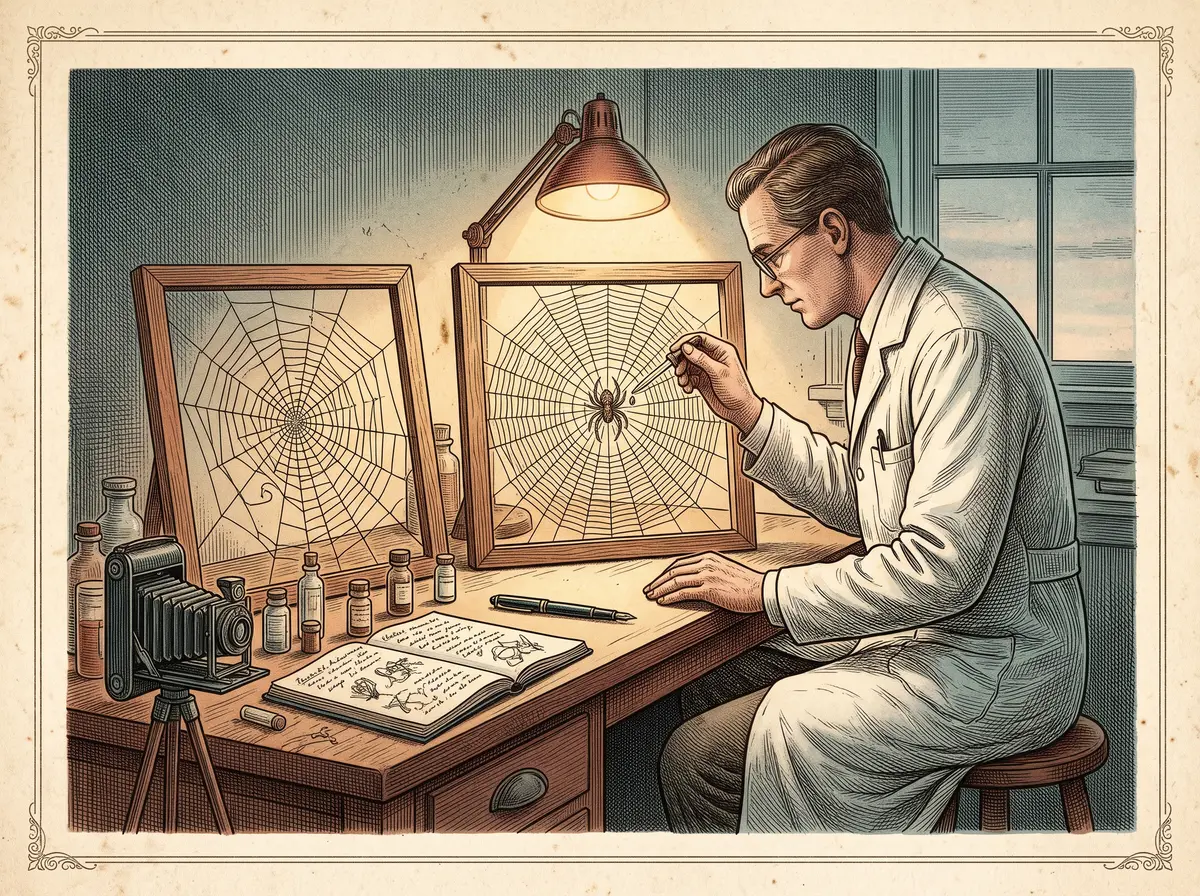
What happened: The Spiders a Pharmacologist Drugged So a Zoologist Could Stop Waking Up
The zoologist was H. M. Peters, who was studying how the European garden spider, Araneus diadematus, builds its orb web: the classic spoked wheel with a spiral laid over it. These spiders typically rebuild every morning just before sunrise, and the whole job takes only about 20 to 30 minutes. Miss that window and you wait another day.
The pharmacologist was Peter N. Witt. Looking back in a 1971 review, Witt described the start plainly: a Tübingen zoology professor recruited a young pharmacologist “to try to shift web-building to a convenient time.” Witt tried stimulants, including amphetamine, on the logic that a pepped-up spider might get to work earlier.
It didn’t work. The spiders kept their own hours. But the webs they built under the drugs came out wrong in ways you could see and measure: uneven spokes, spirals crowding together in some places and gaping in others. Peters and Witt reported these distorted webs in 1949, and Witt, rather than dropping the failed favor, turned it into a research program that lasted more than two decades.
The method was simple. Witt dissolved a drug in sugar water and touched a drop to the spider’s mouth, or mixed it into food. Then he photographed the next web and compared it, thread by thread, with the same spider’s normal webs. Over the years his spiders received a long list of substances: amphetamine, caffeine, mescaline, strychnine, scopolamine, psilocybin, sedatives, tranquilizers, and LSD.
Each left its own signature. In Witt’s 1971 review, amphetamine produced irregular spacing in both the spokes and the spiral. Scopolamine made spiders lose their way mid-spiral, laying partial loops that circled several different centers. The barbiturate pentobarbital left wedge-shaped gaps where the last spokes should have gone. High doses of psilocybin, the compound in so-called magic mushrooms, stopped web-building altogether. Caffeine, too, bent the geometry: small doses made smaller webs with uneven spokes, and larger doses made the design messier still.
Then there was LSD. Witt reported in 1951 that spiders given very tiny doses built webs that were larger and more regular than their normal ones, with more even spacing. It was the one notable case in his work where a drug seemed to tidy up a web rather than scramble it. Larger doses, though, produced smaller and more irregular webs, like everything else.
Witt eventually moved to North Carolina, where he continued the work at the state’s Department of Mental Health in Raleigh. Decades later, in 1995, researchers at NASA’s Marshall Space Flight Center revisited the idea with modern statistics, dosing garden spiders with caffeine, marijuana, Benzedrine (an amphetamine), and the sedative chloral hydrate, and proposing web analysis as a way to rank how toxic a chemical is.
Why it was strange: The Spiders a Pharmacologist Drugged So a Zoologist Could Stop Waking Up
The experiment failed at the only thing it was meant to do. Nobody set out to study spider pharmacology; a tired scientist wanted to sleep later. The drugs had no effect on when the spiders built, which was the whole point, and an enormous effect on how they built, which nobody had asked about.
There’s also something odd about where the evidence ended up. You can’t interview a spider about how it feels. But an orb web is a physical record of every decision its builder made: where to anchor each spoke, how far apart to lay each turn of the spiral. Witt realized he didn’t need to watch the spider’s nervous system. It left him a diagram.
For a spider whose web went to space instead, read The Teenager Who Sent Two Spiders to Spin Webs in Space.
What scientists learned: The Spiders a Pharmacologist Drugged So a Zoologist Could Stop Waking Up
The main lesson was that complex, inborn behavior can be measured precisely enough to detect subtle chemical effects. Witt treated each web as data: number of spokes, the angles between them, the spacing of the spiral, the total catching area. Because a healthy spider’s webs are fairly consistent, even small drug-induced changes stood out.
Different drugs broke the web in different ways, which hinted at which step of the building process each one disrupted. Amphetamine, for example, left the spider’s probing leg movements intact but scrambled the spacing, suggesting the problem lay not in gathering information but in turning it into precise action.
Witt also tested a bolder idea: using spiders as living detectors for unknown substances in human body fluids, such as blood, urine, or spinal fluid from patients. He was candid that this didn’t pan out. In his 1971 review, he wrote that no characteristic active compound had turned up in patients compared with healthy people, and that either none existed or the spider test wasn’t sensitive enough to find it.
For another case of a scientist recruiting spiders for an unexpected job, see The 300 Spiders a Chemist Raised to String a Violin.
How it reaches us today: The Spiders a Pharmacologist Drugged So a Zoologist Could Stop Waking Up
The “drugged spider” webs became some of the most reproduced images in popular science, especially the NASA photos, which still circulate as a joke about what coffee does to your concentration. That’s fun, but it overstates things: a spider’s response to caffeine doesn’t map neatly onto a human’s, and the NASA brief was about screening chemical toxicity, not judging anyone’s morning cup.
The more lasting idea is that animal behavior can serve as a sensitive instrument. NASA’s researchers pitched web analysis as a possible alternative to some toxicity testing on “higher animals,” and researchers have since explored spiders and their webs as indicators of pesticide exposure. The deeper question Witt chased, how a tiny brain encodes such an intricate building plan, is still being studied today.
More animals that ended up changing science live on Creatures That Changed Science.
Fun fact: The Spiders a Pharmacologist Drugged So a Zoologist Could Stop Waking Up
A single adult garden spider’s web, by Witt’s measurements, uses only about 0.1 to 0.5 milligrams of silk, but that silk stretches 10 to 20 meters and contains 1,000 to 2,000 points where threads are fused together. All of it gets built in under half an hour, in the dark.
Sources: The Spiders a Pharmacologist Drugged So a Zoologist Could Stop Waking Up
- Witt, P. N. (1971). “Drugs alter web-building of spiders: A review and evaluation.” Behavioral Science 16, 98–113 (PDF via MAPS bibliography)
- Witt, P. N. (1954). “Spider Webs and Drugs.” Scientific American 191(6), 80–87
- Noever, D. A., Cronise, R. J., & Relwani, R. A. (1995). “Using Spider-Web Patterns To Determine Toxicity.” NASA Tech Briefs 19(4), NASA Marshall Space Flight Center (NASA Technical Reports Server)
- “Charlotte’s Web: What Was She Smoking?” A Blog Around the Clock, Scientific American Blog Network
A note: this story involves drugs that can be addictive or harmful to people. If you or someone you know is struggling with substance use, talking to a doctor or a local support service is a good first step — in the U.S., the SAMHSA National Helpline (1-800-662-4357) is free and confidential.