Weird Medical History · Archaeology
The Stone Age Toothache Patched With Beeswax — and Missed for 101 Years
In 2012, Claudio Tuniz and Federico Bernardini in Trieste were trying out new X-ray equipment on an old museum jawbone when they spotted something on one of the teeth that shouldn't have been there: a thin, pale cap sealing a crack in a canine. It turned out to be beeswax, and it had been sitting in that man's mouth for about 6,500 years.
By the Curiosities Desk · · 5 min read · Filed under Archaeology · Today’s round
What happened: The Lonche Beeswax Filling
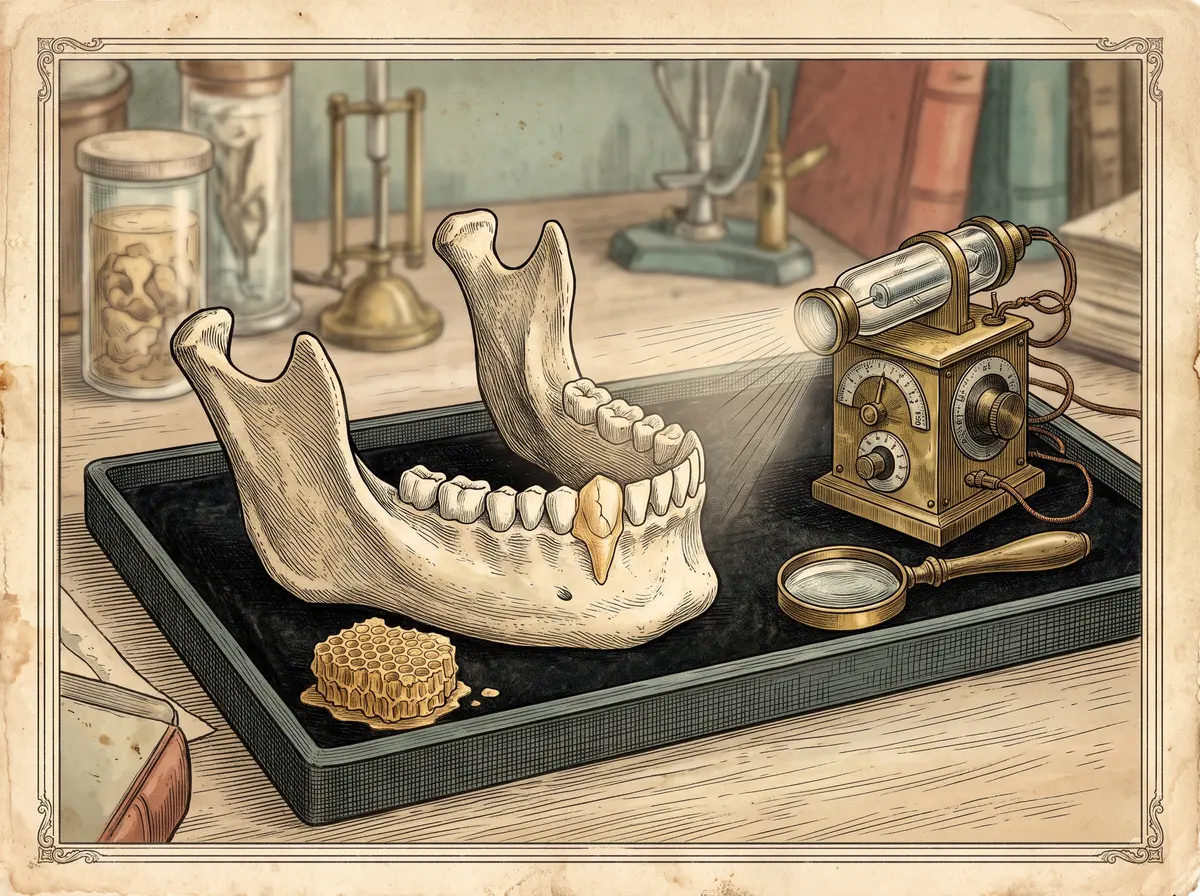
In May 1911, the naturalist Josef Müller found part of a human lower jaw stuck in the rock of a cave near the village of Lonche, in northern Istria (today in Slovenia). The fragment still held five teeth: a canine, two premolars, and two molars. It went to the Natural History Museum of Trieste, in Italy, where Müller later became director, and there it mostly stayed out of sight. A short note on the jaw appeared in the 1930s, and an X-ray study from that era noticed nothing unusual, partly because the images were too blurry to show much.
The jaw’s second life began a century later, almost by accident. Claudio Tuniz, who coordinated an X-ray imaging laboratory run by the Abdus Salam International Centre for Theoretical Physics (ICTP) and the Elettra synchrotron in Trieste, and his colleague Federico Bernardini were using the specimen to test new imaging equipment. As Tuniz later put it, the jawbone had stayed in the museum “for 101 years without anybody noticing anything strange.”
The first scans used X-ray micro-CT, which works like a hospital CT scanner but at far finer detail. It showed that the left canine had a long vertical crack, and that so much enamel had been worn off the biting surface that a large patch of dentine, the softer, sensitive layer underneath, lay exposed. The team then took the tooth to Elettra’s synchrotron, a ring-shaped particle accelerator that produces extremely bright X-rays. Those images revealed a thin layer of foreign material capping the worn area and running down into the top of the crack.
What was it? By eye, it looked like it might be a natural resin. But infrared spectroscopy, which identifies substances by how they absorb infrared light, matched it much better to beeswax than to other natural waxes.
That left one big question: was the wax old, or had someone dabbed it on in a museum drawer? The team sent about a gram of bone and a speck of wax, roughly a milligram, for radiocarbon dating. Both came back at around 6,500 years old. The results were published in the journal PLoS ONE in September 2012, under the plain title “Beeswax as Dental Filling on a Neolithic Human Tooth.”
Why it was strange: The Lonche Beeswax Filling
Nobody expected a Stone Age dental filling to be hiding in plain sight in a museum collection, let alone to turn up during an equipment test. The evidence was invisible without modern physics: Tuniz said it was “extremely difficult” to spot the work by naked eye or simple tools.
It also challenged an easy assumption, that early farmers simply put up with toothache. Wear like this suggests teeth used hard, possibly as tools, and a cracked, exposed canine would have hurt every time its owner bit down. Someone, perhaps the man himself, appears to have done something about it.
That “appears” matters. The researchers could not prove the wax went in while he was alive. It may have been applied around the time of death, as part of some burial practice nobody has documented in that region. The authors leaned toward a living patient, partly because the wax seals tiny chips along the edges of the crack, but they listed the post-mortem possibility openly. You can see the same careful reading of old bones in The Stone Age Skull Surgery With a Higher Survival Rate Than the Civil War’s.
What scientists learned: The Lonche Beeswax Filling
From the wear on his teeth, the owner of the jaw was probably 24 to 30 years old, and more likely male than female. If the filling was done in life, its purpose was most likely to dull sensitivity in the exposed dentine and cushion the crack, a palliative treatment (one that eases pain rather than curing the cause). Beeswax is soft, easy to shape when warmed, and water-resistant, which makes it a sensible choice for the job.
If that reading is right, the study gives the earliest known direct evidence of a filling used to treat a tooth, as of its publication. Other finds point to even older dental care. At Mehrgarh, a Neolithic site in Pakistan, researchers reported in 2006 that molars from about 9,000 to 7,500 years ago had been drilled, apparently with flint tools. And in 2017, a team led by Gregorio Oxilia and Stefano Benazzi described two front teeth from Riparo Fredian in northern Italy, roughly 13,000 years old, whose cavities had been scraped out and packed with bitumen, a tar-like substance, along with plant fibers. Each find fills in a little more of how long people have been fixing their own teeth. For another case of ancient people engineering their way around a body problem, see The 3,000-Year-Old Wooden Toe Scientists Test-Drove in Replica Egyptian Sandals.
How it reaches us today: The Lonche Beeswax Filling
The Lonche jaw is a strong argument for going back to old museum collections with new tools. Synchrotron imaging and tiny-sample radiocarbon dating can pull new stories out of specimens that have been catalogued and shelved for a century, without damaging them. Bernardini said at the time that the team had no idea whether this was an isolated case, and planned to look at other Neolithic teeth.
Wax hasn’t left the dentist’s office, either. Dental waxes, some made with beeswax, are still used to model crowns and bridges before they’re cast. The materials are better and the drills are electric now, but the basic impulse, to seal a painful tooth with whatever works, is very old. More discoveries that began with someone looking for something else are collected in The Finds That Started on the Wrong Errand.
Fun fact: The Lonche Beeswax Filling
The same jaw was X-rayed back in the 1930s. The filling was there the whole time; the images just weren’t sharp enough to show it.
A note on the subject: this story involves tooth pain and a person’s remains. If you have a toothache that won’t quit, a dentist has better options than beeswax, and many communities offer low-cost dental clinics.
Sources: The Lonche Beeswax Filling
- Bernardini, F., Tuniz, C., Coppa, A., et al. “Beeswax as Dental Filling on a Neolithic Human Tooth.” PLoS ONE 7(9): e44904 (2012): the original study, with the imaging, infrared, and radiocarbon results and the before-or-after-death question
- Tuniz, C. Post on the Lonche tooth, OUPblog, Oxford University Press (2012): the 1911 discovery by Josef Müller, the 1930s X-ray, and the dating samples
- Elettra Sincrotrone Trieste, “A combination of modern physics tools reveals the oldest dental filling, dating back to the Stone Age”: the synchrotron imaging and the museum’s custody of the jaw since 1911
- Choi, C. Q. “Beeswax Filling May Be Oldest Hint of Dentistry.” Live Science, September 19, 2012: quotes from Tuniz and Bernardini on the 101 years and the plan to study more teeth
- Oxilia, G., et al. “The dawn of dentistry in the late upper Paleolithic.” American Journal of Physical Anthropology (2017), author post-print: the 13,000-year-old bitumen-packed teeth from Riparo Fredian